
Introduction: Growing Supplement Expenses, Do Our Bodies Really Need All of Them?
Rows of colorful supplement bottles lined up on a desk or one side of the dining table—are these perhaps a familiar scenery in your daily life? When you keep up with vitamin B for fatigue recovery, vitamin C for immunity, lutein for eye health, plus probiotics for gut health and omega-3s for blood circulation, the monthly subscription costs for supplements alone are no joke.
As you toss various items into your shopping cart thinking “health must be protected while you can,” supplements inevitably go beyond being a means to protect your health and become yet another fixed expense burden. In particular, there are quite a few products that get purchased impulsively based solely on advertisements or recommendations from acquaintances, only to pass their expiration dates and end up being thrown away.
So, are all these numerous supplements that we consume every month really playing their proper roles in our bodies? Or are we just spending expensive money only to excrete them?
In this post, we will check our recklessly increased supplement expenses and explore smart diet methods together to protect both our wallets and our health by keeping only the products truly needed by our bodies.
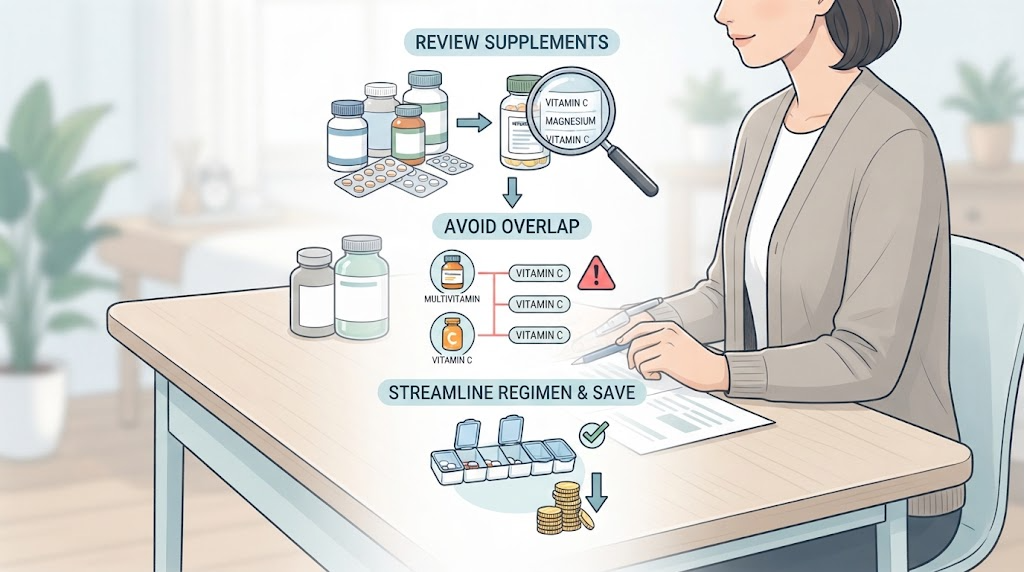
Step 1: ‘Complete Survey’ of Currently Consumed Supplements and Checking for Overlapping Ingredients
The first gateway to reducing supplement expenses is a ‘complete survey’ to accurately figure out what and how much you are eating right now. Start by gathering the supplement bottles scattered all over your house into one place.
- Unfolding the raw material and content tables of all products currently being consumed
After taking all the supplements that were left unattended in drawers, on the dining table, or in the refrigerator and laying them out on the dining table, you will be surprised by the amount, which is larger than expected. What is important here is not simply counting the number of products, but carefully examining the ‘nutritional components and contents’ written on the back of each product. The process of visually confirming for yourself what ingredients the pills you habitually tossed into your mouth every day are actually made of is the starting point of expense dieting.
- Checking for overlapping ingredients: ‘Excessive consumption’ happening without your knowledge
The most common problem that occurs when taking multiple supplements is overlapping ingredients.
Aren’t you taking a separate vitamin C or vitamin B group product while also taking a multi-vitamin?
There are many cases where vitamin E (tocopherol) is basically included in omega-3 products for antioxidant purposes or preservation, and cases of redundantly consuming separate vitamin E supplements are also frequent.
When ingredients overlap like this, even if it is a nutrient absolutely necessary for the body, it far exceeds the recommended intake, which not only increases excretion costs but can also rather cause digestive burden or side effects.
How about drawing an ‘ingredient map’ this weekend by spreading out the ingredient labels of the supplements you eat side by side and checking if there are any overlapping ingredients? It is the surest and most honest way to cut down on unnecessary expenses.

Step 2: Classification Criteria for Essential Supplements vs. Psychological Reassurance (Placebo) Supplements
If you have checked for ingredient overlaps through the supplement complete survey, now is the second step that requires the most cold and objective judgment. It is to boldly classify the ‘essential supplements’ truly needed by your body and the ‘psychological reassurance (placebo) supplements’ eaten to put anxiety to rest.
- Selecting ‘essential items’ according to your eating habits and lifestyle
The exact same supplements are not essential for everyone. Based on your actual eating habits and living environment, you must pick out only the ingredients that are truly prone to deficiency.
Diet check: If your intake of vegetables and fruits is extremely lacking usually, products with objective deficiency factors like vitamin C or antioxidants become the priority, and if you have many indoor activities and can barely see sunlight, vitamin D becomes the priority.
Lifestyle consideration: If you suffer from chronic overtime and work stress, you can place vitamin B group products that help with energy metabolism as an essential lineup.
- Sweeping away impulse purchases and the ‘placebo effect’
On the other hand, the target for closing your wallet is psychological reassurance (placebo) supplements.
Products bought led by SNS or advertisements: These are products purchased while being hypnotized by marketing that stimulates anxiety such as “something bad will happen if I don’t eat this,” but where you didn’t feel any significant changes in your body even after taking them.
Overlapping purposes or excessive segmentation: This is a case where you have bought hundreds of thousands of won worth of supplements segmented by specific body parts such as eye health, joints, skin, and hair loss, and left them neglected because “somehow I feel anxious if I don’t eat them.”
💡 Smart classification tips
If it is a supplement that is difficult to perceive as having actually made a noticeable contribution to your body’s condition changes or fatigue improvement over the past 3 months, boldly put it on the ‘suspension of intake candidate’ list. Supplements are not insurance to buy off anxiety, but merely supplementary means to fill the gaps in your diet.
Even by leaving only essential supplements, you can sharply drop your monthly fixed expenses by more than half.
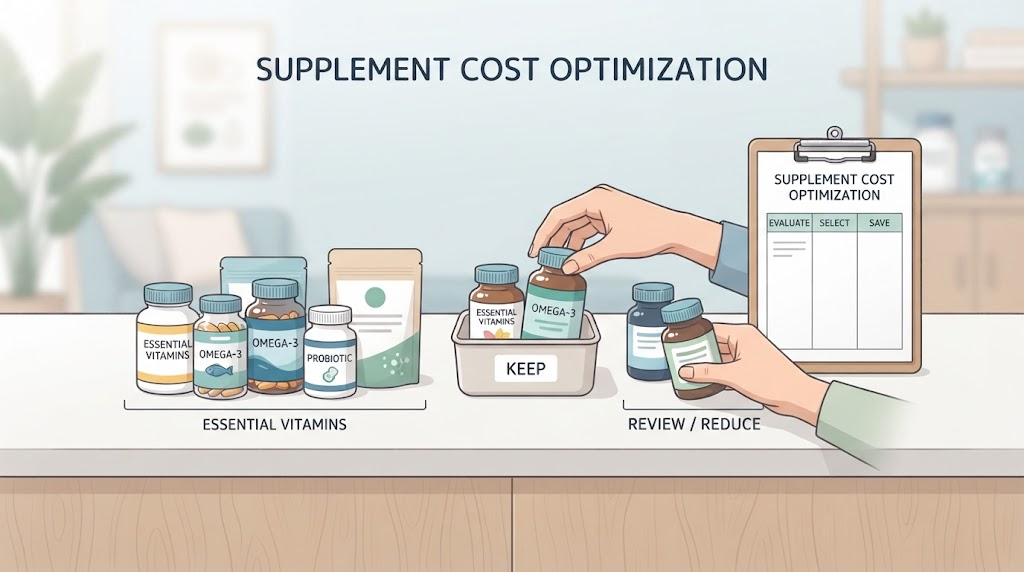
Step 3: Smart Supplement Purchase and Consumption Tips to Save Expenses
If you have cleanly organized essential supplements and unnecessary products, now it is time to take practical tips for consuming the remaining products most wisely and economically. Just a small change in purchasing habits can drastically reduce supplement maintenance costs.
- Comparative analysis of cost-effectiveness between single-ingredient products vs. complex supplements
When choosing supplements, it is easy to think that ‘all-in-one complex products’ containing multiple ingredients at once will unconditionally be good, but from an expense management perspective, that may not be the case.
The trap of complex supplements: When multiple ingredients are mixed and the price is expensive, the content of specific ingredients that you actually need is often hopelessly insufficient, or conversely, there is a high probability that ingredients you are already consuming sufficiently are redundantly included.
The wisdom of single-ingredient combinations: Buying and combining only the core ingredients you truly need to fill (e.g., vitamin D, magnesium, etc.) as individual single products is a shortcut to saving costs significantly relative to ingredient content.
- Considering ‘expiration date’ and ‘consumption speed’ rather than unconditionally large capacities
Caution against the temptation of large capacities: People often make the mistake of impulsively purchasing 1-year or 2-year large capacities, deceived by marketing that says “if you buy in large capacity, the price per piece is cheaper.” However, supplements also carry the risk of oxidizing or spoiling over time after opening, and above all, if you stop taking them midway or your routine changes, you will eventually fail to finish them and they will head to the trash can.
Choosing appropriate packaging units: Periodically purchasing products that match your consumption speed (usually a 2 to 3-month supply) is smart consumption that saves money in the result.
- Slowing down consumption speed by adjusting intake cycles (rest periods or taking every other day)
For ingredients that accumulate in the body like some fat-soluble vitamins or minerals, or during periods when your condition is relatively good, adjusting the frequency of intake is also a good method.
If you divide supplements that you used to take daily to take them 3 to 4 times a week (every other day), or have a ‘rest period’ where you rest for a while after intake for a certain period, the consumption speed of the product slows down so you can extend the purchase cycle.
However, if it is a supplement for general health maintenance rather than a specific disease management product that must be steadily taken according to a doctor’s or pharmacist’s prescription, it is fine to flexibly adjust the intake cycle.
💡 Expense diet core summary
Supplements should not be ‘herbal medicines that make you healthier the more you eat them’, but ‘economic complements’ that fill the nutritional imbalances of your diet. Just by cultivating habits of trimming unnecessary products and making smart purchases, you can lightly diet down the expenses going out every month.

Conclusion: Smart Supplement Consumption Habits Protecting Health and Wallet Simultaneously
We have explored together the 3-step process of dieting down supplement expenses and wisely leaving only the products truly necessary for our bodies.
The process of conducting a complete survey of the supplement bottles piled up all over the desk, filtering out overlapping ingredients, and boldly cutting down on unnecessary products that relied on the placebo effect might feel a bit cumbersome at first. However, this small organization not only reduces the fixed expenses escaping every month, but also builds truly healthy consumption habits of accurately knowing what nutrients your body really needs.
Ultimately, what is more important than dozens of expensive and flashy supplements is a balanced diet, regular sleep, and a consistent lifestyle. Supplements are, after all, only reliable ‘assistants’ that fill the gaps in your daily life, and cannot become insurance that buys your health wholesale.
How about taking a moment this evening to open up the supplement ingredient labels inside your drawer? You will be able to experience pleasant changes where your lighter wallet becomes fuller and your body becomes fresher.
We hope this post has been helpful for your smart expense management and health management. We will come back with more useful lifestyle information and smart consumption tips. Have a healthy and happy day today too!
Korean version: 한국어로 읽기