
Introduction: Why Taking More Dietary Supplements Becomes Poison
Would you believe it if you were told that the dietary supplements you take for your health are actually wearing your body down? Recently, an increasing number of people are taking multiple types of supplements all at once to boost immunity and recover from fatigue. With the craze for “Megadose” high-potency regimens even spreading, it is not uncommon for people to swallow over thirty pills a day.
However, if you carelessly combine and consume supplements with the mindset that “more is better when it comes to good things for the body,” you may suffer from unexpected side effects and toxicity rather than the health benefits you expected. In this article, we will examine the reasons why wrong supplement combinations become poison to our bodies and explore smart solutions.
- The trap created by the illusion that “the more you eat, the better”
Dietary supplements are reliable helpers that fill in deficient nutrients, but much like medications, they are active substances that trigger chemical reactions within the body. There is a fixed limit to the amount of nutrients our bodies can digest and metabolize in a day.
When more than the necessary amount flows in or incompatible ingredients meet, intestinal absorption competition occurs, or it places excessive burden on the liver and kidneys, ultimately harming health.
- Why side effects occur even when good supplements are mixed incorrectly
Reduced absorption rate (antagonism): Certain minerals or vitamins use the same pathways when absorbed into the body. Because of this, competition arises to take up spots first, and the nutrients that are actually needed fail to be absorbed and are excreted.
Side effects due to interactions: Due to chemical reactions between ingredients, medicinal effects may be excessively amplified, or conversely, dangerous side effects such as an increased risk of bleeding may be triggered.
Accumulation in the body and toxicity: Unlike water-soluble vitamins, fat-soluble vitamins and some minerals are not easily excreted outside the body and accumulate, triggering toxicity such as headaches, vomiting, and organ damage.
💡 Key Point
Just as much as “what you eat,” “what you take them with and when you take them” is far more important. In the next part, we will take a detailed look at the 4 representative worst combinations that we commonly fall into.
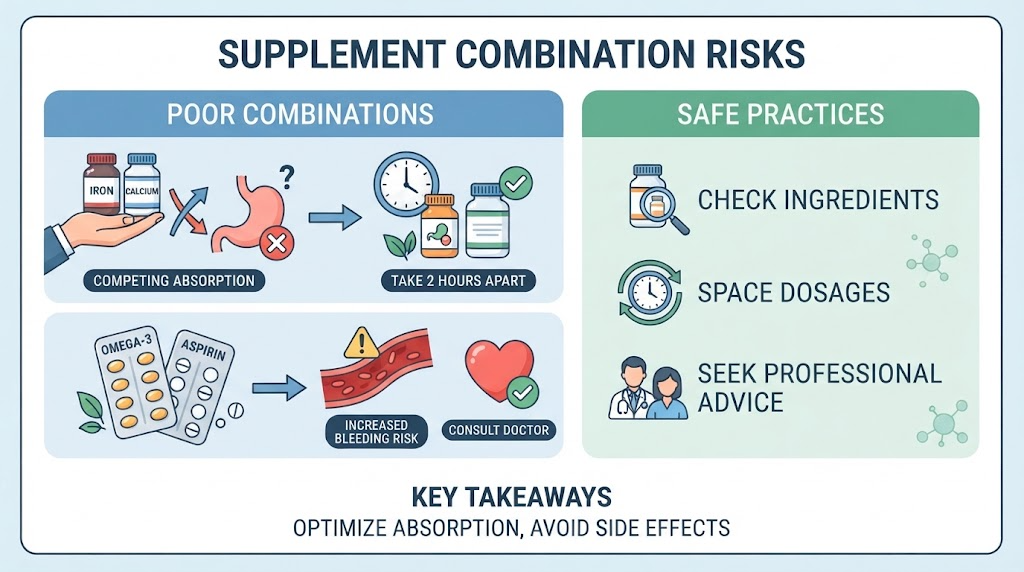
Body 1: 4 Representative ‘Worst Combinations’ of Dietary Supplements
The combination of supplements you take every day for your health might actually be wasting your money or harming your body if consumed together mindlessly. When taken without considering the compatibility between ingredients, absorption is hindered or unexpected side effects occur.
From now on, let’s examine the 4 representative “worst combinations” of supplement intake that we most commonly commit.
- Iron & Calcium: The ‘Polar Opposites’ That Hinder Each Other’s Absorption
Principle and Side Effects: Iron and calcium use the same pathway (intestinal transporter) when absorbed into the body. Because of this, if both ingredients are ingested in high doses simultaneously, a fierce competition occurs in the intestines to be absorbed first. Consequently, the absorption rate of both drops sharply, making it impossible to see any nutritional supplementation effect.
Solution Tip: If you need to take both ingredients, it is recommended to ingest them with a time interval of at least 2 hours.
- Omega-3 & Aspirin (or Anticoagulants): Increased Risk of Bleeding
Principle and Side Effects: Omega-3 is a wonderful supplement that purifies the blood and improves blood circulation, but it has the function of inhibiting platelet aggregation. At this time, if you take anticoagulants (or antiplatelet agents) such as aspirin or warfarin together, the risk of bleeding where blood does not stop can increase sharply. Special caution is required if you are currently taking prescribed medications.
Solution Tip: If you are facing surgery or are constantly taking medications with anticoagulant ingredients, you must consult your primary physician before consuming omega-3.
- Vitamin C & High-Dose Copper/Iron: Destruction Due to Oxidation-Reduction Reactions
Principle and Side Effects: Vitamin C is a powerful antioxidant (reducing agent). When Vitamin C is ingested simultaneously with high-dose minerals such as copper or iron, oxidation-reduction reactions occur within the gastrointestinal tract, oxidizing the minerals and potentially destroying Vitamin C itself. In this process, active oxygen is temporarily generated, which sometimes induces gastrointestinal disturbances.
Solution Tip: In cases of taking high-dose Vitamin C at a megadose level, it is safe to split the time from mineral supplements (e.g., before and after meals, or morning and afternoon).
- Overconsumption of Fat-Soluble Vitamins (Vitamin A + Vitamin D): Inducing Toxicity in the Body
Principle and Side Effects: Unlike water-soluble vitamins, fat-soluble vitamins (A, D, E, K) are not excreted in urine when the amount remaining after use by the body is left over, but rather possess the property of accumulating in the liver or fatty tissue. In particular, if Vitamin A and Vitamin D are redundantly ingested in high doses each, they can excessively accumulate in the body and induce overdose symptoms (toxicity) such as headaches, nausea, dry skin, and worsening of osteoporosis.
Solution Tip: You must check whether Vitamin A and D are already included in your multi-vitamin, and carefully verify whether you exceed the daily recommended intake when additionally taking single-ingredient preparations.
💡 Key Point
You can see true effects only by understanding the characteristics of ingredients and the body’s absorption pathways when taking supplements. In the following part, we will look into the correct intake guide by time of day to prevent these side effects and maximize absorption rates.

Body 2: Correct Intake Guide According to Time and Ingredient Characteristics
No matter how good a supplement is, if the timing of ingestion is off, its effectiveness can be halved or it can place a burden on the stomach. This is because each supplement has different ways of acting within the body and conditions for absorption.
We have organized the correct intake guide according to time and ingredient characteristics to prevent side effects and maximize absorption rates.
- Recommended Intake in the Morning/After Meals: Ingredients That Wake Up Energy
Representative Ingredients: Vitamin B complex, Coenzyme Q10, ginseng (red ginseng), etc.
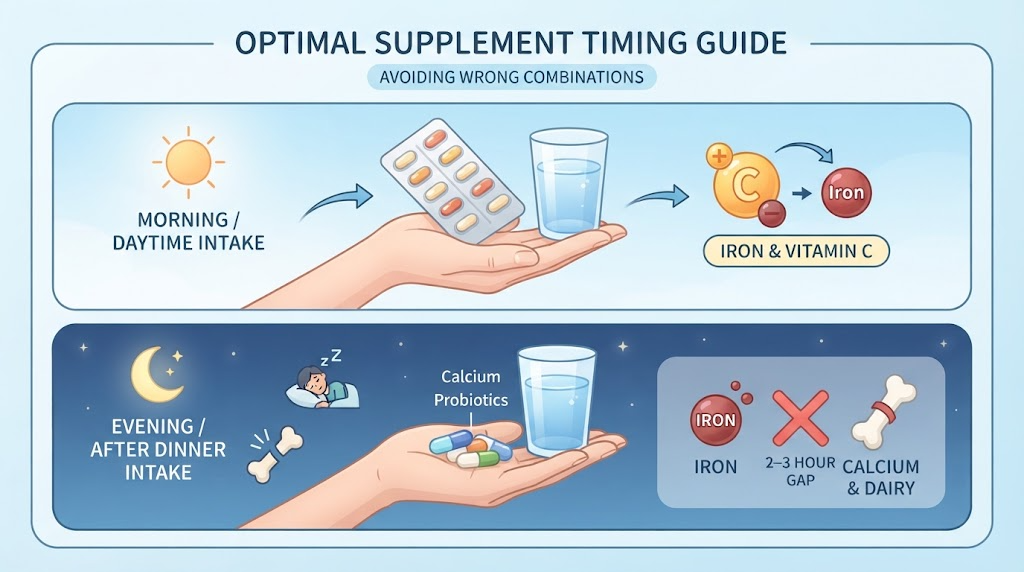
Reasons and Intake Method: The Vitamin B complex is a representative nutrient that activates energy metabolism within the body and infuses vitality. If taken late in the evening, it can interfere with sleep due to a stimulating effect, so it is best to take it right after breakfast. Taking it after meals increases the absorption rate together with fats or nutrients in food and also reduces gastrointestinal disturbances.
- Recommended Intake in the Evening/After Meals: Ingredients That Aid Comfortable Rest and Absorption
Representative Ingredients: Magnesium, calcium, probiotics (however, varying depending on product type), etc.
Reasons and Intake Method: Magnesium has the effect of relaxing muscles and nerves, so it is called a “natural tranquilizer.” Taking it after dinner or before going to bed helps with deep sleep and aids fatigue recovery the next day. Also, calcium is advantageous to ingest in the evening time for bone health absorption and the prevention of nocturnal muscle cramps.
- Ingredients That Must Have a Time Gap (At Least 2 Hours Apart)
As examined earlier, you must completely separate the times during the day when you take ingredients that conflict with each other.
Iron & Calcium/Dairy Products: Take iron on an empty stomach in the morning or with Vitamin C, and push calcium or dairy products like milk and cheese to after lunch or dinner, leaving an interval of at least 2 to 3 hours.
Multivitamins & High-Dose Single Mineral Preparations: If you took a multivitamin in the morning, it is safe to schedule high-dose minerals (calcium, iron, etc.) that you take individually for the afternoon or evening time.
💡 Key Point
Rather than “gulping them all down at once,” “taking them separately in accordance with your body’s biological rhythm and the compatibility between ingredients” is the true secret to protecting your health. In the final part, we will explore how to check whether you are unintentionally consuming ingredients in duplicate.
Body 3: Self-Inspection Method to Prevent Duplicate Ingestion and Overconsumption
The surest and fastest way to prevent supplement side effects is to accurately grasp “what and how much you are eating right now.” However, many people take a multivitamin while adding single preparations of Vitamin C, omega-3, probiotics, and others individually, inadvertently overconsuming certain ingredients.
For safe and healthy consumption, let’s learn about self-inspection methods that can be easily practiced in daily life to prevent duplicate intake and overdosage.
- How to Carefully Check Supplement Labels (Ingredient Tables)
Checking Content and Nutrient Reference Values: Looking at the “Nutrition & Functional Information” section on the back of the product, the content of ingredients included per serving and the percentage (%) compared to the daily nutrient reference value are written. Rather than simply trusting unknown brands or effects, the habit of checking the exact content with your own eyes is important.
Checking Additives and Excipients: Examining whether specific excipients or synthetic ingredients overlap when taking multiple supplements simultaneously is also a tip to reduce gastrointestinal disturbances.
- Duplicate Check Checklist for Multivitamins and Single-Ingredient Supplements
Caution on Multivitamin Traps: Multivitamins already fundamentally include small amounts of various minerals such as Vitamin A, D, E, K, zinc, iron, and copper. If you carelessly add a single Vitamin D or zinc preparation here, you will easily exceed the daily upper limit of intake.
3 Steps for Duplicate Check Self-Diagnosis:
Gather all the containers of all the supplements you are currently taking (including direct-import products) in one place.
Write down the contents of major ingredients such as Vitamin A, D, iron, and zinc written on each product’s ingredient table on a memo pad.
When summing up the contents of all products, check whether they exceed the upper intake limit of the Korean Dietary Reference Intakes designated by the Ministry of Health and Welfare.
💡 Key Point
Supplements do not improve in effectiveness proportionally to “the more you eat them.” The wisdom of choosing only the ingredients essential to your body and consuming them at the right times is the most perfect way to protect your health.

Conclusion: Summary for Safe and Wise Supplement Intake
So far, we have examined the risks of supplement combinations, correct intake methods, and self-inspection methods to prevent duplicate intake. If you want to ensure that taking supplements, which you started to become healthy, does not instead place a burden on your body, you must keep a few key principles in mind.
We have summarized the key points for safe and wise supplement intake.
- The Importance of ‘Customized Intake’ Rather Than ‘The More the Better’
Supplements do not improve your health more just because you take them unconditionally in large amounts and in fancy ways. Identifying what nutrients your body truly lacks and reducing unnecessary duplicate intake is the first step in health management. Throw away the prejudice that “more is better” and carefully select and ingest only the ingredients you truly need.
- ‘Strategic Intake’ Considering Ingredient Compatibility and Time of Day
Leaving a time gap for conflicting ingredients: For ingredients with overlapping absorption pathways such as iron and calcium, leave an interval of at least 2 hours or more to prevent interactions.
Keeping track of times: Vitamin B complex, which provides energy, should be taken in the morning, and magnesium or calcium, which relax the mind and body, should be ingested after dinner to maximize absorption rates.
- Action Plan and Expert Consultation Upon the Occurrence of Abnormal Symptoms
If abnormal symptoms such as heartburn, nausea, skin rash, or headaches appear after changing your supplements, you must stop taking them immediately. In particular, if you are currently taking prescribed medications, have underlying medical conditions, or are pregnant or nursing, it is wisest to consult your primary physician or pharmacist to establish a safe intake plan rather than combining multiple supplements based on your own judgment.
💡 Final Summary
Supplements finally become a sturdy shield protecting your body when you take them smartly based on correct knowledge. Starting today, calmly check the combination of supplements you take and your timing!
Korean version: 한국어로 읽기