2026 Earned Income Tax Credit Regular Application Overview
What is the Earned Income Tax Credit System?
The Earned Income Tax Credit is an employment-linked income support system where the government provides actual income support to low-income workers, business owners (excluding professionals), and religious households who work but struggle to make ends meet.
It is a public national policy designed to increase the real income of working low-income households and help them escape unemployment and poverty, and eligible applicants can receive cash payments.
2026 Regular Application Period and Payment Schedule
Regular application period: From May 1 to May 31 every year (as of 2026)
Payment schedule: Typically completed by late August to September after review
Late application: Applications can be submitted from June 1 to November 30 even if the May regular application period is missed (however, 10% of the calculated subsidy will be deducted, so it is advantageous to apply within the May regular period).
Key Application Methods for 2026
Depending on whether you received a notification notice (mobile or postal mail) or not, you can easily apply as follows.
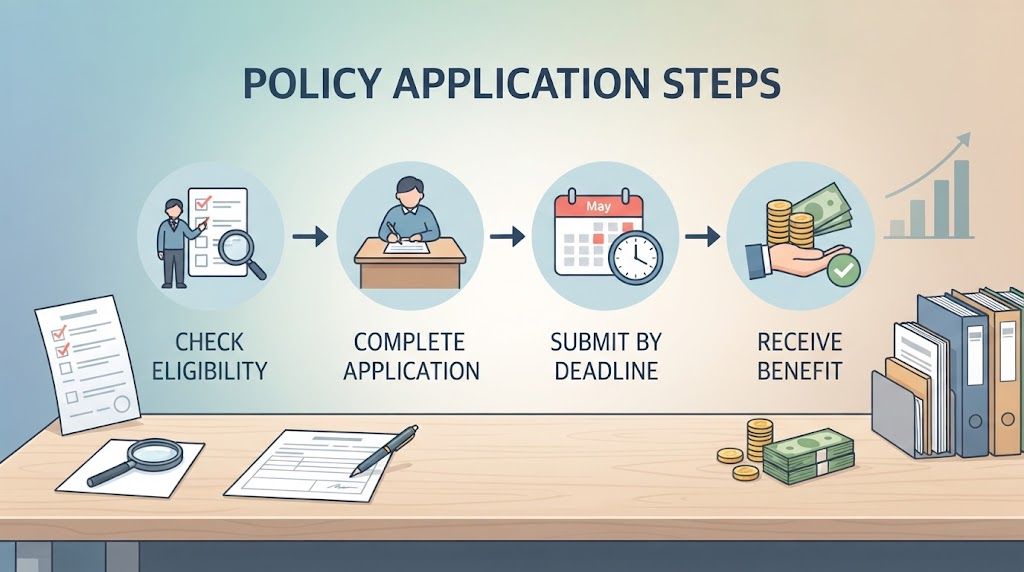
When receiving a mobile notification notice: Tap the [Apply] button within the notice to connect to Hometex (Sontax) and instantly complete the application simply by entering your resident registration number (most convenient)
When receiving a written notification notice: Scan the QR code printed on the notice with your smartphone camera to directly connect to the Sontax app and apply
ARS telephone application: Call the National Tax Service Counseling Center (1544-9944) and follow the voice prompts to enter your resident registration number and individual verification number to apply
Direct access to Hometex (PC) or Sontax (app): Log in to the official National Tax Service Hometex website and directly enter and apply via the [Apply/Submit] menu

2026 Earned Income Tax Credit Criteria by Household Type (Single, Single-Earner, Dual-Earner)
The most foundational step in determining eligibility for the Earned Income Tax Credit is establishing your “household type.” Because the total income limit and maximum payment amount vary completely depending on your household composition, you must accurately identify which category you belong to.
Definitions and Classification Criteria by Household Type
| Household Type | Definition and Composition Requirements | Total Income Limit (Under) | Maximum Payment Amount |
|---|---|---|---|
| Single Household | Households with no spouse, dependent children, or lineal ascendants (parents) aged 70 or older | 22 million won | Up to 1.65 million won |
| Single-Earner Household | Households with a spouse (total salary under 3 million won) or with dependent children / lineal ascendants aged 70 or older | 32 million won | Up to 2.85 million won |
| Dual-Earner Household | Households where both the applicant and spouse each have total earnings of 3 million won or more | 44 million won | Up to 3.3 million won |
Detailed Descriptions and Checkpoints by Type
- Single Household
- This refers to a 1-person household. If you have no legally recognized spouse, dependent children, or parents aged 70 or older, you are classified as a single household regardless of the number of household members.
- As the main target group of this blog post, you must have an annual total income of less than 22 million won to be eligible to apply.
- Single-Earner Household
- This refers to a single-income household. Even if you have a spouse, if your spouse’s annual total salary is less than 3 million won, you are recognized as a single-earner household.
- Alternatively, even without a spouse, this applies if you are supporting dependent children (under 18) with no or low income or lineal ascendants aged 70 or older. (However, the annual income amount of the dependent children and lineal ascendants must be 1 million won or less)
- Dual-Earner Household
- This refers to a household where both the applicant and the spouse have income from labor, business, etc., and each person’s total earnings are 3 million won or more.
- This is the category that recognizes the highest combined couple income, with the highest total income limit of less than 44 million won.
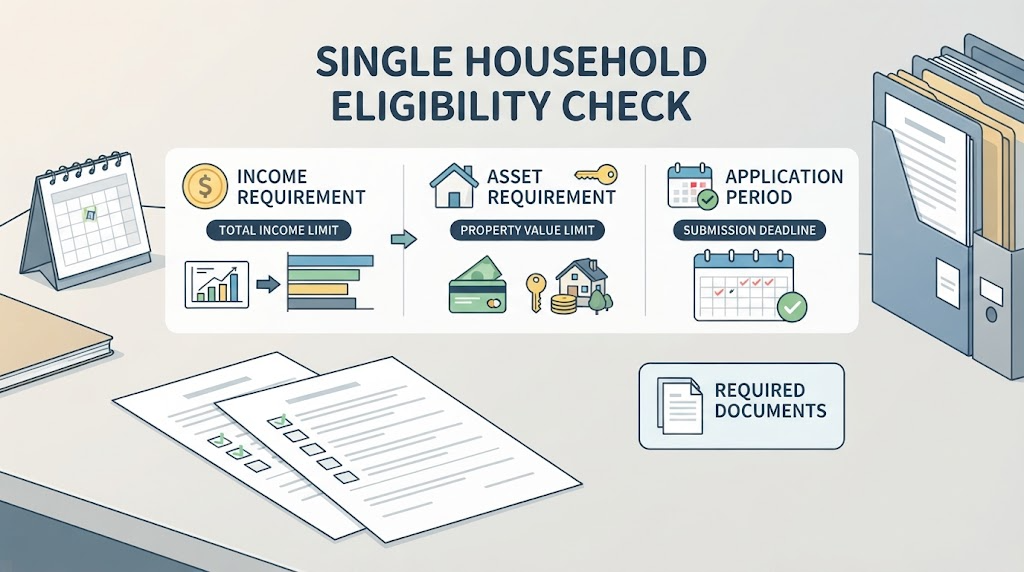
Comprehensive Summary of Core Eligibility Requirements for Single Households
The hurdles that must be cleared to apply for the Earned Income Tax Credit as a single household are largely divided into two categories: income requirements and property requirements.
You must satisfy both requirements to pass the final review and receive the subsidy.
Toss Bank
① Income Requirements (Total Income Limit)
Cheori and Miae-gun’s World – Tistory
For a single household, the combined annual total income for the previous year (the attribution year) (based on yourself since it is a single household) must be less than 22 million won.
3jum3
Scope included in total income:
Cheori and Miae-gun’s World – Tistory
Earned income: Based on pre-tax total salary (excluding tax-exempt income)
Cheori and Miae-gun’s World – Tistory
Business income: Income amount applying adjustment rates by industry type
Cheori and Miae-gun’s World – Tistory
Religious income:
Total salary of religious income
Cheori and Miae-gun’s World – Tistory
Other income, interest, dividends, and pension income:
Sum of various incomes stipulated under tax laws
Cheori and Miae-gun’s World – Tistory
Precautions: Since judgments are based on the annual pre-tax total income sum rather than monthly average income or actual take-home pay, it is advisable to check the exact amount in advance via Hometex or year-end tax settlement records.
② Property Requirements (Total Property Sum)
Korea Tax News
Even if you narrowly pass the income criteria, you must be careful because disqualifications under the property criteria are very common.
Cheori and Miae-gun’s World – Tistory
Property baseline: The total property sum of all household members must be less than 240 million won.
Toss Bank
Payment methods by total property sum (Very Important)
Cheori and Miae-gun’s World – Tistory
Less than 170 million won:
100% full payment
Cheori and Miae-gun’s World – Tistory
170 million won or more to less than 240 million won:
Only 50% of the calculated subsidy is paid at a reduced rate
Cheori and Miae-gun’s World – Tistory
+ 1
240 million won or more:
Excluded from payment (Cannot apply)
Cheori and Miae-gun’s World – Tistory
💡 Core Checkpoints for Calculating Single Household Property
- Included Property Items:
Houses, land, buildings (based on standard market value)
Cheori and Miae-gun’s World – Tistory
Automobiles such as passenger cars (based on standard market value, reflecting depreciation for passenger cars)
Cheori and Miae-gun’s World – Tistory
Jeonse deposits (lease deposits)
Cheori and Miae-gun’s World – Tistory
Financial assets (deposits, savings, stocks, bonds, etc.), securities, membership rights, etc.
Cheori and Miae-gun’s World – Tistory
- Deduction of Debts (Loans):
Toss Bank
No debts, such as mortgage loans, negative balance accounts (credit lines), or credit loans, are deducted from property.
Since only the total net asset amount is summed up, if you have a jeonse deposit or savings, it is calculated based on the total amount without excluding loans.
Toss Bank
- Caution Regarding Inclusion of Resident Family Members’ (Parents, etc.) Property:
Cheori and Miae-gun’s World – Tistory
Even if you are a nominal 1-person household, if you are registered in the same household on the resident registration as lineal ascendants (such as parents), your parents’ property is also added to the total household property.
Because of this, many people are disqualified due to unexpected property excess caused by houses or land under their parents’ names, so you must check your household composition before applying.
Cheori and Miae-gun’s World – Tistory
+ 1

Maximum Payment Amount and Calculation Method for Single Households
The Earned Income Tax Credit is not structured to give more simply because income is lower; rather, it is designed with an “incremental and decremental” calculation method where “it increases in proportion to income up to a certain point as you work, and then gradually decreases once it exceeds a certain level.”
News World
Maximum Payment Amount for Single Households
News World
Maximum payment amount for single households: Up to 1.65 million won
Open/Close
Maximum payment amount for other households for comparison: Up to 2.85 million won for single-earner households / Up to 3.3 million won for dual-earner households
Gometown Love Donationegive
For single households, when the annual total income falls within a certain range (usually the early to middle range), the maximum amount of 1.65 million won is received, and as the income approaches the limit (less than 22 million won), the payment amount gradually decreases.
In addition, according to the minimum payment restriction rule, if the calculated amount is less than 10,000 won, it is not paid, and payments start from the minimum payment amount (40,000 won) or more.
News World
Understanding the Subsidy Calculation Method
The Earned Income Tax Credit has a structure calculated based on total salary, etc.
Incremental section: In the initial section where income is low, the subsidy increases proportionally as income increases.
Constant section (Maximum payment section): When a certain income level is reached, the maximum payment amount by household type (1.65 million won for single households) is maintained in full.
Open/Close
Decremental section: Once income increases further past the maximum payment section (approaching the 22 million won line), the subsidy is reduced at a certain rate according to the excess income, and the moment it reaches 22 million won or more, it is completely excluded from eligibility.
News World
Changes in Actual Receipt Amount According to Property Reduction Brackets
Even if the amount has been finalized through income requirements and calculation methods, the final receipt amount may be adjusted once more depending on the aforementioned property holdings.
Property under 170 million won: 100% full payment of the calculated subsidy
Property of 170 million won or more to less than 240 million won:
Only 50% of the calculated subsidy is paid at a reduced rate
News World
+ 1
Example: Even if the calculated single household subsidy is 1.65 million won, if your property falls within this bracket, a 50% reduction is applied, resulting in a final receipt of approximately 825,000 won.
Open/Close
Property of 240 million won or more:
Excluded from payment (0 won)
Gometown Love Donationegive
+ 1
Frequent Mistakes and Precautions When Applying
Despite meeting the requirements, many people make minor mistakes or overlook precautions, leading to disqualification or receiving a smaller subsidy. Here are 4 typical mistakes most frequently experienced by single-household applicants.
① 10% Reduction Due to Late Application
Mistake: Delaying the application with the thought, “I can just apply anytime later even if I miss the May regular application period,” and missing the deadline.
Precaution: If you miss the May regular application period (May 1 to May 31), a “late application” is available from June 1 to November 30. However, in this case, 10% of the calculated subsidy will be deducted and paid, so it is most advantageous to always apply within the May regular period.
② Omission and Addition Errors in Property of Resident Family Members (Parents, etc.) on Resident Registration
Mistake: Thinking, “I live alone in a monthly rental, so I only need to look at the property of a 1-person household (single household).”
Precaution: The property evaluation for the Earned Income Tax Credit aggregates the properties of all household members on the resident registration. If you are bundled in the same household on the resident registration with lineal ascendants and descendants such as parents, brothers, or sisters, even their houses, land, and deposit properties will be fully combined, which may result in disqualification due to an unexpected excess of the property limit. Be sure to check the household composition on your resident registry copy before applying.
③ Mistakes in Aggregating Jeonse Deposits and Financial Assets
Mistake: Calculating only visible real estate or automobiles while omitting financial assets such as jeonse deposits (lease deposits), savings deposits, or stocks.
Precaution: The National Tax Service meticulously investigates jeonse deposits (lease deposits) and various financial assets through administrative networks. In particular, since debts (such as jeonse loans or credit line overdraft accounts) are not deducted from property, the entire deposit amount is reflected as property as is. You must carefully examine your total net asset amount.
④ Neglecting the National Tax Service Notice (Mobile or Postal Mail) After Receiving It
Mistake: Delaying the application thinking it will be complicated despite receiving the notice, or passing it by mistaking it for a spam message.
Precaution: If the National Tax Service has sent you a notice via mobile or mail, there is a very high probability that you are an eligible recipient who has already passed most of the primary hurdles for income and property requirements. By using the “individual authentication number” written on the notice, you can easily complete your application in just 1 to 2 minutes with a few touches on Hometex or Sontax, so it is safe to apply immediately upon receiving the notice.

Conclusion and Summary
We have comprehensively reviewed the single-household criteria among the regular application eligibility requirements for the 2026 Earned Income Tax Credit. Trace back through the core points once more, and check whether you fall under the application targets through an easy-to-miss self-diagnosis.
💡 Single Household Application Core Checklist
[ ] Household Type: Do you correspond to a single household (1-person household) with no spouse, dependent children, or parents aged 70 or older?
[ ] Income Requirement: Is your total combined annual income for the previous year less than 22 million won?
[ ] Property Requirement: Is the total combined property of all household members less than 240 million won? (Full payment if under 170 million won; 50% reduction if between 170 million won and 240 million won)
[ ] Resident Registration Household: Do you meet the criteria even when including the property of cohabitants (parents, etc.) on your resident registration?
[ ] Application Period: Do you plan to proceed with the application within the regular application period from May 1 to May 31? (Beware of the 10% reduction disadvantage for late applications)
Check Eligibility and Apply Right Now
The Earned Income Tax Credit is a system where funds are never paid out unless you apply yourself, even if you meet the requirements. Especially if you received a notification notice (mobile or postal mail) from the National Tax Service, there is a very high probability that you are an eligible recipient, so please be sure to take care of it within the period.
Hometex Official Website: Go to National Tax Service Hometex
Mobile App: Install the Sontax (App), log in ➔ Use the [Apply/Submit] ➔ [Earned Income Tax Credit Regular Application] menu
ARS Telephone Application: 1544-9944 (Easy application following voice prompts)
We hope you thoroughly check your eligibility requirements this year and secure up to 1.65 million won in benefits without any omissions!
Korean version: 한국어로 읽기