Introduction: Can I Also Get the National Tomorrow Learning Card Issued?
When looking into government-funded education to prepare for a new job, change careers, or enhance job competencies, there is a gateway you face first. That is the issuance of the ‘National Tomorrow Learning Card’.
If you search the internet, some say “everyone gets one,” while others say “you can’t get it if your income is high or you’re a student,” making it only confusing. When you actually try to apply, worries start piling up as to whether you might fall short on your income criteria or expected graduate requirements.
Let’s carefully examine the core criteria that you must check before applying to see whether you are actually included in the issuance target for the National Tomorrow Learning Card.
- “Can Really Anyone Get the National Tomorrow Learning Card?”
The National Tomorrow Learning Card is a powerful support system that integrated previously separate cards for job seekers and workers into one, allowing anyone who is a South Korean citizen to participate in vocational competency development training.
Advantage of the integrated card: Accessibility has vastly improved because you can receive necessary training with a single card regardless of whether you are unemployed, employed, or self-employed.
Support scale: Since you can receive training cost support ranging from 3 million won up to a maximum of 5 million won per person, it is a filial system that can drastically save on self-development costs if utilized properly.
- For Those Who Are Anxious: “Will I Be Excluded from the Support Target?”
Although the name of the system is ‘anyone’, unfortunately, it is not unconditionally issued to all citizens. Exception rules exist depending on occupation or status.
Public officials, private school faculty, pension beneficiaries, high-earning executives and employees working in large corporations above a certain scale, and some self-employed individuals whose livelihood is not hindered are restricted from issuance or subject to separate criteria.
Therefore, checking first “whether I happen to fall under an excluded category” is a shortcut to saving time.
- Core Requirements to Thoroughly Examine in This Post
To prevent issuance rejections or errors in advance, you must intensively check the following two elements.
- Income Criteria: How the support rate or personal copay changes depending on your income level or health insurance payment amount
- Expected Graduate Requirements: Exactly when college or high school students can get the card issued
First Step for Smart Issuance Application
The National Tomorrow Learning Card is a practical system where anyone can receive reliable support as long as conditions are met.
In the following contents, we will dissect one by one how to accurately diagnose your income criteria and academic status (whether you are an expected graduate). Check your card issuance eligibility right now!

Core Checkpoint 1: Understanding Basic Principles of Support Targets and Excluded Targets
“The National Tomorrow Learning Card can be issued to any South Korean citizen.” However, quite a few people submit application forms only to face rejection or text messages denying issuance. This is because since the purpose of the system is tailored to “citizens who need vocational competency development,” clear support exclusion targets exist depending on status or income.
You need to thoroughly check whether you meet the basic principles to get the card issued and whether you happen to fall under an excluded target.
- Basic Target Scope for National Tomorrow Learning Card Issuance
In principle, the National Tomorrow Learning Card is issued to most South Korean citizens who need vocational competency development training.
Job Seekers: Unemployed individuals looking for work, job applicants
Workers: Employees of small-to-medium and large enterprises, non-regular workers, special-type employment workers (special-types)
Self-employed & Freelancers: Self-employed individuals and sole proprietors below a certain income threshold, freelancers, etc.
Students: High school seniors about to graduate and expected graduates in the final year of college (graduate school)
- Representative ‘Exception Targets’ Whose Issuance is Unfortunately Restricted
If you fall under specific statuses or high-income job groups such as the following, you are unfortunately excluded from the National Tomorrow Learning Card issuance target.
Public officials and private school faculty: Public officials and private school faculty with stable employment structures are not eligible for issuance in principle.
Military personnel (active duty): Military personnel facing discharge (excluding certain exception rule applications such as discharge expected persons) or military personnel currently serving on active duty.
High-income executives and employees: Workers in large-scale enterprises with very high annual sales or wage levels who exceed a certain income threshold.
Other statutory restriction targets: Elderly individuals aged 75 or older, daytime graduate students whose livelihood is not hindered (open university, night graduate school, etc. are granted exceptions), and others recognized as having low need for government-supported training.
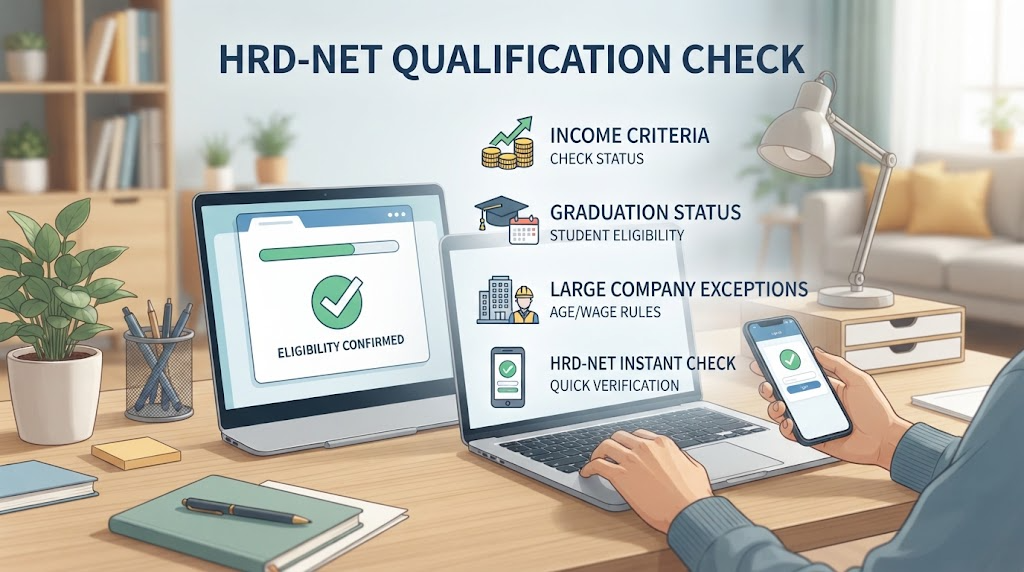
- “If It’s Ambiguous Whether I’m an Issuance Target?” How to Check in 1 Second on HRD-Net
Since conditions are so diverse, just reading the text might leave you confused as to where your case belongs. The surest and fastest way is to use the official Ministry of Employment and Labor vocational training portal.
After logging in to the Ministry of Employment and Labor HRD-Net (or linked platforms like Employment 24) homepage and going through identity verification, you can instantly check your card issuance eligibility and remaining limit in real time.
Rather than worrying complexly, checking your qualifications with a single login is the most accurate.
💡 Going a Step Further: Be Sure to Check Exception Rules Even for Excluded Targets
Sometimes people give up thinking, “I’m a worker, but since it’s a large enterprise, I probably can’t get it.” However, even for large-scale enterprise workers, exception clauses allowing issuance depending on employment status and income conditions exist, such as being aged 45 or older or having a monthly wage of less than 3 million won.
If you feel like you are slightly straddling the exclusion criteria, it is wise to directly inquire with the competent employment center (without a country code, 1350) to verify the detailed criteria.
Core Checkpoint 2: Examining Income Criteria Baselines and Subsidy Fluctuation Conditions
The National Tomorrow Learning Card is basically a system open to the majority of South Korean citizens, but the support limit or personal copay ratio fluidly changes depending on an individual’s income level or employment status. This is why you must clearly pinpoint “which bracket my income falls into and up to how much support I can receive.”
Let’s look into the subsidy fluctuation conditions and core points according to income criteria.
- Basic Support Limit and Maximum 5 Million Won Expansion Structure
Tistory
When you are issued the National Tomorrow Learning Card, a training cost support limit of 3 million won is basically granted for 5 years.
However, the support scope expands depending on the individual’s income situation or the characteristics of the training course they participate in.
EXITBASIC
Additional support benefits: In cases of low-income families or specific employment support targets, up to 2 million won is added to the basic limit, widening the scope of training cost support up to a total maximum of 5 million won.
While the principle is to self-pay a certain percentage of the training cost (around 15-30% depending on the course), depending on income criteria or participation systems, this personal copay can be substantially discounted or entirely exempted.
Tistory
- Differential Application and Exemption Benefits of Personal Copays According to Income Criteria
Depending on where your income falls within the government’s support criteria, the tuition fee structure changes completely.
When linking with the National Employment Support System:
For instance, if you fall under a participant of Type 1 of the National Employment Support System or a vulnerable group below a certain median standard income, the training cost personal copay is exempted or minimized, allowing you to focus on education without financial burden.
Employment 24
Worker income criteria: While targets among large enterprise workers who exceed a certain income (such as monthly wages of 3 million won or more, under age 45, etc.) may face restrictions in issuance or differing support rates, small-to-medium enterprise workers or low-income daily workers can receive thicker support.
Employment 24
Self-employed and special-type employment workers (special-types):
Smooth issuance and support are possible only when meeting annual sales criteria (e.g., self-employed individuals with annual sales of less than 400 million won) or monthly income criteria (e.g., special-type workers with monthly income of less than 5 million won).
Employment Policy Details_System Guide | Employment Policy List | Policy/System | Customer Center>
- Gauging Your Income Level Through Office Worker Health Insurance Payment Amounts
When examining income criteria, even without individually pulling documents like Hometax income verification certificates, you can gauge general target classification through the health insurance payment amount you pay monthly.
A significant portion of government support projects screens household-summed income or individual income based on health insurance payment amounts (excluding long-term care insurance premiums).
If you check your recent payment amount through your workplace or local health insurance billing notice or the ‘The Health Insurance’ app, you can grasp your income bracket much more smoothly during employment center consultations or online applications.
💡 Going a Step Further: Checking Accurate Support Rates by Course on HRD-Net
Depending on income criteria or card issuance types, how much the tuition fee is for a specific subject you want to take (how much your personal copay will come out to be) varies slightly.
If you search for the course you want to take on the Ministry of Employment and Labor HRD-Net (Employment 24), you can calculate in advance in real time the exact actual burden reflecting your qualification standards through the [Apply My Card] button, so be sure to check before applying.

Core Checkpoint 3: If You Are a College or High School Student? Complete Organization of ‘Expected Graduate’ Requirements
The part that people looking into government-funded education to prepare in advance for employment or career changes while in student status find most confusing is the ‘expected graduate’ requirement. Questions naturally arise such as, “If I’m a college student, starting from what year can I make a card?” or “Can students on a leave of absence also apply?”
To prevent wasted trips, we completely organize the National Tomorrow Learning Card issuance eligibility by student status based on Ministry of Employment and Labor standards.
- Issuance Availability Timing for College and Graduate Students (Based on Remaining Remaining Course Years/Semesters)
Just because you are a college student does not mean you can get a card issued unconditionally as soon as you enter. The core criterion is the ‘remaining course years (semesters) until graduation’.
General college students: The expected graduate criterion is usually ‘enrolled students in the final year of college’. Eligibility to apply for issuance is granted starting from the point of enrollment in the first semester of the 4th year for a 4-year university (where the remaining course period is within 6 months).
Junior college (2-3 year) students: You can apply starting from the point of entering the final year (1st semester of the 2nd year for 2-year programs, 1st semester of the 3rd year for 3-year programs).
Graduate students: Graduate students are also included in the issuance target when they have the status of final-semester enrolled students (expected graduates). (However, full-time students among daytime graduate students whose livelihood is not hindered may be restricted.)
- Applications During Leave of Absence and Vacation Periods, Is It Really Possible?
In case of students on a leave of absence: In principle, the National Tomorrow Learning Card requires proof of ‘enrolled student (expected graduate)’ status, so general students on leave of absence are excluded from issuance targets. However, if there are exceptional circumstances such as having deferred graduation or facing registration for the final semester even while on leave, confirmation from the employment center is required.
Vacation period utilization tips: If you get the card issued in advance during the summer vacation after finishing the 1st semester of the 4th year or the vacation ahead of the job hunting season in the 2nd semester of the 4th year, it is most efficient because you can dive straight into practical education during the semester or immediately after graduation.
- If You Are a High School Student? Vocational High School and General High School Special Exception Criteria
Beyond college students, paths are open even in high school student status to receive early vocational training.
Vocational high school (specialized high schools, Meister high schools, etc.) 3rd-year students: Vocational high school 3rd-year students who wish to find employment without entering college are able to get the National Tomorrow Learning Card issued and participate in training even while enrolled, according to criteria set by the Minister of Employment and Labor.
General high school consignment students: Students who are enrolled in a general high school and wish to take Ministry of Employment and Labor-designated vocational training courses on consignment in their 3rd year can receive separate support through linkage procedures between the school and the employment center.
💡 Going a Step Further: Bringing Enrollment Certificates and Expected Graduation Certificates in Advance
When proving college student status online (HRD-Net) and applying for the card, student status is sometimes not immediately reflected in the system, causing rejections.
Before applying, obtain a ‘Certificate of Enrollment’ or ‘Certificate of Expected Graduation’ in advance through the school portal or Government 24.
The remaining semesters or expected graduation timing must be clearly stated on the certificate so that the review is not delayed and the card can be issued quickly.
Core Checkpoint 4: Pre-Preparations and Procedures to Check Without Fail Before Applying for Issuance
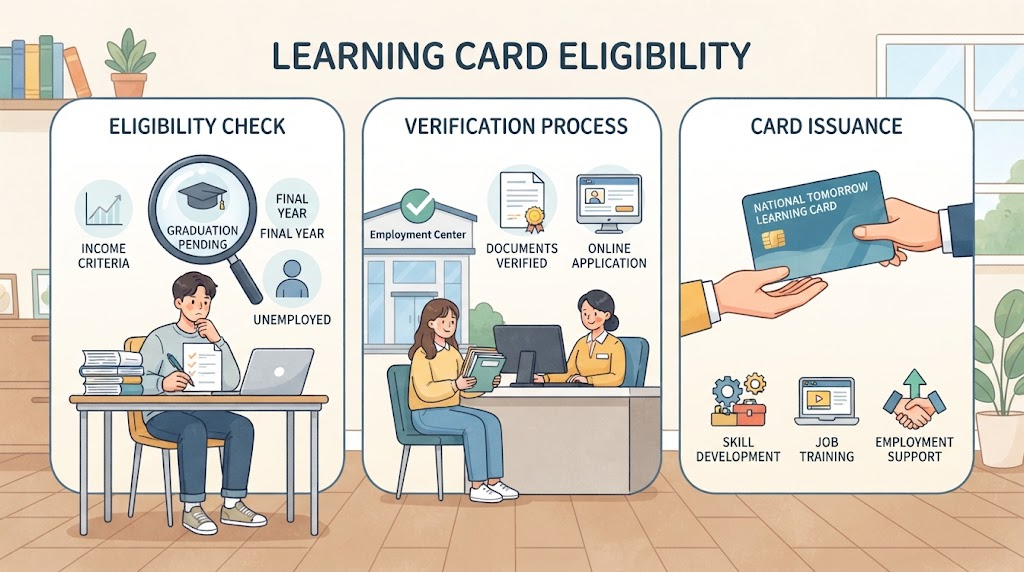
Once you have thoroughly checked your income criteria and expected graduate requirements and become convinced, “I fall under the issuance target!”, it is now time to step through the application procedures to get the card in your hands in earnest. Even if you made up your mind, missing the sequence or skipping essential steps can cause reviews to be delayed or rejected.
We outline the pre-preparations and application process you must go through to get the National Tomorrow Learning Card issued at once without mistakes.
- ‘Essential Pre-Steps’ That Must Be Completed Before Applying for Issuance
To apply for the National Tomorrow Learning Card in the Ministry of Employment and Labor system, you must go through a few preceding steps rather than pressing the card issuance button right away.
Vocational Training Portal (HRD-Net) Membership Registration and Login: Complete membership registration on HRD-Net (or the Employment 24 integrated platform) using your own mobile phone and log in.
Worknet Job Registration (for job seekers): If you are applying for the card in the status of unemployed or a job seeker, submitting a resume on Worknet and completing job application registration are required for the card issuance review to proceed normally. (This is the most frequent step people omit and get rejected for!)
Watching Guide Videos and Training Counseling: Watch the guide videos related to the National Tomorrow Learning Card guided within the site, and follow the guidance of the competent employment center if necessary.
- Card Issuance Application Process (Online vs. Offline)
Once you have finished preparation, select the method that is most comfortable for you and apply for the card.
Online Application (Most Recommended): Access the HRD-Net homepage or mobile app, enter your personal information in the [National Tomorrow Learning Card Issuance Application] menu, and request a qualification screening. You will select an affiliated card company (Nonghyup, Shinhan, etc.) and get it issued as a card containing check card (or credit card) functions.
Offline Visit Application: If the online procedure is complex or you want direct guidance, you can bring your ID, visit your local employment center directly, and apply with the help of the counter staff.
- Required Duration for Issuance and Establishing a Course Schedule
It usually takes a certain amount of time for the card to arrive in your hands.
Screening and Delivery Period: It takes an average of 1 to 2 weeks (about 7 to 14 days) until qualification screening and card issuance/delivery.
If the opening date is approaching urgently and you still don’t have a card, troubles may occur in course registration, so if there is a training course you want to take, it is safe to submit your issuance application at least 3 weeks before the course starts.
💡 Going a Step Further: Thoroughly Comparing Card Affiliate Benefits
The National Tomorrow Learning Card can be issued by choosing between Shinhan Card and Nonghyup (NH) Card. Minor subsidiary benefits such as public transportation discounts, convenience store discounts, and coffee shop discounts differ slightly by card company in addition to the transportation card function, so if you select a card company fitting your consumption style, you can neatly claim even small benefits.

Conclusion: Wrapping Up the National Tomorrow Learning Card Issuance Requirement Check
So far, we have thoroughly examined the basic targets and exclusion requirements, income criteria and subsidy structure, and expected graduate requirements and application procedures for college and high school students that must be checked without fail for National Tomorrow Learning Card issuance.
We shouldn’t be giving up just by believing vague rumors floating on the internet thinking “I probably can’t do it,” or conversely wasting time getting rejected after blindly applying, right? If you accurately diagnose your income bracket and academic status and step through it starting from the pre-preparation stage, anyone can become the protagonist of reliable government-funded benefits.
📋 Final Self-Diagnosis Checklist Before Applying for National Tomorrow Learning Card Issuance
Before pressing the card issuance application button, check for the last time whether you can check ‘O’ on all the items below!
| Check Item | Core Verification Content | Self-Diagnosis |
|---|---|---|
| 1. Support Exclusion Target Status | Do you not fall under issuance restriction targets such as public officials, private school faculty, and high-income executives/employees? | [ ] |
| 2. Income and Health Insurance | Have you grasped the support target bracket based on your income level or workplace health insurance payment amount? | [ ] |
| 3. Student Status (Expected Graduate) | If you are a college (graduate) student or high school student, do you meet the remaining course years (expected graduation timing) criteria? | [ ] |
| 4. Essential Pre-Steps | Have you completed HRD-Net registration and Worknet job registration in case of job seeker status? | [ ] |
| 5. Application Timing | Are you preparing your application with leeway at least 2-3 weeks in advance based on the desired course opening date? | [ ] |
💡 Epilogue: When Conditions Are Ambiguous, Don’t Hesitate to Knock on the Door
For those who think, “It’s ambiguous whether my situation falls under the exception rules,” or “Online inquiries keep confusing me,” rather than worrying alone, directly inquiring with the Ministry of Employment and Labor Counseling Center (without a country code, 1350) or your local competent employment center is the surest and fastest path. They kindly provide guides that fit your conditions precisely.
Holding the issued card in your hand is not the end, but the first step in starting the engine for a wonderful challenge for your career and growth.
We sincerely root for today’s article to become the most reliable guide for your smart, regret-free National Tomorrow Learning Card issuance and successful competency enhancement!
📌 Next Post Preview
In the next article, we will return with “National Tomorrow Learning Card Application Error Coping Methods & Resolution Know-how When Issuance is Rejected”. If you have any questions or blocked parts, please feel free to leave them in the comments!
Korean version: 한국어로 읽기