Introduction: Why Is “Curriculum Comparison” Essential Before Enrolling in an Academy?
Once you receive your National Tomorrow Learning Card, the doors to government-funded education swing wide open. From IT development, design, and computerized tax and accounting to marketing, countless academies and courses tempt us.
However, it is extremely easy to find people around us who registered on a whim with the mindset of “It’s government-funded and free (or has a low personal copay), so let’s just apply,” only to lose interest after a few weeks, or complete the course and regret it because it didn’t help them get a job at all.
Since you are investing your precious time and energy, we examine why “carefully comparing the curriculum” before registering for an academy is absolutely essential.
- “Time Cannot Be Reversed” – The Value of My Time, More Precious Than Cost
Government-funded education courses are large-scale projects that usually require pouring months of full-time weekdays or weekends into them.
If you pour your time into formal classes that end simply with receiving a completion certificate, you miss out on other proper studies or opportunities during that time.
You must choose a high-value course that perfectly matches your career direction so that you can be deployed directly into the field right after completion.
- Filtering Out ‘Trendy’ Lectures with Fancy Names Only
There are also places that run curriculums hastily put together based on recent trends, or outdated educational courses lingering in the past.
You must check whether the classes involve nothing more than dabbling in basic tool usage without handling the latest tools or technology stacks (frameworks) that companies actually use in the field.
Knowing how deeply practical skills are handled is much more important than a superficial list of dozens of plausible-sounding technologies.
- Job Hunting Difficulties Caused by ‘A Piece of Cake’ Style Classes
Classes with too low of a difficulty level or ones that let you pass just by filling attendance might feel comfortable at first. However, such courses lower the quality of your portfolio and ultimately trip you up at the interview venue.
You must ask yourself, “Is this a curriculum that I can truly make my own, even if it’s a bit strict?” to develop real employment competitiveness.
Criteria for Choosing Smart Government-Funded Education
Ultimately, comparing government-funded academies is the process of verifying “how elaborately this curriculum is structured around my goals (employment, career change, capability enhancement).”
From the next chapter, we will thoroughly dissect the core checkpoints for selecting an academy without failure, ranging from how to distinguish practice-oriented curriculums to instructors and job placement systems.

Core Checkpoint 1: Practice-Oriented vs. Theory-Oriented? Dissecting Curriculum Structure
When you go for counseling at a government-funded academy, most of them promote themselves by saying, “Our course is 100% practice-oriented!” However, when you actually open the lid, quite a few cases end up repeating basic theory only. If you don’t want to waste your precious time and government training subsidies, you need to be able to sharply dissect the framework (structure) of the curriculum presented by the academy.
We outline three points that you must check to select a real curriculum that works directly in the field.
- Checking the ‘Golden Ratio’ of Theory and Practice
From a beginner’s perspective, basic theory learned through books seems like it should be solid, but the ultimate goal of government-funded education is ultimately ’employment and field deployment’.
Places full of theory only: You should avoid courses that simply recite concepts centering around textbooks or end by repeating basic functions that anyone can follow alone by reading a book.
Ideal ratio: The core is whether basic concept organization is compressed to around 20-30% of the total education time, while the remaining 70-80% is filled with practice and projects where you directly write code or create deliverables.
- Does It Reflect ‘Modern Trends’? (Filtering Out Outdated Technologies)
Technology and marketing trends change day by day. There are places that still recycle tools or syntax that were used in the field a few years ago as their main curriculum.
Cross-verify through searches whether the technology stacks or program versions listed in the detailed academy curriculum are tools that companies are actually actively using in real practice.
For instance, if it is IT development, you must carefully check whether it covers the latest frameworks or collaboration tools (such as Git), and if it is marketing or design, whether essential latest practical tools and AI utilization methods are included.
- The Presence, Absence, and Quality of a Final Project That Makes It ‘Mine’
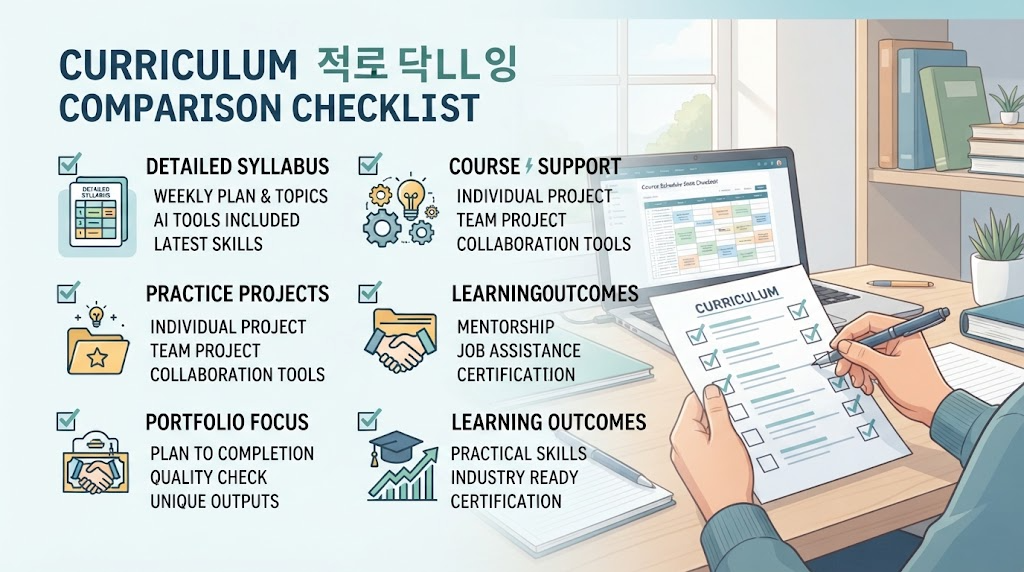
The highlight of the curriculum is undoubtedly the ‘portfolio project’. You need to check whether it is simply practice where you copy and paste someone else’s source code, or whether it includes a process of building your own unique deliverables entirely from planning to completion.
See if individual projects and team projects are arranged in a balanced manner within the curriculum.
If there are team projects, you can indirectly gain practical collaboration experience such as resolving collaboration conflicts and using version control tools, which becomes a powerful weapon during interviews.
💡 Going a Step Further: Requesting Detailed Curriculum Indexes
You should not just trust a rough one-line introduction on the academy’s website. When applying for counseling, request a ‘Detailed Weekly Curriculum Guide (PDF, etc.)’ and thoroughly compare what specific contents are learned and what deliverables are derived from week 1 to graduation.
The more specifically and systematically the curriculum is structured, the better you can gauge how sincere that academy is about its educational program.
Core Checkpoint 2: Instructor Expertise and 1:1 Feedback System
No matter how well-structured a curriculum is, the quality of the class varies drastically depending on the competence of the instructor who delivers and guides it. In particular, since government-funded education features students with vastly different baseline proficiency levels, the instructor’s expertise and close-care system become decisive factors determining course completion and employment success or failure.
Let’s examine the core checkpoints regarding instructors and feedback that you must look into to select an academy without failure.
- ‘Instructors Who Only Know Theory’ vs. ‘Practitioners Who Know the Field’
The depth of a class taught by an instructor who has only ever taught contents written in certificates or books is completely different from one taught by a practical expert who has survived in the real field for several years or more.
Importance of real-world field experience: Instructors from practical backgrounds go beyond simply reading textbooks to vividly deliver troubleshooting (error resolution) know-how, practical tips, and industry atmospheres actually encountered in the field.
Checking history: During academy counseling, feel free to boldly inquire about the main instructors’ major careers, portfolios, and industry backgrounds. The more transparently a place discloses what fields they worked in and what projects they accomplished, the more trustworthy it is.
- Classes That Just Rush Through Progress? Checking 1:1 Feedback and Question Systems
Due to the nature of government-funded education taken together by dozens of people, students who fail to keep up with the progress and fall behind easily occur.
The trap of one-way communication: If the structure relies on the instructor alone staring at the blackboard and pushing progress until the end, it becomes difficult to ask questions even when you encounter something you don’t know, ultimately leading you to lose interest in the class.
Ideal feedback structure: You must check whether an instructor or dedicated mentor moves around during practice time to review individual code, or whether channels (Q&A bulletin boards, open chats, Slack, etc.) where questions can be smoothly exchanged even after class are constantly operated.
- Filtering Out ‘Instructor Satisfaction’ in Student Reviews
Reviews on academy promotional pages are usually edited focusing on positive content. To check the true reputation of the instructors, an objective eye is required.
Look for specific mentions in blogs, communities, or graduate communities such as “how sincerely the instructor answers questions” and “whether they take care of students until the end without anyone falling behind.”
Rather than vague praises like “they guided us passionately,” reviews containing detailed feedback or mentoring anecdotes are much more reliable.
💡 Going a Step Further: Checking Instructor Assignment Methods in Advance
Sometimes, a representative instructor with a flashy background is introduced upon registration, but when the term actually starts, they are replaced by an assistant or dispatched instructor with insufficient experience. It is safe to clearly nail down before registration whether “the main instructor of the course I am taking will lecture in-person as fixed throughout the entire course.”

Core Checkpoint 3: Super Important After Completion! Job Placement and Post-Management
90% of the ultimate purpose of taking government-funded education lies in “successful employment and career change.” No matter how hard you studied and how wonderful deliverables you created, if you are thrown out into the job market alone after completion, it is utterly hopeless.
We outline the core criteria for discerning whether an academy is a place that simply hands you a completion certificate and ends things, or a place that provides close support until you cross the threshold of actual employment.
- Unpacking the Trap of the Puffed-Up ‘90% Employment Rate’ Figure
When looking at academy promotional banners or receiving counseling, you can easily encounter phrases like “Employment rate of 90% or higher!” However, you must not believe this number as-is.
Filtering out deceptive employment rates: It is not uncommon for places to exaggerate by counting even simple part-time jobs completely unrelated to your major or short-term contract jobs without four major public insurances as ’employed’.
What you really need to check: Rather than the employment rate right after simple completion, it is best to inquire along with specific portfolios about how many people actually succeeded in regular employment in your desired job field (development, marketing, design, etc.) and what level of companies graduates mainly get hired by.
- ‘Substantial Employment Support Programs’ Rather Than Just for Show
Employment support is meaningless if it sounds grand in name only but actually amounts to throwing a few resume templates at you. The more systematic an academy is, the better equipped its practical support system is.
Resume and cover letter clinics: You must check whether time is arranged to 1-on-1 edit your resume to supplement its weaknesses from the perspective of a working recruiter and make your job competencies stand out.
Mock interviews and feedback: Look into whether a curriculum is included that conducts mock interviews and provides specific feedback in preparation for unexpected questions, technical interviews, or pressure interviews frequently encountered in actual interview venues.
- Partner Company Pool and Graduate Post-Management System
Solid academies regularly form partnerships with companies looking to hire graduates.
Opportunities for linked employment: If the academy’s own partner company network is robust, you can enjoy the benefits of securing interview opportunities or priority recommendations (talent recommendation system) more easily than through the general open recruitment market.
Post-management after completion: Rather than a place where ties are completely severed once classes end, a place with a post-management system that matches job postings or continues portfolio feedback until you get hired even after completion is much more reassuring.
💡 Going a Step Further: Finding Real Employment Reviews from Senior Graduates
Rather than just believing the academy’s words, search for the academy name on blogs or job communities (Job Planet, Let’s Intern, developer communities, etc.) to find real employment reviews from actual graduates. This is the most reliable way to figure out the vivid bare face of “how actively the employment support department works” and “how well interview opportunities are actually connected.”

Core Checkpoint 4: Training Allowances and National Tomorrow Learning Card Tips
When looking into government-funded education, practical factors just as important as the curriculum and instructors are costs and subsidies. If you let your guard down thinking, “It’s government-funded so it must be totally free,” you might get flustered by unexpected personal copays, whereas if you utilize the system well, you can receive decent living expense support and focus solely on studying.
We summarize the points you must check to utilize the National Tomorrow Learning Card by 200%.
- Latest 2026 Criteria: Understanding the Structure of Personal Copays and Training Allowances
Boot Tent
Since government-funded systems are revised slightly every year, knowing the latest criteria is necessary to avoid misunderstandings.
Establishment of specialized training copays:
For major specialized training courses such as K-Digital Training (KDT), National Key and Strategic Industry Job Training, and Industrial Structure Change Response, a personal copay of up to 10% of the training fee may be charged.
However, to prevent students’ financial burdens, a maximum limit of 600,000 won is applied, and vulnerable groups are exempt from copays.
Winspec
+ 2
Strengthened training allowances:
To alleviate living expense worries during the education period, training allowances for major specialized training courses such as KDT are increased and paid at up to around 200,000 won per month.
Since this is precious support money that enters your bank account every month once you meet the attendance rate condition (generally 80% or higher), you must make sure to claim it.
Izen Academy Education Group
- Receiving a ‘Subsidy Jackpot’ by Linking with the National Employment Support System (Kookchiche)
Rather than registering with just the National Tomorrow Learning Card, it is much more advantageous to take the course combined with the National Employment Support System (Type 1 or Type 2).
Overlap collection of job search promotion allowances: If you take government-funded education while participating in Type 1 of the National Employment Support System, you can receive both the job search promotion allowance and the training allowance supported together depending on conditions, which vastly relieves financial stress.
When receiving academy counseling, it is wise to ask first, “Is this a course that allows linkage with the National Employment Support System?” and apply for both systems together through the Employment Center and the academy.
- Attendance Management and Preventing Mid-Course Dropout Equals Money!
The most important thing to watch out for in government-funded education is strict attendance management.
If tardiness, early leaves, and absences accumulate and your attendance rate drops below the standard threshold (usually 80%), not only will you be treated as a mid-course dropout (expelled), but you may also face disadvantages such as having to pay out-of-pocket for remaining training fees or deductions from your National Tomorrow Learning Card account.
Since training allowances are also calculated and paid on a daily basis based on the number of days attended, you must approach it with the mindset that diligent attendance itself is money.
💡 Going a Step Further: Accurately Estimating the ‘Final Personal Copay’ Before Enrolling
During academy counseling, request clearly based on the National Tomorrow Learning Card system inquiry results: “How much is the exact personal copay when I take this course, and how much training allowance comes out every month?” Sometimes, academies fail to accurately guide copays, causing panic right before the start of classes, so it is safe to check your card balance and support limit (up to 5 million won) in advance.

Conclusion: Final Summary Checklist for a Regret-Free Government-Funded Education Selection
We have carefully examined the 4 core checkpoints (curriculum, instructors and feedback, employment linkage, cost and support funds) that you must check before registering for an academy.
Since government-funded education invests your precious time and money, only those who thoroughly compare and evaluate can reap definite results and the fruit of employment. We have organized ‘My Own Government-Funded Academy Final Comparison Checklist’ which is great to use directly when comparing multiple academies by visiting them in person.
📋 Government-Funded Academy Final Comparison Template at a Glance
If you are receiving consultations from multiple academies and deliberating, try turning the items below into a table and scoring them!
| Comparison Item | Detailed Verification Question | Academy A | Academy B | Academy C |
|---|---|---|---|---|
| 1. Curriculum | Is the foundation ratio within 20% to 30%, and the practice/project proportion 70% or higher? | [ ] | [ ] | [ ] |
| 2. Latest Tech Stack | Does it reflect the latest tools and trends actually used by companies (such as AI utilization)? | [ ] | [ ] | [ ] |
| 3. Instructors & Feedback | Are they experienced field practitioners, and is constant Q&A and 1:1 feedback available? | [ ] | [ ] | [ ] |
| 4. Employment Linkage | Is the ‘actual desired job regular employment rate’ high (not inflated numbers) and is the support solid? | [ ] | [ ] | [ ] |
| 5. Costs and Support Funds | Are accurate out-of-pocket cost estimates calculated, and can you fully receive training allowance benefits? | [ ] | [ ] | [ ] |
💡 Epilogue: The More You Legwork You Do, the Shorter Your Job Preparation Period Becomes
Thoughts like “It’s a hassle, so should I just go to the one close to home?” or “The counselor sounds plausible, so should I just register?” might briefly pass through your mind. However, making a wrong choice once could waste several months of time and energy, forcing you back to square one.
- Directly visit at least 2 to 3 academies or request detailed curricula to compare them.
- Do not miss checking accurate card balances and support benefits through the employment center.
We sincerely hope that today’s article becomes the most reliable compass for your smart, regret-free government-funded education selection, and successful employment and career change!
📌 Next Post Preview
In the next article, we will return with “Real Survival Stories of Government-Funded Academy Students & 200% Practical Utilization Tips After Completion”. If you have any questions, please feel free to leave them in the comments!
Korean version: 한국어로 읽기