Introduction: The Absolute Ring Governing Government-Funded Training Success—’Attendance Rate’
You probably knocked on the classroom door with high expectations after applying for government-funded training with great determination, hoping to learn new skills or lay the groundwork for employment and career transitions. You are likely participating in classes, taking diligent notes, and trying not to miss a single word from the instructor.
However, did you know that no matter how perfectly you understand the class contents and how excellent your test scores are, if you fail to fulfill a single condition, all these efforts will go up in smoke? That condition is the absolute standard determining the success or failure of government-funded training: the ‘attendance rate’.
Many trainees casually think to themselves, “Surely attendance won’t become an issue?”
Being late due to sudden overtime or company dinners,
Leaving early under the excuse of feeling slightly sick,
Or confusing offline classes with non-face-to-face (online) classes and forgetting to check in and out are mistakes easily brushed aside.
However, in the government-funded training system utilizing the National Tomorrow Learning Card, the attendance rate is soon the law and the core of qualification requirements. Taking this lightly might cause you not only to fail to receive a completion certificate for the classes you sweated through, but also to shoulder painful penalties such as card limit deductions and the suspension of training allowance disbursements.
So, where is the magic line of attendance rate that we must strictly maintain to safely secure our completion certificates? From now on, we will thoroughly dissect all standards of attendance management and practical know-how to prevent mistakes.

Core Criteria: Accurate Completion and Attendance Standards by Government-Funded Training Course
To successfully finish government-funded training and hold the completion certificate in your hands, you must meet clear attendance standards regulated by the Ministry of Employment and Labor and HRD-Net. Because the applied rules differ slightly depending on the form of training (offline, online, blended, etc.), you must accurately understand the nature of the course you are taking to prevent the misfortune of insufficient attendance.
① Completion Criteria for Group (Offline) and Blended Training Courses
In the case of blended courses where you directly attend an academy or combine offline and online learning, the strongest iron rule is applied.
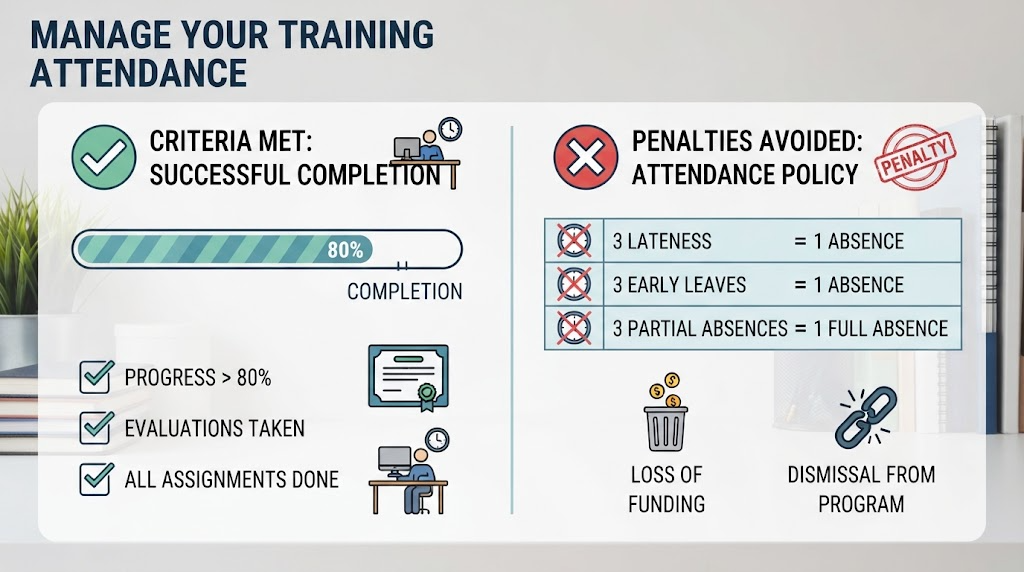
Mandatory overall attendance rate of 80% or higher: A completion certificate is issued only when you attend at least 80% of the total training days (or total designated training hours) of the training course. For example, in a 100-hour total course, you must normally attend at least 80 hours.
Processing as course incomplete when below 80%: The moment it drops to 79% due to even a 1% shortage, no matter how good your test scores are, it is processed as ‘incomplete (expelled)’ and your support benefits vanish into thin air.
② Completion Criteria for Online Remote Training Courses
Courses conducted 100% via internet lectures or remotely have slightly different standards from offline ones.
Progress rate of 80% or higher and evaluation participation: You must fulfill the lecture progress rate for each session (typically taking 80% to 100% of the total lectures) and participate without omission in assignments or mid-term/final evaluations included within the course to be recognized for final completion.
Special caution is required because simply logging in and leaving lectures running often fails to be recognized as progress by the system.
③ Fatal Blows Occurring When Tardiness, Early Leaves, and Outings Accumulate (Three-Strikes System, etc.)
Not only absences, but also tardiness, early leaves, and outings directly impact attendance rate calculations.
According to Ministry of Employment and Labor regulations, 3 instances of tardiness, early leaves, or outings are typically converted to 1 absence, chipping away at your overall attendance rate.
Because careless thoughts like “Being a little late or leaving early won’t count as an absence” pile up and become the main culprit instantly breaking down the 80% attendance rate wall, you must approach attendance management with the mindset that it is money and passing.
Traps and Precautions in Attendance Checking That Are Easy to Mess Up
“I sat diligently in class without missing a single session, but later on, I found out it was processed as an absence?”
This is a frequent story tearfully appealed by people taking government-funded training courses. Even though they diligently sought out the classroom to guard the magic line of an 80% attendance rate, traps exist where system-based attendance checking methods are missed or minor carelessness causes instant processing as an absence.
So that your sweat drops do not become in vain, we point out 3 fatal attendance check traps that trainees commit the most.
① Omission of Check-In and Check-Out (“I Attended Class, But It’s an Absence?”)
Attendance in government-funded training is not recognized simply by ‘sitting in the classroom’. You must complete electronic attendance checks (QR code scanning, fingerprint recognition, beacon authentication, etc.) respectively upon entering and leaving through the HRD-Net attendance management system or the method designated by the academy.
There are countless cases where people rush into class fearing they will be late and forget to check in, or miss checking out because they spirit away out of the classroom after class ends.
If the check-out is omitted, it is not recognized system-wise as having completed the training to the end, and the entire day can be processed as an absence; therefore, you must develop a habit of checking the attendance button strictly at the start and end of class.
② The Terrifying Hammer Faced During Proxy Attendance and Fraudulent Attendance
Sometimes, when an urgent matter arises or you think you will be late, you might ask a fellow trainee, “Please scan my smartphone or attendance card for me.”
However, this clearly falls under ‘fraudulent attendance’.
The Ministry of Employment and Labor’s recent attendance management system strongly monitors proxy attendance or false location authentication in real-time. If caught for fraudulent attendance, you will receive terrifying legal and administrative punishments, including not only immediate expulsion (incomplete) processing for that course, but also the complete suspension of National Tomorrow Learning Card use for a certain period, the recovery of illegal receipts, and even fines. You must never look for shortcuts.
③ Common Mistakes When Using Mobile Attendance (HRD-Net Attendance Management App, etc.)
Recently, many training institutions have adopted mobile attendance methods utilizing smartphone apps. In this process, technical mistakes like the following easily occur:
Blocking smartphone GPS and Bluetooth permissions: Cases where you fail to catch the attendance authentication signal because you turned off location (GPS) or Bluetooth permissions in your smartphone settings despite being inside the classroom.
App errors and network disconnections: Cases where you close the app without checking whether the attendance completion screen popped up because the communication status inside the building was poor.
When using mobile attendance, you need a safety device to visually double-check your smartphone’s network status and the ‘Attendance Completed’ text on the app screen directly before and after class.

3 Heartbreaking Disadvantages That Occur When Attendance Management Fails
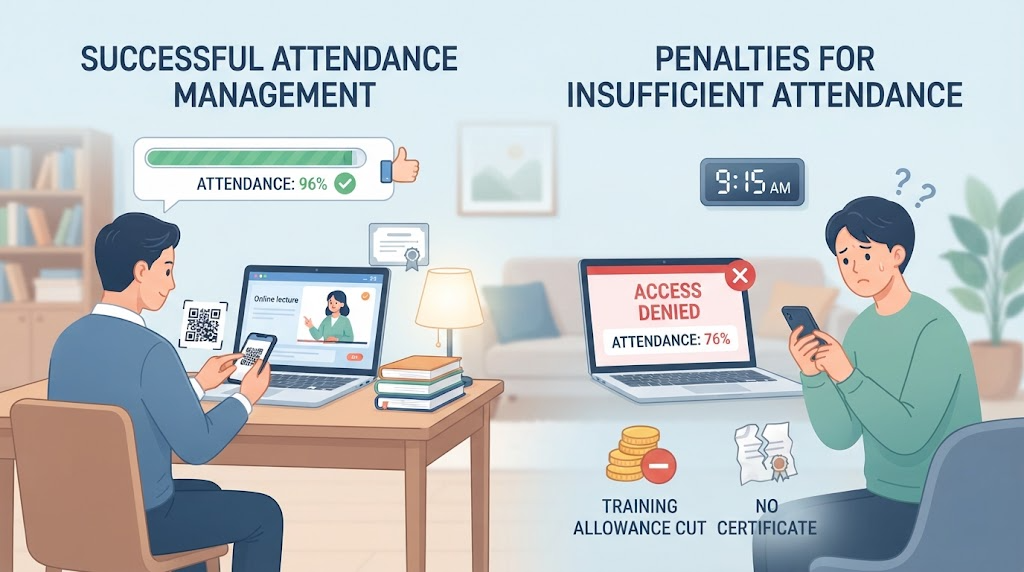
If you take tardiness or early leaves lightly or forget to check in and out, causing the 80% attendance rate line to collapse, it does not simply end with “Ah, I missed out on this training.” You end up shouldering 3 heartbreaking disadvantages that deal fatal blows to your wallet and future career development plans.
① Course Completion Failure (Incomplete) and Deprivation of Certification Acquisition Opportunities
The moment your attendance rate drops to 79% due to even a 1% shortage, all the lectures you stayed up all night listening to and your efforts are not officially recognized.
Because a completion certificate is not issued, eligibility to take practical certification exams you intended to acquire through the course gets blocked, or you cannot list it on your resume as experience or completion history, causing your time and effort to vanish into thin air.
② Total Cut and Recovery Measures for Training Allowances (Living Expenses)
The handy training allowances (living expense subsidies) paid out every month in connection with job seeker courses or the National Employment Support System are calculated based on attendance rates.
If processed as incomplete due to insufficient attendance, the allowance for that month is naturally not paid at all, and if a problem arises overlapping with administrative processing times among already disbursed allowances, you might experience an absurd and embarrassing situation where you even have to spit back (recover) subsidies that already entered your bank account.
③ Penalties of Card Limit Reductions and Future Reapplication Restrictions for the National Tomorrow Learning Card
Expulsion (incomplete) due to insufficient attendance receives the exact same administrative penalties as the ‘dropout’ covered earlier.
A certain amount is immediately deducted from your Tomorrow Learning Card subsidy account limit, and if incomplete counts accumulate, applying for new government-funded training or issuing a card itself is legally restricted for a certain period in the future. Even if you want to learn other useful skills right away tomorrow, this becomes a fatal blow holding you back.
3 Practical Tips to Secure a 100% Attendance Rate and Complete Your Training
To safely guard the magic line of an 80% attendance rate and prevent missing out on course completion due to a single mistake or unexpected situation, we share 3 practical attendance management tips you must remember.
① Setting Alarms and Arriving Early (Preparing for Public Transit Delays and Unexpected Variables)
The most common cause of attendance management failure is ‘hair-trigger tardiness’.
If you try to barely make it on time and the subway is delayed or the elevator line becomes long, you will instantly be processed for tardiness or miss your check-in time.
Try cultivating a habit of arriving with about 15 to 20 minutes to spare before class starts. Not only will you gain peace of mind, but you can also secure precious time to calmly complete your check-in and preview that day’s lecture materials.
② Habit of Finalizing Daily Attendance Status Checks (Double-Checking with the HRD-Net App)
Leaving the classroom with peace of mind just because class is over is strictly prohibited.
On your way home or after arriving home, you must develop a habit of opening the HRD-Net Attendance Management mobile app and visually checking with your own eyes whether your check-in and check-out records for the day were accurately processed normally.
Occasionally, due to communication errors or system omissions, check-outs failing to be reflected happens rarely. If you discover this immediately on the same day, you can request a correction from the academy administration office, but after a few days pass, proof becomes difficult, and you might unfairly end up confirmed as absent; therefore, ‘same-day confirmation’ is essential.
③ Defending Yourself with the ‘Official Attendance’ System During Unavoidable Hospital Visits or Family Events
As life goes on, unexpected accidents occur, you might suddenly fall severely ill and need to go to the hospital, or unavoidable family events arise. If you just take unexcused absences during these times, your attendance rate gets chipped away, but by utilizing the ‘official attendance’ (exception recognition for early leaves, absences, etc.) system recognized by the Ministry of Employment and Labor, you can defend against penalties.
In case of illness or injury: Submit objective hospital documents such as medical certificates or admission/discharge confirmation certificates.
In case of direct family events, etc.: Prepare supporting materials such as wedding invitations, death certificates, and family relation certificates.
If you notify the training institution administration office immediately upon the occurrence of the reason, check whether it meets the official attendance processing criteria, and submit supporting documents, a path opens up where that absence is recognized as attendance or you can avoid disadvantages.

Conclusion: Maximizing government-funded benefits 100% through thorough attendance management
So far, we have carefully examined the core attendance rate management criteria and practical tips to prevent course completion failure and various penalties in government-funded education courses.
Government-funded education through the National Tomorrow Learning Card is an invaluable opportunity and a reliable wing to pioneer new careers and develop professional competencies. However, all of these benefits can truly become fully mine only when the most basic condition of diligence, ‘an attendance rate of 80% or higher’, is met.
Casual thoughts like “What would happen just by being late today?” or “I can check in for entry later” return as a fatal boomerang that turns the time and effort I’ve poured in until now into bubbles in an instant.
Small habits that can be practiced starting today, such as arriving with plenty of time, double-checking electronic attendance for entry and exit, and utilizing official attendance in unexpected situations, safely protect your completion certificate and training allowance.
No matter how great a lecture and curriculum are, they cannot bear fruit without the diligence of keeping your seat in the classroom. We sincerely cheer that you maximize government-funded benefits through thorough attendance management and attendance enforcement, and achieve your brilliant career growth and successful employment/job transition dreams!
Korean version: 한국어로 읽기