
Introduction: Why Government-Funded Certificates Are the Ultimate Opportunity for Non-Majors
This is a draft of the first section [Introduction: Why Government-Funded Certificates Are the Ultimate Opportunity for Non-Majors] for a Naver blog post. It has been written in a friendly yet persuasive tone fitting for a blog.
Introduction: Why Government-Funded Certificates Are the Ultimate Opportunity for Non-Majors
“Can’t I do IT or development if I’m not a science or engineering major?”
“I didn’t major in business or accounting, but can I transition into bookkeeping or office administration now?”
When considering career changes or job hunting, the first walls you hit are ‘major’ and ‘experience’. If you have a desired job in mind but are hesitating to even start because you’re a non-major, today’s post will serve as your most reliable breakthrough.
In particular, government-funded training programs through the ‘National Tomorrow Learning Card’, which any South Korean citizen can utilize, are the most powerful weapon allowing non-majors to start a new career without risk. Let’s look into why preparing for government-funded certificates right now is the ultimate opportunity, one by one!
- Zero Tuition Burden, Solid Learning from Basics to Practical Skills
Even if you want to attend an academy, steep tuition fees often make you hesitate. However, by using government funding, the state subsidizes the costs, allowing you to take high-quality lectures with significantly reduced or almost no out-of-pocket expenses.
In particular, most government-funded programs are structured with systematic curricula ranging from ‘beginner classes’ to practical application courses and certificate preparation classes. Even if you start from scratch like a base camp, following the instructor’s guidance will help you discover that your skills have grown before you know it.
- Reducing Living Expenses During Job Preparation with Training Allowances
Many of you probably feel overwhelmed because you want to focus solely on your studies, but have to juggle part-time jobs or make a living. Among government-funded training courses, there are programs where monthly training allowances are paid if you meet a certain attendance rate (usually 80% or higher).
Although it’s not a huge amount, it helps ease economic and psychological burdens during the job preparation period by saving on textbook costs or covering small fixed expenses like meals and transportation.
- Securing ‘Objective Credentials’ That Shatter the Prejudice of Being a Non-Major
Writing “I am deeply interested” on a resume is far less impactful than proudly placing a national-certified license right on it. When hiring non-majors, what companies value most is ‘how diligently you prepared for this role.’ The very fact that you completed a government-funded course and obtained a related certificate perfectly proves your passion and foundational knowledge for the job.
💡 Summary
For non-majors, government-funded certificates are not just studying, but a cheat key to safely and surely transition careers. Instead of worrying, “Can I do this?”, take your first step with the mindset, “Let me start solidly from the basics too!”
Shall we continue with the next section featuring the table or detailed content of [Comparing Popular Government-Funded Certificate Difficulties at a Glance]? Please feel free to let me know!
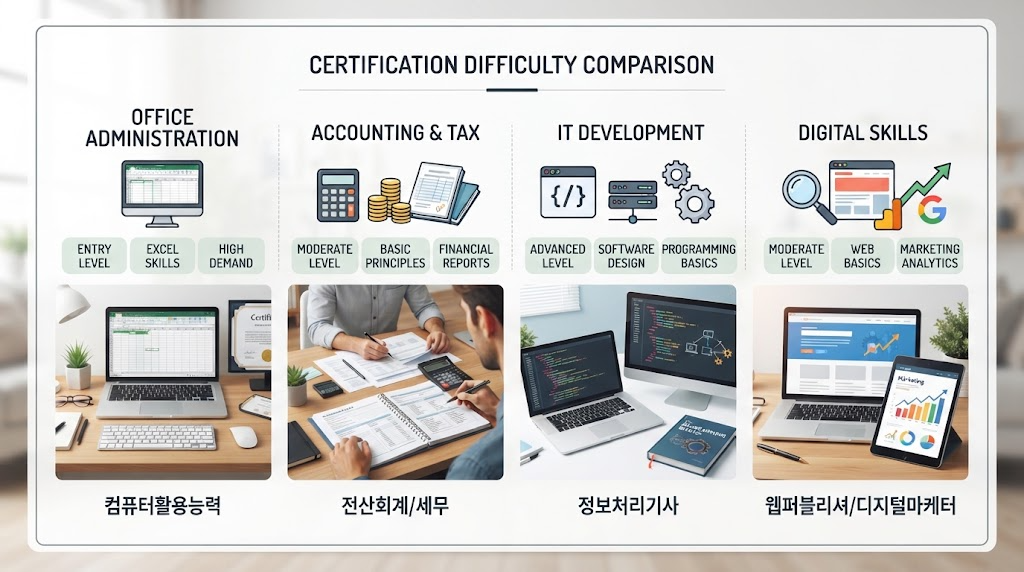
Comparing Popular Government-Funded Certificate Difficulties at a Glance (Comprehensive Table)
“Which certificate is right for me? And how difficult is it?”
This is the most common concern before applying for a government-funded training program. To ensure non-majors don’t get intimidated, we have carefully selected four representative, high-demand certificates in the job market that are most popular through government funding, and compared their difficulty levels and features!
📊 Recommended Government-Funded Certificates Comparison Table for Non-Majors
| Field | Certificate Name | Perceived Difficulty for Non-Majors | Key Learning Content | Recommended Target |
|---|---|---|---|---|
| Office & Administration | Computer Literacy Level 2 (Level 1) | Medium (Level 1 is High) | Spreadsheets (Excel), Databases (Level 1 only) | Those who want to build solid Excel skills as the foundation for all office jobs |
| Accounting & Tax | Electronic Accounting Level 1 / Electronic Tax Level 2 | Medium-High | Accounting Principles, Cost Accounting, Value-Added Tax and Income Tax, Accounting Program (KcLep) | Those who want to secure a solid foundation in accounting and get hired in bookkeeping or finance roles |
| IT & Development | Information Processing Engineer (Industrial Engineer) | High | Software Design, Database Construction, Programming Language Utilization | Majors-independent challengers wanting to transition careers into IT and development |
| Digital Practice | Web Publisher / Digital Marketer | Medium | HTML/CSS, Basics of JavaScript, GA4 and Performance Marketing Practice | Those who want to build trendy digital practical skills and join shopping malls or marketing teams |
🔍 Key Points & Non-Major Guide by Certificate
- Computer Literacy (The Flower of Office Administration)
- Features: Since basic tasks in all companies start with Excel, the barrier to entry is relatively low while its utility is extremely high.
- Non-Major Tip: Since Level 2 only deals with Excel, self-studying or short-term government funding is quite sufficient. However, starting from Level 1, Databases (Access) and complex functions are included, causing the difficulty to skyrocket. If you are a non-major, we recommend starting lightly from Computer Literacy Level 2, or taking a government-funded practical course that builds from the basics.
- Electronic Accounting Level 1 / Electronic Tax Level 2 (The Employment-Powerhouse Accounting Line)
- Features: Even those who know nothing about accounting can easily pass if they learn step-by-step starting from the concepts of ‘debit and credit’.
- Non-Major Tip: After building a foundation with Electronic Accounting Level 1, many prepare by linking directly to Electronic Tax Level 2. Working with numbers feels unfamiliar at first, but because past exam question patterns are clearly repeated, these are certificates where you get results proportional to your effort.
- Information Processing Engineer / Industrial Engineer (The First Step in an IT Career)
- Features: This is an essential certification for becoming a developer or IT engineer. Since eligibility requirements (such as a relevant major or the Academic Credit Bank System) are necessary, checking in advance is a must.
- Non-Major Tip: For non-majors, the theoretical scope is wide and unfamiliar, making the difficulty high. Combining systematic code practice and past exam analysis through a government-funded IT bootcamp or certificate preparation class is a surefire shortcut to drastically increasing your pass rate compared to self-studying.
- Web Publisher / Digital Marketing (Practical, Practice-Oriented Course)
- Features: This is a field where portfolios and practical competencies are considered much more important than the certificate itself.
- Non-Major Tip: There are many government-funded courses where you learn step-by-step starting from the basic structure of HTML even if you don’t know the first thing about coding. Because the results are immediately visible, this is one of the courses where non-majors can easily stay interested and finish to completion.
💡 Selection Tip
Rather than blindly chasing certificates that others say are good, first think about which job field you want to go into (office, accounting, IT, marketing). When searching through the list of government-funded courses, selecting programs that match the certificates above will drastically lower your failure rate!
Shall we continue with the detailed content of [Recommended Certificates & Learning Points by Field]? Please feel free to let me know your preferred direction!

Recommended Certificates & Learning Points by Field (Customized for Non-Majors)
This is a draft of the third section [Recommended Certificates & Learning Points by Field (Customized for Non-Majors)] for a Naver blog post. It contains learning tips that non-majors must know for each field.
Recommended Certificates & Learning Points by Field (Customized for Non-Majors)
Among the major certificates we looked at earlier, we will point out specific learning points and strategies for the office, accounting, and IT fields that non-majors choose most often when actually taking on the challenge. If you’ve been thinking, “I really know nothing at all, will I be okay?”, you’ll be able to find the answer right here!
- [Office Administration] Computer Literacy Level 2 / Level 1
What kind of course is this?
It is a national certificate that verifies the ability to utilize spreadsheets (Excel) and databases, which are essential competencies for corporate administrative and office roles.
Perceived Difficulty for Non-Majors: 🟡 Medium (Based on Level 2) / 🔴 High (Level 1)
Customized Learning Points for Non-Majors
Getting friendly with functions: If Excel isn’t familiar to you, you need to practice step-by-step starting with basic functions like IF, VLOOKUP, and INDEX/MATCH. Even if it looks complicated at first, repeating them like formulas will make patterns visible.
Starting lightly from Level 2: If you are a non-major, rather than recklessly challenging Level 1, we recommend a step-by-step strategy where you first build confidence and basic skills with Computer Literacy Level 2 before tackling Level 1.
Government-funded utilization tip: Studying alone makes it easy to waste time stuck on functions you don’t know. Learning the instructor’s know-how and shortcut tips at a government-funded academy is the secret to cutting your preparation period in half.
- [Accounting & Tax] Computerized Accounting Level 1 / Computerized Tax Accounting Level 2
What kind of course is this?
It is a certification that evaluates practical skills in recording a company’s cash flow and processing tax returns, and is called a cheat key for getting hired in bookkeeping and finance positions.
Non-Major Perceived Difficulty: 🟠 Medium-High
Customized Learning Points for Non-Majors
Mastering the Concepts of ‘Debit’ and ‘Credit’: The beginning and end of accounting study is ‘journal entry’ (recording accounting transactions) to position assets, liabilities, equity, expenses, and revenue. Once you grasp these basic concepts well, momentum builds from then on.
Practical Practice with Dedicated Programs (KcLep): It is difficult to pass by digging into theory alone. You must repeat practical practice—inputting slips and closing accounts directly through the KcLep program provided during government-supported classes—over and over again.
Aiming for Linked Acquisition: Many students prepare for them at the same time while completing a government-supported course, usually setting test schedules in the order of ‘Computerized Accounting Level 1 ➔ Computerized Tax Accounting Level 2’.
- [IT & Development] Engineer Information Processing / Industrial Engineer (or Web Publisher)
What kind of course is this?
It is a representative engineer certification in the IT field covering general software development knowledge. (※ Checking eligibility for the exam is mandatory!)
Non-Major Perceived Difficulty: ⚫ High
Customized Learning Points for Non-Majors
Getting Friendly with Unfamiliar Terms: Terms themselves can feel like an alien language to non-majors, such as databases, operating systems (OS), and software engineering. Rather than memorizing blindly, you should approach it in a way that understands the overall flow and architecture.
Meeting Eligibility Requirements for Non-Majors: If your education or experience conditions are not met, you can receive consulting on methods to match exam eligibility by linking with the ‘Credit Bank System’ during government support consultations, so make active use of it.
Writing Practical-Centered Code: Since the proportion of coding tests or practical exams is high, you can reach the passing zone only by going through the process of writing code directly with a keyboard and fixing errors, rather than studying just by looking with your eyes.
💡 Core Summary
A non-major’s weapon is not ‘the mindset to do things perfectly from the start’, but ‘the persistence to follow step-by-step faithfully from the basics’. The government support course acts as a reliable pacemaker that anchors this persistence!
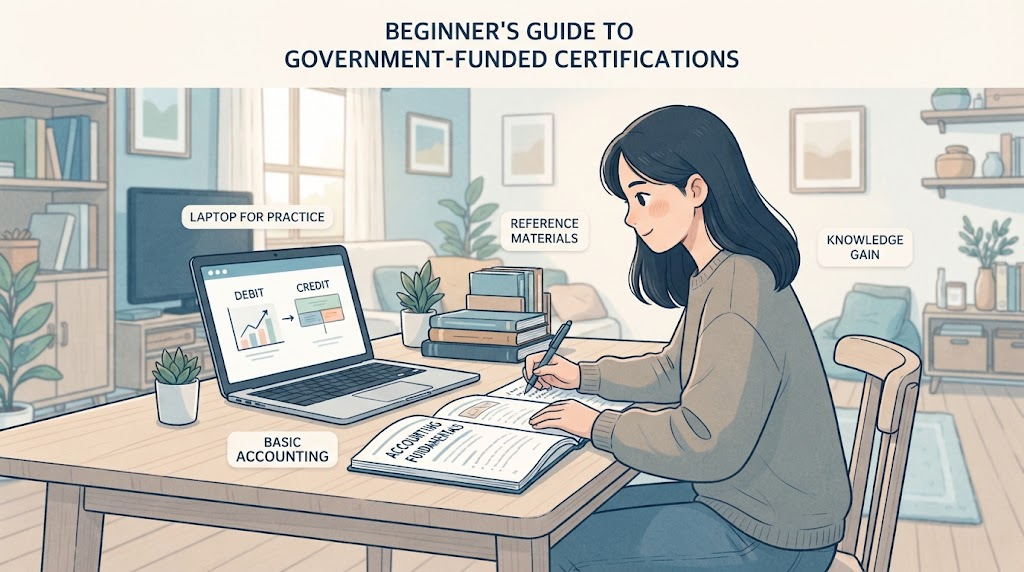
3-Step Roadmap for Successful Certification Acquisition
This is the draft of the main text for the fourth section of the Naver blog posting, [3-Step Roadmap for Successful Certification Acquisition]. It contains a step-by-step guide that can be practically put into action, from government support application to completion and employment linkage.
3-Step Roadmap for Successful Certification Acquisition
“I get it, but where on earth and how should I start?”
For those who feel overwhelmed even after deciding to take on the challenge, we outline a practical 3-step roadmap to follow from government-supported certification acquisition to employment. If you follow along step-by-step in this order, you’ll be set!
Step 1. Selecting the Right Course for Me (How to Use Employment24 & HRD-Net)
Starting from National Tomorrow Learning Card Issuance
The first thing to do is access the Ministry of Employment and Labor integrated portal (Employment24 or HRD-Net) and apply for the National Tomorrow Learning Card. Since it usually takes several days to a week for issuance, it is good to apply in advance.
Thoroughly Comparing Training Institutions and Courses
When choosing the right place for you among numerous courses, make sure to check the following three things.
Out-of-Pocket Expense Ratio: Check how much your final out-of-pocket expense will be when supported by your card
Completion Rate and Employment Rate: The overall student satisfaction of the academy and the presence of employment support programs
Review Check: Reading honest reviews left by actual students can be of great use in gauging the instructor’s lecturing power or academy atmosphere.
Step 2. Maintaining an Attendance Rate of 80% or Higher and Securing Training Allowances
Tardiness and Early Leaves Are Absolutely Prohibited!
The basic completion condition for a government-supported course is attending 80% or more of the total training hours. No matter how hard you study for written exams, if you fail to meet the attendance rate, you may be processed for dropping out and miss support benefits, so attendance management is top priority.
Checking Training Allowances That Flow In Nicely Every Month
If you faithfully attend throughout the course period, training allowances under the name of transportation and meal expenses will be deposited into your bank account. (※ Amounts vary depending on course type and linkage with the National Employment Support System) As a non-major, it serves as a reliable supporter allowing you to focus on your studies, so check it carefully.
Step 3. Resume and Cover Letter Linkage Strategy After Acquiring Certification
Creating Synergy Between Completion Certificate + National Certified Certification
If you successfully complete the government-supported course, you will hold both a ‘Completion Certificate’ and an acquired ‘Certification’ in your hand. Beyond simply filling a line in the resume certification section, the core is to melt ‘what projects you performed and what skills you learned’ specifically into your cover letter.
Utilizing the Academy’s Employment Support Center 200%
Most excellent government-supported academies have dedicated employment counselors stationed. Since they provide various employment linkage services ranging from resume correction and mock interviews to partner company matching, don’t be shy and actively request help!
💡 Roadmap Summary
Step 1 (Employment24 card issuance and course registration) ➔ Step 2 (Studying while receiving faithful attendance and training allowances) ➔ Step 3 (Acquiring certification and utilizing academy-linked employment support). If you just follow this routine, even non-majors can successfully start a new career!

Conclusion: Hesitation Only Delays the Start, Give It a Try!
“I’m a non-major, can I really do this?”
“At this age and with this career background, can I learn something new and get hired?”
If your head gets complicated with worries like these even before starting, another year tends to slip by without accomplishing anything. But remember. Even at this very moment, countless non-majors are learning step-by-step from the basics through government support and confidently stepping into new job roles.
Rather than waiting for perfect preparation, taking that first step to apply for the National Tomorrow Learning Card and finding a course that suits you is the surest way to change our future. Right now, when you can lighten your tuition burden and receive solid support through training allowances, is truly the best timing to take on the challenge.
Hesitation only delays the start! Referencing the information shared today, we sincerely cheer for you to take your first step toward a new challenge and a wonderful career transition.
💬 Good Articles to Read Together & Communication Guide
If you have any questions or government-supported courses you would like to know about in more detail, please feel free to leave them in the comments!
If today’s article was helpful, please quickly receive more beneficial employment and certification information through likes (❤️) and neighbor additions. Have a happy day today as well!
Korean version: 한국어로 읽기