Introduction: The Overwhelming Job-Changing and Re-employment Market, and Why ‘Practical Competitiveness’ Comes Before Building Specs
In a fierce employment and job-changing market, everyone has likely opened a book at least once, thinking, “Everyone else is getting this certificate, so I should just get it too.”
Hoping that “the more certificates I have, the better my resume will look” or “if I list them all on my resume, my document screening pass rate will go up,” people pour in time and money. However, upon entering the interview room, many fail or struggle because they are caught off guard by unexpected questions or fail to prove their practical competencies.
Amid a rapidly changing employment market and a practical-centered rolling recruitment trend, the talent companies truly want is not someone who holds many “fancy decorative specs,” but someone equipped with ‘practical competitiveness’ who can immediately pull their own weight the moment they are placed on site.
No matter how difficult or flashy a certificate is, if it does not align with your job role or cannot be applied to actual work, it is nothing more than a piece of paper.
In this article, we will thoroughly guide you through everything from clear criteria for choosing certificates that genuinely help on the job—going beyond mere spec-building—to tips for a failure-free selection when preparing for a career change or re-employment.

The Difference Between Certificates That Are 1% Useless on the Job vs. Real Practical Certificates That Save Your Resume and Interview
Many office workers start studying for certificates to fill a line on their resume, only to panic after successfully finding a job or changing careers, realizing that “what I learned at school or academy is completely different from the actual field.”
What decisive differences exist between ‘decorative certificates’ that make corporate recruiters and practical interviewers click their tongues and ‘real practical certificates’ that make an interviewer’s eyes light up?
We compare the distinct differences between the two types of certificates.
- Memorization-Oriented Decorative Certificates (The Trap of Document Pass-Throughs)
Theory-Centered and Multiple-Choice Exams: These are certificates primarily acquired through text memorization and trick-based multiple-choice problem solving. When taking the test, you cram and pass, but when you need to open an Excel format or cut accounting slips at work, you cannot remember a thing.
Lack of Job Relevance: Aside from filling a few extra lines in the resume certification section, they do not connect with actual work processes, so when an interviewer asks in-depth practical questions, you fail to answer properly and are left speechless.
- Real Practical Certificates Directly Linked to Field Processes (Weapons That Save Resumes and Interviews)
Execution and Program-Centered: These are tests that directly handle the manipulation abilities of programs (Excel, Douzone, etc.) or practical processes used daily in actual corporate sites, such as Computer Literacy, Computerized Tax Accounting, and Financial Management.
Competencies Proved in Interviews: You can specifically appeal by saying, “While acquiring this certificate, I became proficient in handling corporate closing and data pivot functions,” instilling a strong sense of trust in the interviewer that “they can pull their weight starting tomorrow.”
💡 Practical Certificate Judgment Tip
Before you start studying for a certificate, take a look at the past exam questions or practical test types of that certificate first. A certificate that involves directly handling programs or writing practical formats, rather than one with only thick theoretical books, becomes a much more powerful weapon in the job-changing market!
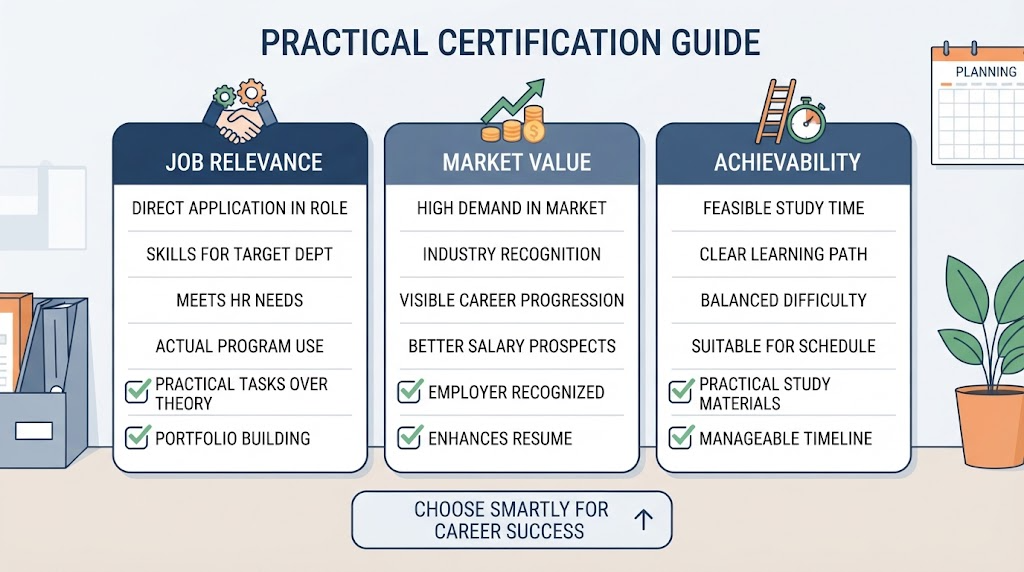
3 Core Criteria for Failure-Free Certificate Selection (Job Relevance, Return Value, and Difficulty)
When preparing for a career change or re-employment, it is natural to fall into deep thought, wondering, “Will getting this certificate really help me get a job?” Chasing blindly after certificates that others say are good or that are recommended in employment communities is a surefire way to waste time and money.
To pour your precious time and effort into guaranteed results, we outline 3 core criteria that you must check for a failure-free certificate selection.
- Direct Relevance to the Target Job (Job Suitability)
Criteria for Document Evaluation: Recruiters look first at whether an applicant has “competencies that can be used immediately in our department,” not the sheer number of certificates on a resume. You must first check whether the certificate directly touches upon the core work processes of the job you wish to apply for (e.g., financial accounting, human resources & general affairs, digital marketing).
Exclusion of Unnecessary Specs: Rather than acquiring several low-bonus certificates that have nothing to do with the job, digging deeply into 1 to 2 core certificates directly linked to practical work is much more advantageous in both document screening and interviews.
- Efficiency and Return Value Relative to Investment (Value vs. Cost and Time)
Acquisition Period and Cost: For office workers or re-employment seekers, ‘time’ is the most precious asset. You must coldly evaluate whether the economic costs—such as application fees, textbook costs, and academy fees—as well as the several months required to pass, bring a clear return on investment (career change success, salary negotiation advantage).
Value of Utilizing Government Support: Checking whether it is a certificate you can prepare for efficiently while receiving tuition support or training allowances through the National Tomorrow Learning Card is a wise financial and spec-building strategy.
- Realistic Difficulty Matching Your Current Competencies
Checking Pass Rates and Baseline: If you rashly challenge the highest-difficulty certificates (e.g., tax accountants, professional engineers, or other long-term test preparation exams) as a non-major or without sufficient foundational knowledge, you are likely to quit midway or experience burnout.
Step-by-Step Challenge Strategy: Climbing up step-by-step starting from basic certificates (e.g., Computer Literacy Level 2 or Computerized Accounting Level 2), or selecting a certificate of realistic difficulty where you can focus and win in a short period (1 to 2 months) to firmly grasp the passing title is a shortcut to boosting both self-esteem and employment success rates.
💡 Certificate Selection Tip
Scrap 10 job postings you are interested in. Simply filtering out the essential and preferred certificates that appear most frequently in the preferred qualifications or requirements sections can establish the most reliable criteria to eliminate the probability of failure!

Recommended Certification List Most Preferred in the Field by Job Role (Office Administration, Financial Accounting, Marketing, IT)
When you decide to change careers or re-employ, the first wall you hit is the question, “What kind of certificate should I actually get so that people in the field will recognize it?”
There is no such thing as a universal certificate that fits every job role, and there are certainly representative certifications that field managers and recruiters in each sector evaluate most highly as indicators of practical competency.
We clearly organize the core recommended certification lists most preferred in the field by office administration, financial accounting, digital marketing, and IT/development job roles.
- Office Administration and Management Support Roles
Computer Literacy Level 1 and Level 2: The most standard and powerful certificates proving Excel and data management skills in administrative, general affairs, and human resources departments across all domestic companies.
Computerized Accounting Level 1 / Computerized Tax Accounting Level 2: An essential course that reliably increases the document screening pass rate in management support departments where basic accounting knowledge and tax processing are mandatory.
Korean History Proficiency Test (Levels 1 to 3): Consistently loved as a foundational spec because it often grants extra points during recruitment for public institutions or general corporations.
- Finance, Accounting, and Bookkeeping Roles
Computerized Tax Accounting Level 1 and Level 2 / Computerized Accounting Level 1: Based on the ‘Douzone’ program most widely used in domestic medium and small-sized business practices, proving that you can be deployed immediately to slip entry and closing operations upon employment.
Financial Management Specialist / Accounting Management Level 1 and Level 2: Demonstrates deep professional expertise across financial accounting, tax accounting, and cost management accounting, making it a powerful weapon when transferring to a finance or accounting department.
TAT / FAT (Korea Certified Tax Accountants Association Certification Tests): Evaluated for practical-centered tax and accounting program operation abilities, resulting in very high field preference.
- Marketing and Planning Roles
Search Advertising Marketer Level 1: A representative practical certificate in the marketing field that officializes online ad execution and data analysis competencies on major platforms such as Naver and Kakao.
GAIQ (Google Analytics Individual Qualification): An official Google Analytics certification that objectively proves website traffic analysis and performance marketing capabilities.
GTQ (Graphic Technology Qualification) Level 1 / Computer Graphics Craftsman: Great for showing Photoshop and Illustrator proficiency in marketing fields where content creation is essential.
- IT, Development, and Data Roles
Engineer Information Processing / Industrial Engineer Information Processing: The most foundational yet official national technical certification for IT and software development roles, serving as a representative benchmark separating majors from non-majors.
SQLD (SQL Developer) / ADsP (Data Analysis Semi-Professional): Popular certifications proving database querying and basic data analysis capabilities in fields where data-driven decision making has become the mainstream.
AWS Cloud Certifications (SAA, etc.): Strongly appeals to practical suitability in modern IT environments where cloud infrastructure utilization skills are essential.
💡 Certificate Utilization Tip
When listing certificates on your resume, do not just write the title of the certificate; weaving ‘the programs covered during the certificate acquisition process (Excel macros, Douzone, GA, etc.) and practical application experience’ into your resume summary or cover letter for a line or two can instantly capture the interviewer’s attention!

Tips for Acquiring Certifications Without Cost Burden Using Government Support (National Tomorrow Learning Card) and Employment24
Are you hesitating to get certifications essential for practical work because of the burden of hundreds of thousands of won in academy fees, textbook costs, and application fees?
If you are a job seeker preparing for a career change or re-employment, or an office worker dreaming of a career transition, you must unconditionally utilize the ‘National Tomorrow Learning Card’ system, where the government supports up to 85% to 100% of tuition fees and even pays a monthly training allowance.
We outline practical Employment24 utilization tips that lower your cost burden to zero and maximize your success rate in obtaining certifications.
- How to Use the Employment24 (Formerly Employment and Labor HRD-Net) Integrated Platform
Accessing the Official Portal: Log in to the ‘Employment24 (www.work24.go.kr)’ website or official mobile app, which is the integrated employment service portal reorganized from the existing HRD-Net.
Customized Course Search: By entering your desired certification course (e.g., ‘Computerized Tax Accounting’, ‘Computer Literacy’, ‘Financial Management Specialist’) in the search bar, you can compare online and offline government-supported training courses nationwide, out-of-pocket costs, training periods, and employment rates all at a glance.
- Maximizing National Tomorrow Learning Card Issuance and Support Benefits
Card Application and Issuance: The National Tomorrow Learning Card, which can be issued by any Korean citizen (excluding civil servants, private school pension beneficiaries, etc.), supports a training account ranging from 3 million won to a maximum of 5 million won per individual.
Reduction of Out-of-Pocket Expenses: If you select a training course with a high employment rate or one corresponding to national core and strategic industry fields (national core job types), you can take professional training with full tuition support (0 won out-of-pocket).
- Managing Attendance Rates to Secure Training Allowances (Living Expense Support)
Condition of 80% or Higher Attendance Rate: If you achieve an attendance rate of 80% or higher per unit period, training allowances (up to several hundred thousand won per month) in the name of transportation and meal expenses will be deposited into your bank account during the training period.
Living Expense Defense Strategy: For re-employment seekers who find it difficult to juggle part-time jobs or side gigs and must fully dedicate themselves to studying for certifications, the training allowance serves as the most reliable support system providing financial breathing room.
💡 Government Support Tip
Before applying for a training course on Employment24, be sure to carefully check ‘review ratings’ and ‘trainee completion rates’. You can catch both birds—certification acquisition and employment—only by selecting an excellent training institution with high lecturer satisfaction and well-structured employment linkage programs!

Conclusion: Moving Beyond Certification Acquisition to Successful Career Change and Re-employment
In the fierce front lines of career changes and re-employment, the process of pondering what ‘practical competitiveness’ is truly necessary for your job and preparing step by step, rather than blindly chasing certificates that everyone else is getting, is by no means an easy journey.
However, as we examined together today, instead of decorative specs simply designed to fill a resume, choosing real practical certificates directly linked to field processes and cleverly utilizing Employment24 and the National Tomorrow Learning Card to lighten your cost burden will make your career transition much more solid and certain.
Acquiring a certification is not the end, but merely the most powerful starting point to prove your value in a new workplace and confidently pull your own weight.
We sincerely cheer for your brilliant future as you erase fear with a little wisdom and persistence at the crossroads of a daunting career change and re-employment, making a wonderful leap in a new space and job role!
The iwaw.kr platform, filled with housing, living, and career tips that are always with you, will continue to visit you with more useful and practical information.
💬 Good Articles to Read Together & Communication Guide
If you have any questions during your certification preparation or career change process, please feel free to leave them in the comments.
If today’s article was helpful, please quickly receive rich career information through likes (❤️) and neighbor additions. We pray that your new challenges are filled only with happiness and a sense of achievement!
Korean version: 한국어로 읽기