Introduction: Introduction to the Earned Income Tax Credit System and the Importance of Single-Household Targets
To provide practical help to households experiencing living difficulties despite working hard due to low income, the representative welfare system supported by the state is none other than the ‘Earned Income Tax Credit’. The Earned Income Tax Credit is a very solid support project where the government pays subsidies in cash to help the economic self-reliance of the working low-income class and alleviate the income gap.
In the past, support centered on households with dependents was mainstream, but as single-person households have surged recently, the importance of and interest in support for ‘single households’ are also increasing day by day. Especially for single-household youth and single-person households who must entirely shoulder all living expenses such as housing costs, food costs, and utility bills alone without help from those around them, the Earned Income Tax Credit is precious financial resource like rain in a drought.
However, unfortunate cases often occur where people miss the regular application period set every year or fail to receive precious benefits due to a lack of understanding of single-household criteria. Even if you missed the regular application period, there is a relief system called ‘late application’, so there is no need to give up at all.
In this posting, we will easily organize everything from the basic eligibility requirements for the 2026 Earned Income Tax Credit regular application, the characteristics and benefits of single households, to late application tips to ensure you secure the subsidy even if you are late. If you do not want to miss out on the subsidy, please check today’s content to the end!

2026 Earned Income Tax Credit Regular Application Basic Eligibility Requirements
To apply for the Earned Income Tax Credit, you must satisfy all three requirements set by the National Tax Service: household member composition criteria, total income criteria, and asset criteria. Let’s take a detailed look at the major eligibility requirements as of 2026 item by item.
- Criteria by Household Member Composition
For the Earned Income Tax Credit, income and asset criteria are applied differently depending on the household member composition. They are classified as follows based on household members living together on the resident registration:
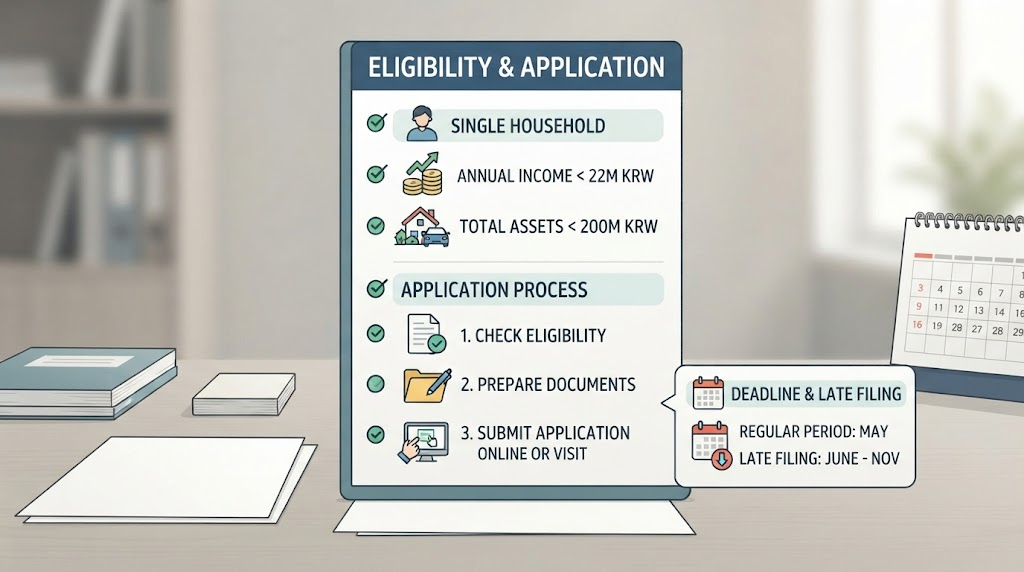
Single Household: A household with no spouse, dependent children, or direct ascendants aged 70 or older (single-person household)
Single-Earner Household: A household where the spouse’s annual total salary amount, etc., is less than 30,000 KRW, while having dependent children or direct ascendants aged 70 or older
Dual-Earner Household: A household where the annual total salary amount, etc., of each of the applicant and spouse is 3 million KRW or more
- Income Criteria (Annual Total Income Amount)
It must be less than the annual total income reference amount determined according to the household member composition. (It is calculated by summing up earned income, business income, religious person income, interest, dividend, and pension income, etc.)
Single Household: Annual total income of the couple combined of less than 22 million KRW
Single-Earner Household: Annual total income of the couple combined of less than 32 million KRW
Dual-Earner Household: Annual total income of the couple combined of less than 38 million KRW
- Asset Criteria (Summed Across All Household Members)
As of the previous year, the total sum of assets owned by all household members must be less than 200 million KRW.
Assets Subject to Summation: All assets such as land, buildings, houses, automobiles, Jeonse deposits, financial assets, securities, membership rights, etc.
Whether Debt is Deducted: When calculating assets, debt is not deducted and it is judged based on the total asset value. (However, if the total asset sum is 140 million KRW or more and less than 200 million KRW, only 50% of the subsidy payment amount is reduced and paid.)
If you have carefully checked the basic eligibility requirements, next we will intensively explore the specific characteristics and benefit benefits of single households that people living alone are most curious about!
Focusing on Single Households (Characteristics and Subsidy Benefits)
In the Earned Income Tax Credit system, a ‘single household’ refers to a single-person household with no family to support, and its importance is growing as it recently accounts for the highest proportion among all recipients. Let’s take a detailed look at the specific criteria and characteristics of subsidy benefits for single households.
- Exact Criteria and Scope of Single Households
To be recognized as a single household, you must meet all of the following requirements:
Household Member Composition: Refers to a household where the applicant themselves has no spouse, direct ascendants (parents, grandparents, etc., meeting the support condition of age 70 or older), and dependent children.
Resident Registration Criteria: All household members on the resident registration must satisfy the above requirements, and single-person households residing independently alone are representative. (However, even if residing at the same address as parents, separating households and proving that an independent livelihood is maintained requires strict screening of household-based criteria, so distinction on resident registration is very important.)
- Single Household Subsidy Benefits and Payment Amount Characteristics
Maximum Payment Amount: Single households have lower total income criteria and asset criteria amounts compared to single-earner and dual-earner households, and the maximum payment amount is also set relatively smaller due to the structure where it increases as the number of household members increases. (The annual maximum payment amount fluctuates according to the inflation rate and tax law revisions.)
Support Experience Effect: Although the amount itself may be smaller compared to multi-person households, in a reality where the fixed expenditure burden of single-person households such as monthly rent, utility bills, and food costs is very large, the single-household subsidy is a great help to livelihood stability. In particular, it performs a practical social safety net role for youth single-person households and elderly single-person households.
If you have understood the requirements and benefits of single households, let’s continue to check the ‘late application tips and reduction penalties’ on how to cope if you missed the regular application period!

What If You Missed the Regular Application Period? ‘Late Application’ Tips and Reduction Penalties
Just because you forgot and missed the Earned Income Tax Credit regular application period (May every year) does not mean you cannot receive the subsidy at all. The National Tax Service operates a ‘late application’ system to rescue targets who missed the regular application deadline.
However, since a slight disadvantage (reduction penalty) occurs for failing to apply within the deadline, it is important to accurately understand the contents of the system and cope quickly. We summarize the core contents and precautions of late application.
- Late Application Available Period and Targets
Available Application Period: Application is possible from immediately after the regular application deadline usually until November 30 of that year. (If even this period passes, receiving the Earned Income Tax Credit for that year becomes completely impossible, so you must definitely submit within the deadline.)
Application Targets: All Earned Income Tax Credit recipient qualifiers who met the requirements during the May regular application period but failed to complete the application due to personal circumstances or schedule mistakes.
- Reduction Penalty Upon Late Application
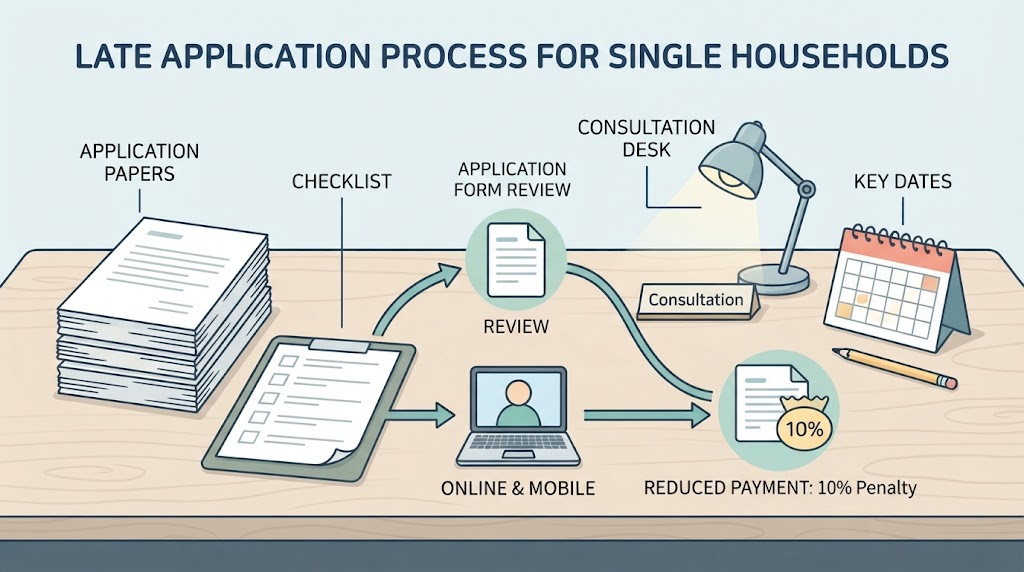
Compared to targets who normally submitted during the regular application period, when making a late application, 10% of the calculated total subsidy payment amount is deducted (reduced) and paid.
For example, if 1 million KRW in subsidy is finally calculated as a result of the screening, in the case of a late application, 900,000 KRW with 10% reduced is paid, so the later you apply, the more losses occur, making it advantageous to apply quickly as soon as you discover it.
- Late Application Submission Methods (Utilizing Hometax and Sontax)
Online and Mobile Submission: After logging into the National Tax Service Hometax (hometax.go.kr) PC website or the smartphone ‘Sontax’ app, you can easily apply through the [Subsidies/Year-end Settlement/Electronic Donations] ➔ [Earned/Child Tax Credit Regular Application] menu. (If you have received a notice, you can also easily access it with one click through the link included in the KakaoTalk or text message.)
Telephone (ARS) Application: You can also easily submit through ARS telephone (National Tax Service Subsidy Counseling Center) by utilizing the individual authentication number listed on the notice, etc.
Late application has a reduction penalty, but it is a much better relief method than completely losing precious subsidies. If you happened to miss the May period, connect to Hometax right now and check your eligibility!
Common Mistakes and Precautionary Honey Tips When Applying
The Earned Income Tax Credit becomes a thankful subsidy of great help if prepared meticulously, but unfortunate situations can occur where screening is delayed or payment is rejected altogether due to a single minor mistake during the application process or input stage. We summarize key precautions and honey tips to prevent common mistakes during the recipient process and successfully secure your subsidy.
- Preventing Errors in Contact Information and Refund Account Information
Most Common Mistake: When applying via Hometax or Sontax, the mobile phone number is often changed or entered incorrectly, failing to receive the National Tax Service’s screening progress status, additional document request notices, screening result notices, etc.
Resolution Tip: Before applying, you must definitely check whether the mobile phone number and address in your Hometax member information are up to date and enter them accurately. In addition, it is safe to double-check several times whether you accurately entered the refund account number in your own name where the subsidy will be deposited without typos. (Entering an account in another person’s name or an incorrect account number can significantly delay payment.)
- Being Cautious of Omissions When Calculating Income and Asset Requirements
Summation of Income Other Than Earned Income: If there is business income, interest/dividend income, other income, etc., in addition to earned income, if the ‘total income amount’ combining them exceeds the baseline, you will be eliminated from eligibility. It is important to grasp your overall income structure in advance.
Checking the Borderline of Asset Criteria (Less Than 200 Million KRW): When summing up the values of land, buildings, houses, automobiles, Jeonse deposits, etc., they are calculated based on the official announcement price or standard market price as of the base date (June 1 of the previous year), so if you are on an ambiguous borderline, it is advisable to check eligibility in advance through the Hometax ‘Subsidy Preview’ service, etc.
- Actively Utilizing In-Deadline Application and Notices
If you exceed the regular application period (May) or the late application period, the method to receive legal relief disappears, so you must definitely mark the deadline on your calendar.
When you press the ‘Apply’ button within the KakaoTalk notice or text message sent by the National Tax Service, it links easily with one click, so be careful not to delete it by mistaking it for spam.
If you familiarize yourself with these precautions in advance and check them meticulously, you will be able to safely receive the Earned Income Tax Credit benefits without mistakes or omissions!

Conclusion: Do Not Miss Out and Apply to Secure Your Precious Subsidy
So far, we have meticulously explored everything from the basic regular application eligibility requirements to receive the 2026 Earned Income Tax Credit, the characteristics and recipient benefits of single households, late application tips and reduction penalties to cope with when missing the regular period, and finally, honey tips to be cautious of when applying.
For single households and low-income workers who worry about tight living expenses and fixed expenditures despite working hard, the Earned Income Tax Credit is a very precious and solid pillar of support that breathes economic life into them. Regardless of the size of the amount, frugally claiming and securing your rights can be said to be the beginning of wise asset management.
Lastly, check the core checklist for successful subsidy reception once again!
[Check 1] Confirming Satisfaction of Qualification Requirements: Confirming total income criteria by single, single-earner, and dual-earner household and household-member-combined asset criteria (less than 200 million KRW)
[Check 2] Strict Observance of Application Deadline: If you missed the regular application period (May), quickly submit within the late application period (by November 30) before the reduction (10%) penalty is applied
[Check 3] Utilizing Hometax and Sontax: Easily check eligibility and complete application with one click via PC Hometax or smartphone Sontax app
[Check 4] Reviewing Information Accuracy: Final check on whether there are typos in essential input information such as contact numbers and refund account numbers
Although the application process may feel somewhat cumbersome, if you prepare meticulously and submit within the deadline, you can fully make the precious benefits supported by the state your own. We sincerely cheer that the information guided today will be a small addition to your stable economic life and warm daily routine!
Korean version: 한국어로 읽기