Prologue: Supplements That Others Say Are Good, Are They the Right Answer for Me Too?
Have you ever sighed looking at the supplement bottles piled high on the dining table as soon as you opened your eyes in the morning?
High-dose vitamins purchased after being swayed by reviews on social media saying “My chronic fatigue vanished completely after taking this,” milk thistle handed over by a colleague saying it is good for the liver, and omega-3 and lutein ordered for each family member thanks to a home shopping host’s enthusiastic explanation. Before you know it, the pills that have increased one by one amount to 6 to 7 pills, but even after diligently taking them for a month or two, you have probably experienced feeling bloated and experiencing heartburn rather than feeling lighter in your body.
“Others say they saw great effects, so why is my body staying the same?”
The answer is simple. It is because that person’s body and your body have completely different deficiency states.
The Traps of Supplement Overdose and Misuse
Modern people’s consumption of supplements often stems from ‘relieving anxiety.’ The guilt of failing to maintain a proper diet amid busy daily life and the vague fear that accumulated fatigue might lead to collapsing drive people to fill their supplement shopping carts.
However, indiscriminate intake without considering the metabolic state of one’s body becomes a poison rather than a medicine.
Accumulation of fat-soluble vitamins: Fat-soluble components such as vitamins A, D, E, and K are not easily excreted in urine like water-soluble vitamins, but instead accumulate in the liver and adipose tissue, which can cause toxicity.
Overloading the liver and kidneys: No matter how good an ingredient is, the moment it enters the body, it must be metabolized in the liver and filtered through the kidneys. Taking too many supplements all at once places an unnecessary overload on detoxification organs, which ironically causes extreme fatigue.
Interference with absorption between ingredients: If calcium and iron are swallowed at once, they compete to take the same absorption pathway and both end up discarded outside the body. Long-term intake of high-dose zinc can also induce copper deficiency.
Ultimately, taking supplements purely based on other people’s recommendations without understanding the cause merely produces ‘expensive urine’ or leaves burdens on organs.
Why Knowing ‘the Ingredients I Need’ Comes First
The essence of a supplement lies in ‘supplementing’—filling in the gaps that diet and lifestyle habits have failed to cover. Taking them without checking what is lacking on your dining table and which organ is overworked most throughout your daily routine is no different from blindly inserting new parts without even knowing where the broken component is.
The ingredients needed by someone whose liver function has declined from overtime work and alcohol consumption,
The ingredients needed by an office worker who stays indoors and does not get sunlight,
And the ingredients needed by someone whose autonomic nervous system is on edge from insomnia and stress must be completely different.
What we need right now is not the checkout button to add yet another trendy supplement, but a screening process to objectively discern “whether my body is truly a target that needs supplements right now” and, “if so, what ingredients are genuinely deficient.”
Instead of peeking into others’ shopping carts, let us now begin taking the first step to design your own health routine by listening to your body’s signals.

Step 1: Self-Diagnosis Checklist (How to Determine If You Need Supplements)
Before choosing a supplement, the first question to ask is not “Is this popular these days?” but “Is my body truly in a state that requires external supplementation right now?”
For those who consume balanced whole foods for all three meals and engage in regular outdoor activities, expensive supplements may not be particularly necessary. On the other hand, if you have entered a certain age group or continue an irregular lifestyle, the depletion rate of specific nutrients becomes much faster.
Use the three criteria below to check whether you qualify as a candidate who actively needs dietary supplements.
- Checking Metabolic Changes by Age Group
As you age, digestion, absorption rates, organ functions, and internal synthesis capabilities change. Identifying vulnerabilities according to your life cycle comes first.
- Young Adults / Office Workers in Their 20s and 30s: A period when energy expenditure and stress hormone secretion reach their peaks. Demand is high for active water-soluble vitamins that support cellular energy metabolism and nerve-stabilizing minerals that are easily depleted by irregular sleep.
- Middle-Aged Adults in Their 40s and 50s: Hormone secretion drops sharply, while vascular elasticity and basal metabolic rate decline. The need increases for antioxidants that eliminate free radicals, blood circulation-improving factors, and nutrients that support joints and cartilage.
- Seniors Aged 60 and Above: Stomach acid secretion decreases, significantly lowering absorption rates of minerals, proteins, and specific vitamins from food. Supplementing essential vitamins that aid neurotransmission and components that promote calcium metabolism for bone health is recommended.
- Lifestyle & Dietary Habit Self-Diagnosis
Everyday habits are the primary culprits accelerating the depletion of bodily nutrients. If you meet 3 or more of the following criteria, you are a target candidate for supplements whose nutritional balance is difficult to achieve through diet alone.
| Category | Checklist Items | Vulnerable Nutrients |
|---|---|---|
| Dietary Habits | Relying on delivery food, instant meals, or fast food for 3 or more meals a week | Trace minerals, multi-vitamins |
| Activity Level | Indoor lifestyle with less than 20 minutes of daily sunlight exposure | Vitamin D |
| Stimulants / Luxuries | Drinking alcohol 2 or more times a week or consuming 2 or more cups of coffee daily | Vitamin B complex, magnesium, water |
| Sleep / Stress | Less than 6 hours of sleep a day, frequent overtime work, and high work tension | Coenzyme Q10, zinc, theanine |
| Special Circumstances | Maintaining a strict low-calorie diet for 3 or more months | Protein, essential fatty acids, iron |
- Signals Suspected of Deficiency Sent by Your Body
Even without taking blood tests, you can assess where bottlenecks have formed across metabolic pathways through physical signs and daily conditioning.
- Eyelids and shoulders feel heavy as lead even after getting enough sleep
→ Suspected deficiency in vitamin B complex and coenzyme Q10, which burn carbohydrates and fats into energy
- Twitching under the eyes or waking up to calf cramps every night
→ Suspected deficiency in magnesium, which coordinates neurotransmission and muscle contraction and relaxation
- Eyes feel dry, stiff, and dim with frequent foreign-body sensations while looking at monitors
→ Suspected deficiency in lutein/zeaxanthin and omega-3, related to decreased macular pigment optical density in the retina and mucous membrane dryness
- Feeling bloated and experiencing irregular bowel movements even with slight stress
→ Need for supplementation with probiotics and intestinal mucosa regenerating factors due to an imbalance in the gut microbiome
- Easily catching colds and frequently developing canker sores during seasonal changes
→ Suspected low levels of zinc and vitamin D, which oversee immune cell proliferation and mucosal barrier defense
Once you narrow down the areas suspected of deficiency via the checklist, you should arrange the core components tailored to your priorities one by one rather than blindly grabbing a handful of multivitamin supplements. In the next step, based on these signals, we will identify customized nutrient combinations that perfectly suit your health status.
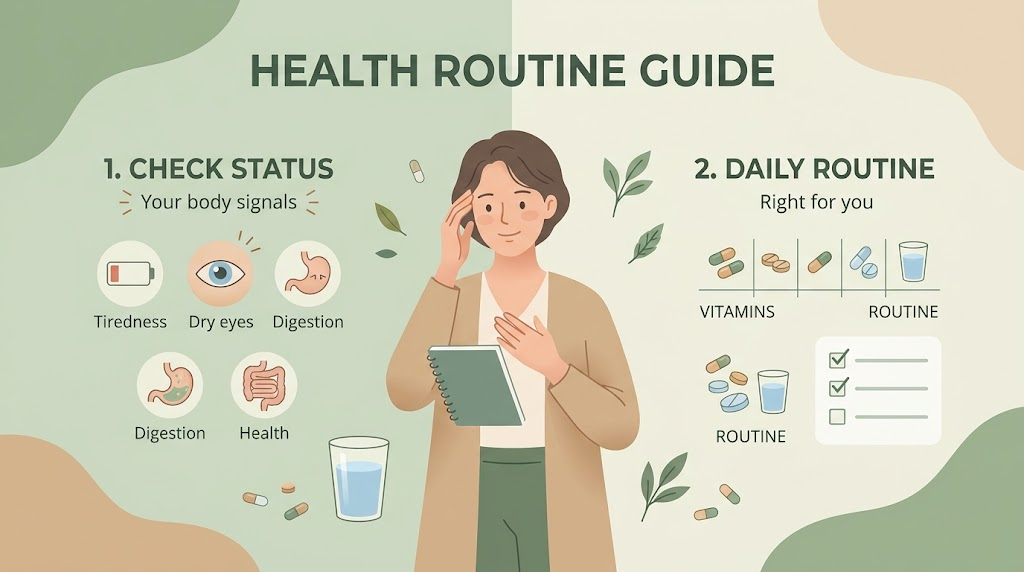
Step 2: Matching Tailored Nutrients by Your Health Status
Once you have identified the deficiency signals sent by your body through the Step 1 self-diagnosis, it is time to match nutrients that precisely fit your condition.
Attempting to take every supplement available on the market blindly leads not only to financial burdens but also strains the liver and stomach. Selecting 1–2 categories with the most distinct symptoms you experience and narrowing them down to ‘core combination formulas’ that maximize mutual absorption and synergy will accelerate noticeable results.
- Chronic Fatigue and Overtime Work Type (Office Workers / Examinees)
- Recommended Combination: High-potency active vitamin B complex + milk thistle (silymarin)
- Synergy Principles:
- To revive a sagging body caused by overtime and an irregular lifestyle, a vitamin B complex that converts carbohydrates, proteins, and fats into energy (ATP) is essential. Formulations containing active components such as benfotiamine and bisbentiamine, which offer higher absorption rates and longer retention times than standard thiamine, are effective.
- Combining this with milk thistle (silymarin), which protects hepatocyte membranes and supports the synthesis of the antioxidant glutathione, smoothly detoxifies fatigue by-products accumulated during metabolic processes, thereby accelerating fatigue recovery speed.
- Screen-Focused and Dry-Eye Type (Desk Workers / Heavy Smartphone Users)
- Recommended Combination: Lutein/zeaxanthin complex extract + high-purity omega-3 (EPA and DHA)
- Synergy Principles:
- Prolonged exposure to blue light from smartphones and monitors reduces macular pigment optical density in the center of the retina, causing eyes to feel dim and blurry. Lutein and zeaxanthin, which are not naturally synthesized in the body, must be supplemented to protect both central and peripheral vision simultaneously.
- Adding omega-3 (DHA), which replenishes the lipid layer of the tear film to prevent tear evaporation, completes a dual defense barrier that relieves dryness and foreign-body sensations on the ocular surface.
- Irregular Meal and Gut Discomfort Type (Indigestion / Bowel Movement Imbalance)
- Recommended Combination: Probiotics + zinc
- Synergy Principles:
- Frequent consumption of instant foods and irritant-heavy dining out decreases beneficial bacteria and proliferates harmful bacteria, thinning the intestinal mucosa. Restoring beneficial bacterial colonies with uniform probiotics featuring verified colony-forming units (CFU) is essential.
- Taking zinc, a mineral fundamentally involved in the division and regeneration of intestinal mucosal cells, tightens loosened intestinal mucosal barriers and prevents harmful substances from leaking into the bloodstream.
- Stress and Sleep-Deprived Type (Insomnia / Headache / Muscle Tension)
- Recommended Combination: Chelated magnesium + L-theanine
- Synergy Principles:
- Under chronic stress, cortisol levels spike and the sympathetic nervous system overheats, leading to rapid depletion of bodily magnesium. Magnesium (bisglycinate form recommended for lower gastrointestinal distress and fast absorption), which calms nervous excitement and relieves muscle rigidity, serves as the foundation.
- Adding L-theanine, which induces the generation of alpha (α) waves in the brain to facilitate relaxation and mental tranquility, helps shorten the time spent tossing and turning with racing thoughts in bed and promotes entry into deep sleep stages.
Summary of Customized Nutrient Matching at a Glance
| My Type | Key Complaint Symptoms | Recommended Ingredient Combination | Expected Effects |
|---|---|---|---|
| Chronic Fatigue / Overtime Work | Sluggishness upon waking, daytime lethargy | Active vitamin B complex + milk thistle | Activation of energy metabolism, liver detoxification support |
| Eye Fatigue / Dryness | Blurry vision, gritty foreign-body sensation | Lutein/zeaxanthin + omega-3 | Macular pigment maintenance, suppression of tear film evaporation |
| Gut Discomfort / Irregular Meals | Frequent abdominal bloating, irregular bowel movements | Probiotics + zinc | Proliferation of beneficial bacteria, strengthening intestinal mucosal barrier |
| Stress / Sleep Deprivation | Tension headaches, tossing and turning, shallow sleep | Chelated magnesium + theanine | Sympathetic nervous system stabilization, muscle relaxation, improved sleep quality |
Shall we continue to Step 3: Designing a timed intake routine that boosts absorption rates by 200%?

Step 3: Designing a Timed Intake Routine That Boosts Absorption Rates by 200%
No matter how superior the supplement ingredients you select are, swallowing them all at once can lead to a significant portion being excreted unabsorbed or causing heartburn. This is because nutrients have differing inherent properties, such as water-soluble ones that dissolve in water, fat-soluble ones absorbed with fats, and live bacteria vulnerable to stomach acid.
Here is an optimal timing-based intake guide tailored to biological circadian rhythms and nutrient absorption pathways.
- Immediately After Waking (Empty Stomach): Surviving Stomach Acid to Reach the Gut Alive
- Recommended Nutrient: Probiotics
- Intake Tips: Drink 1 glass of lukewarm water first, then take the supplement
- Reason: Drinking lukewarm water into an empty stomach that has fasted overnight dilutes stomach acid; taking probiotics afterward increases the likelihood that live bacteria will survive the attack of stomach acid and bile acids to reach the intestines. Because hot water can kill the bacteria, be sure to use lukewarm water.
- Immediately After Breakfast: Energy Boosting to Power Daytime Vitality
- Recommended Nutrients: Active vitamin B complex, vitamin C, coenzyme Q10
- Intake Tips: Take within 15 minutes after breakfast
- Reason: Vitamin B complex acts as a metabolic accelerator that converts nutrients in food into energy (ATP), so it is best taken in the morning when starting daily activities. High-potency vitamin B complex and vitamin C are strongly acidic and can cause gastrointestinal distress (nausea, heartburn) if taken on an empty stomach, so they must be taken immediately after meals with plenty of water.
- After Lunch or Dinner: Maximizing Absorption Through Bile Acid Secretion
- Recommended Nutrients: Omega-3, vitamin D, lutein, milk thistle
- Intake Tips: Immediately after the meal with the highest fat content of the day
- Reason: Omega-3, vitamin D, and lutein are fat-soluble ingredients that dissolve in oil. Intestinal absorption increases significantly when bile acid is secreted after a meal to emulsify fat components. Taking them on an empty stomach lowers the absorption rate and may cause fishy burps, so taking them immediately after meals is safe.
- 1 Hour Before Bed: Nervous System Stabilization and Sleep Quality Improvement
- Recommended Nutrients: Chelated magnesium, L-theanine
- Intake Tips: Take with half a cup of lukewarm water 30 minutes to 1 hour before going to sleep
- Reason: Magnesium is a mineral that eases muscle tension and calms nerves, aiding the metabolism of melatonin, the sleep hormone. L-theanine increases alpha (α) waves in brain waves, lowering stress and helping you enter deep sleep. Because taking them during the day can make you drowsy, it is ideal to schedule them in the evening or before bedtime.
Intake Summary Guide by Time of Day
| Time of Day | Recommended Supplements | Intake Conditions | Key Points |
|---|---|---|---|
| Immediately After Waking | Probiotics | Empty stomach + lukewarm water | Improving gut arrival rate after diluting stomach acid |
| After Breakfast | Vitamin B complex, vitamin C, coenzyme Q10 | Immediately after meals | Promoting energy metabolism and preventing gastrointestinal distress |
| After Lunch / Dinner | Omega-3, vitamin D, lutein, milk thistle | Immediately after fat-containing meals | Maximizing fat-soluble ingredient absorption through bile acid secretion |
| 1 Hour Before Bed | Magnesium, L-theanine | Small amount of lukewarm water before bed | Nervous system relaxation, muscle tension relief, and sleep induction |

Step 4: Combinations and Precautions You Must Avoid When Building a Supplement Routine
Even if packed with ingredients beneficial to the body, swallowing conflicting combinations together can cause absorption rates to plummet to rock bottom or lead to adverse effects such as internal stones and bleeding risks. You must screen in advance for absorption competition, interactions between nutrients, and conflicts with medications currently being taken.
- ‘Clashing Combinations’ That Inhibit Absorption When Taken Together
Because similar minerals or specific components share uptake pathways (receptors) into the body, taking them together blocks the absorption of one another.
- Calcium vs. Iron
- Cause: Both minerals share the same intestinal absorption pathway, so taking them simultaneously causes the absorption rate to drop sharply by more than half.
- Solution: Take iron supplements in the morning (empty stomach recommended) and calcium in the evening or before bedtime when it offers nerve-calming benefits, leaving an interval of at least 4 to 6 hours.
- High-Dose Zinc vs. Copper / Iron
- Cause: Long-term consumption of high-dose zinc at 50mg or higher creates excessive metal-binding proteins in intestinal cells, suppressing the absorption of copper and iron and potentially causing anemia.
- Solution: When choosing multi-minerals, select products balanced with a proper ratio of zinc to copper (around 10:1 to 15:1).
- Magnesium / Calcium vs. Antibiotics (Quinolones, Tetracyclines)
- Cause: Polyvalent cations such as magnesium and calcium form complexes (chelates) with certain antibiotic molecules, completely blocking drug absorption.
- Solution: Take them with a sufficient time gap of at least 2 to 3 hours or more from prescribed antibiotics.
- ‘Duplicate Intake & Overdose’ Caution Ingredients Caught While Taking Multiple Bottles
When adding individual functional products on top of a foundational multivitamin, fat-soluble vitamins and minerals easily exceed tolerable upper intake levels.
- Vitamin A (Retinol): A representative ingredient redundantly included in multivitamins, eye supplements, and skin supplements. As excessive accumulation can cause liver toxicity, headaches, and hair loss, check whether it is substituted with beta-carotene.
- Vitamin D: Added to various products for immunity, bone health, fatigue recovery, and more. Taking high doses of 5,000 to 10,000 IU or more daily over the long term without checking blood concentrations increases the risk of hypercalcemia or kidney stones.
- Zinc & Selenium: Minerals quickly exhibit toxicity upon excessive intake. To avoid overlapping 2 to 3 immune function products, you must check the total sum of ‘% Daily Value’ on the back of the products.
- Checking Conflicts with Prescription Drugs for Chronic Diseases
If you take daily prescription medications for chronic conditions, functional substances in supplements can interfere with drug efficacy.
| Supplement Ingredient | Conflicting Prescription Drug | Potential Risk | Action Guide |
|---|---|---|---|
| Omega-3 / Ginkgo Biloba Extract | Anticoagulants such as Aspirin, Warfarin | Increased bleeding risk due to delayed blood clotting, bruising | Discontinue 1 to 2 weeks before surgery/procedures and consult your doctor |
| Milk Thistle (Silymarin) | Diabetes medications (hypoglycemic agents) | Risk of hypoglycemic shock due to changes in insulin sensitivity | Monitor blood sugar and adjust intake intervals |
| Vitamin K | Warfarin (anticoagulant) | Suppresses anticoagulant action of warfarin, leading to blood clot risk | Patients taking warfarin must exclude vitamin K |
| High-Dose Potassium | ACE inhibitor-class hypertension medications | Causes hyperkalemia due to reduced bodily potassium excretion | Avoid potassium supplements due to arrhythmia risk |
- Maintaining a Safe Interval from Coffee and Caffeinated Beverages
Swallowing supplements with morning coffee or energy drinks is equivalent to throwing the supplements straight away.
- Mineral Binding and Excretion: Tannins and chlorogenic acid in coffee or green tea bind with iron, calcium, magnesium, and zinc, causing them to be excreted in stool without being absorbed.
- Loss of Water-Soluble Vitamins: High caffeine promotes diuresis, causing vitamin B complex and C to be rapidly excreted in urine before even reaching cells.
- Principle: Supplements must be taken with lukewarm water, and an interval of at least 1 to 2 hours or more must be maintained from coffee or green tea.

Epilogue: A Lightly Started Health Routine with Minimal Core Combinations
If ambition gets ahead and you place more than 5 to 6 supplements on the dining table from the beginning, within a few days taking them becomes a stress in itself, easily ending up abandoned in a drawer.
The core of supplement management is not ‘taking a lot,’ but ‘consistently maintaining the necessary ingredients.’
- Starting Lightly with 2 to 3 Core Combinations
When first designing a routine, it is wise to focus on a single symptom that your body most urgently demands to improve.
If chronic fatigue is the top priority: High-dose active vitamin B complex + evening magnesium
If gut health and immunity come first: Probiotics on an empty stomach in the morning + vitamin D after meals
If blood circulation and dry eyes are a concern: Omega-3 after lunch + vitamin B complex
Start with 1 to 2 of these most foundational core combinations and first observe bodily changes for 2 to 4 weeks to ensure there are no adverse reactions such as heartburn or allergies. Supplementing one by one as needed after adapting is the safest route that does not place a strain on the liver and kidneys.
- 3 Lifestyle Fundamentals That Maximize Supplement Effects
No matter how high-quality the ingredients you consume are, if the basal metabolic environment has collapsed, it is like pouring water into a bottomless pit. Supplements, as their name suggests, are merely tools that ‘supplement’ daily life.
Adequate Hydration: Drink 1.5 to 2L of lukewarm water divided throughout the day for water-soluble vitamin metabolism and the excretion of bodily toxins.
Consistent Wake-Up Time: If day and night are reversed or sleep duration is erratic, hormone balance is disrupted, and perceived fatigue will not be relieved no matter how good the supplements you take are.
Patience for 4 to 8 Weeks: Supplements are not medications that induce immediate arousal. Physiologically, it takes at least 4 weeks or more for intracellular enzymes to normalize and depleted mineral reserves to replenish.
Only when a small number of supplements chosen by accurately understanding your body’s deficiencies mesh with a regular daily routine can the body regain its original, light vitality. Starting today, lighten up the dining table and begin step-by-step with just one core routine that is truly essential for your body.
Additional Task Options for Completing the Full Post:
Generating Naver blog optimized tags and SEO summary
Converting full combined text into HTML format
Korean version: 한국어로 읽기