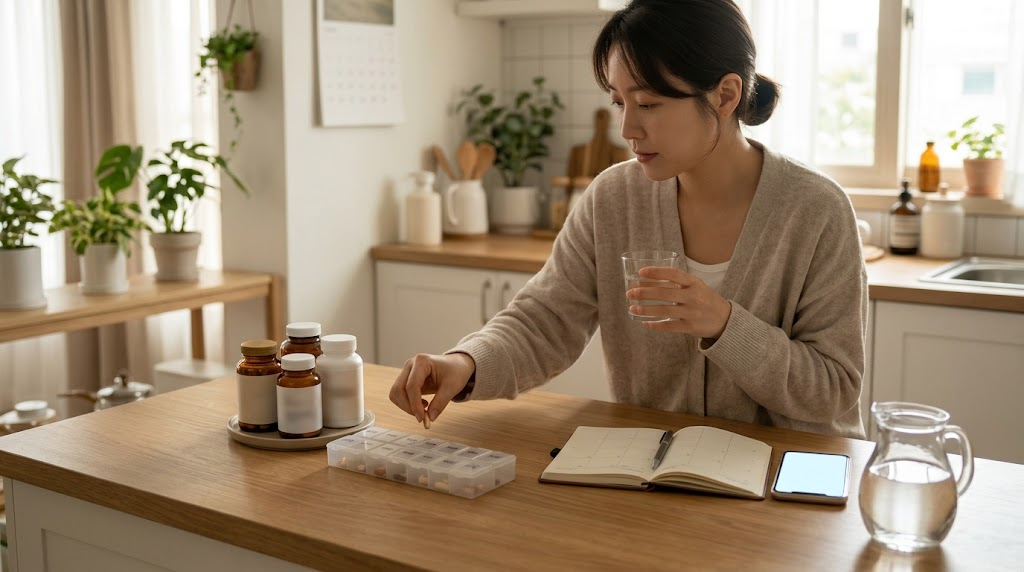
Prologue: Abandoned Supplement Bottles Despite Good Intentions—Why Does It Always Fizzle Out After Three Days?
Whenever our bodies feel heavy or fatigue sets in, anyone might take the plunge and order dietary supplements. Tearing open the shipping box, we make a firm resolution: “This time, I’ll really take them without fail, shake off this tiredness, and regain my vitality.” Yet, just a week later, that determination quietly fades away.
Bottles of supplements sitting half-full with their caps tightly closed in a corner of the dining table or inside a drawer—this is likely a familiar scene. Even though we bought them at a high price, when their expiration dates pass and they ultimately head for the trash can, a feeling of wastefulness settles in alongside an inexplicable sense of self-reproach.
However, is the reason taking supplements repeatedly peters out after three days really due to a “lack of willpower”?
To get straight to the conclusion, that is not the case. Remembering to take supplements during a busy daily routine is an area of sophisticated habit formation that is difficult to sustain simply through the vague resolution of “I’ll take them when I remember.” Amid the morning rush, a flood of work tasks, and drained energy after clocking out, actions that demand extra attention are inevitably the first to be pushed aside.
Unless you establish an environment and routine that naturally prompt your hands to reach for them without relying solely on willpower, failure is only natural. In this post, we will examine the structural reasons why you have struggled to take them consistently and explore how to design your own sustainable supplement routine to practice every day without stress.
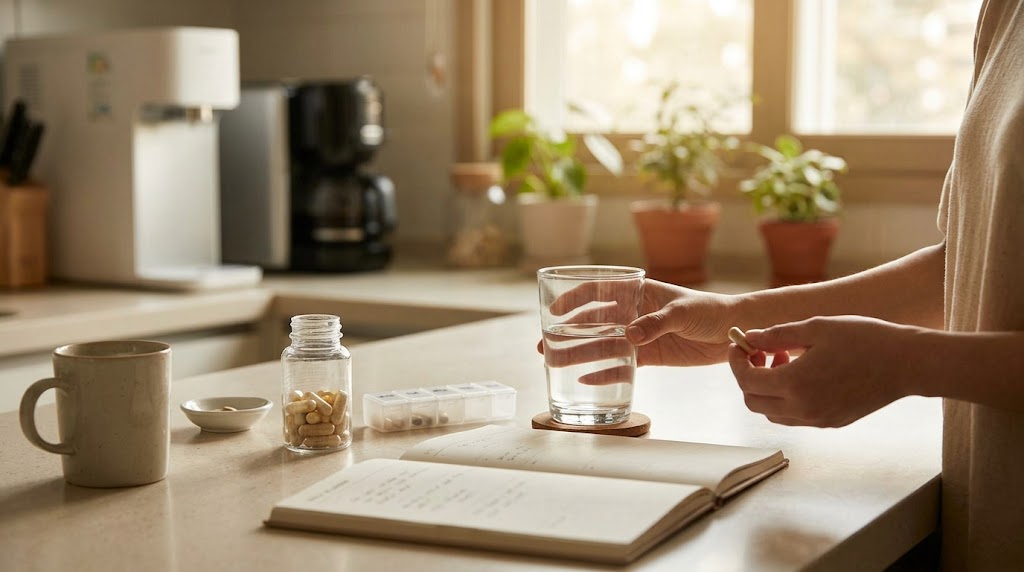
The Key to Reducing Missed Doses: Combining with Existing Daily Routines (Creating a Habit Chain)
The biggest reason people fail to take their supplements or medication is not a “lack of willpower,” but the absence of a “behavioral trigger.” Thinking “I need to remember to take it” every time tires the brain, and in a busy daily life, priorities naturally get pushed back.
The secret to dramatically increasing your success rate is attaching the action of taking them to an existing behavior you already perform unconsciously every day—in other words, creating a “habit chain” (Habit Stacking).
- Connect to an ‘Action’ Instead of a ‘Time’
If you rely on specific times such as “take at 9:00 AM” or “take at 2:00 PM,” your routine breaks the moment you miss that time due to meetings, travel, or deep work focus. On the other hand, when it comes to taking supplements or medication alongside fixed actions that inevitably occur every day, the most common reason for failure is not a “lack of willpower,” but “trying to carve out new time separately.” Establishing a new behavior on its own requires substantial cognitive effort, but attaching it behind a deeply ingrained daily habit allows the brain to perceive it as a natural, single flow. This is the strategy of “habit stacking” in behavioral science—creating a habit chain.
The Basic Formula of a Habit Chain
Right after [an existing routine already repeated every day], connect [the new taking behavior].
Rather than setting an alarm for a specific time, this method uses a fixed, unavoidable daily action as a “trigger.” Alarms are easy to forget once turned off, but actions like your daily coffee or brushing your teeth are hard to skip.
Examples of Combining Daily Routines by Type
- Morning Fasted Routine (Probiotics, Stomach Medication, etc.)
Existing routine: Drinking a glass of lukewarm water after waking up
Chain link: The moment you pour water from the purifier, take the probiotics kept within arm’s reach.
Placement tip: Keep the supplements right next to the water purifier or cup coaster.
- Lunch/Afternoon Energy Routine (Vitamin B Complex, Vitamin C, etc.)
Existing routine: Heading to the coffee machine or grabbing a tumbler after lunch
Chain link: Before brewing coffee or taking the first sip, take your post-lunch supplements.
Placement tip: Keep a pill organizer right under your office computer monitor or next to your tumbler.
- Evening Post-Meal Routine (Omega-3, Vitamin D, Magnesium, etc.)
Existing routine: Running the dishwasher or finishing the dishes after dinner
Chain link: Right after clearing the sink, take supplements out from the first shelf of the upper kitchen cabinet and take them. Since fat-soluble nutrients are absorbed better along with fats in food right after a meal, pairing them with the conclusion of your meal is effective.
- Pre-Bedtime Relaxation Routine (Theanine, Chelated Magnesium, Melatonin, etc.)
Existing routine: Plugging in the smartphone charger before sleeping
Chain link: The moment you plug the charger into the bedside nightstand, take them with the glass of water on the nightstand.
Visual Triggers to Solidify the Habit Chain
For the chain not to break, aligning the ‘movement line of behavior’ with the ‘line of sight’ is essential.
Shortening the movement line: If stored deep inside a cabinet or inside a drawer, it is difficult to combine with the routine. Supplements must be exposed within a physical radius of 30cm where the behavior takes place.
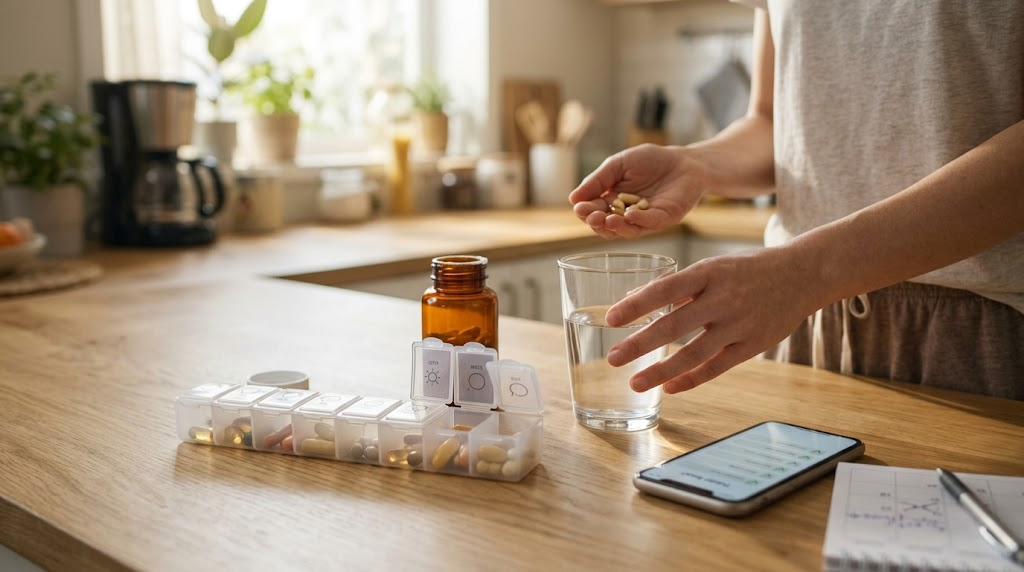
Utilizing pill organizers: By using weekly pill organizers and pre-placing them at the locations where each routine happens—such as the dining table, office desk, and bedside nightstand—the hassle of opening and closing lids and searching for bottles disappears.
Do not force a new habit. Simply slipping the supplement routine onto the chain of behaviors you already perform every day will dramatically increase your success rate.
How to Utilize Visual Triggers: Out of Sight, Out of Mind
The simplest yet most fatal reason for failing to consistently take supplements or medication is that ‘they are out of sight.’ The moment you neatly tuck them away inside a drawer, a deep kitchen cabinet, or a pill storage box, our brain forgets their very existence.
The most powerful stimulus prompting behavior is a ‘visual cue.’ We will look at specific placement strategies to design an environment that catches your eye instead of leaving taking them up to willpower.
- Placement in the ‘Golden Zone’ of Daily Movement Lines
Pill bottles should be placed within a physical radius of 30cm where your gaze stops or your hand invariably reaches during the day.
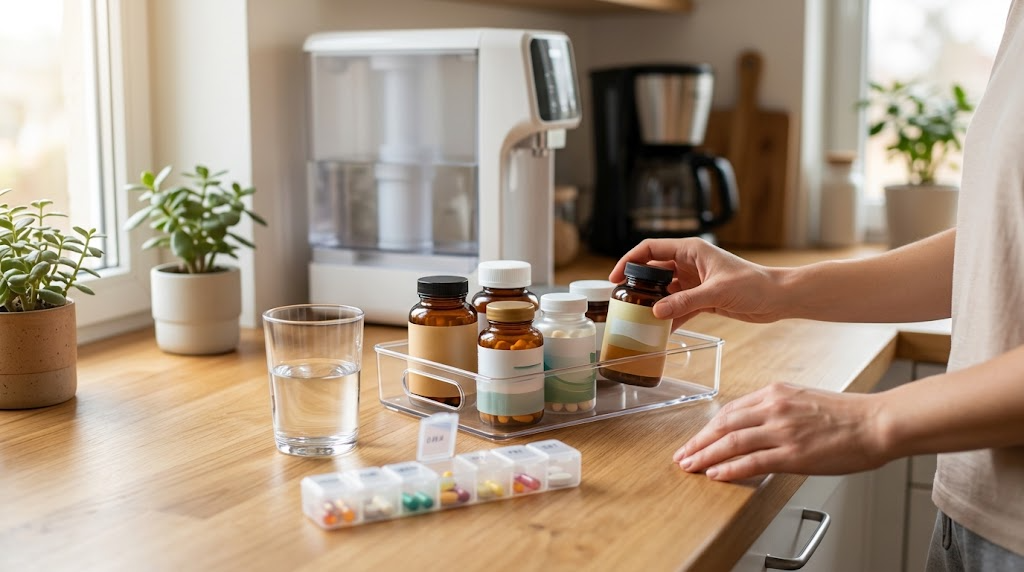
Next to the water purifier or coffee machine: When drinking water or brewing coffee right after waking up in the morning, your gaze falls here, making it the best location to take fasted supplements (such as probiotics).
Center of the dining table: For multivitamins, omega-3, and others that should be taken before or after meals, organizing them on a transparent tray in the middle of the dining table immediately connects visually with the act of eating.
Under the computer monitor stand: For office workers, right under the office desk monitor or next to the keyboard is the optimal golden zone. It immediately reminds you to take them before starting work or after lunch.
Bedside nightstand: Place magnesium or theanine, which should be taken before bed, right next to your phone charger so your hand naturally reaches for them just before falling asleep.
- Put Away Opaque Storage and Utilize ‘Transparent Pill Organizers’
Lining up multiple original brown bottles or large supplement containers makes the space look cluttered, ultimately leading to hiding them inside drawers.
Transparent daily pill organizer: Using a transparent dispenser divided into weekly units allows you to see the number of remaining pills at a glance, fundamentally eliminating the confusion of “Did I take it today or not?”
Simple visual feedback: Merely seeing an open lid or an empty compartment gives the brain a sense of achievement that ‘today’s task is complete’ and increases routine sustainability.
- Adding Intuitive Visual Devices
Notepads or sticker labeling: When taking multiple kinds, writing the intake timing (e.g., ‘morning after meal’, ‘before bed’) in large letters on conspicuous colored label stickers on the caps reduces the cognitive fatigue of choosing.
Pairing with a water glass: Rather than leaving only the pills by themselves, keeping a dedicated cup or tumbler always filled right next to the pill container eliminates the cumbersome step of ‘seeing the pills and going to fetch water.’
The core of visual triggers is not “remembering and taking them out,” but “making yourself take them because they catch your eye as you pass by.” Right now, take out the supplements hidden in your cabinet and move them to the most visible spot along your daily movement line.
To continue writing the next supplement routine post:
Draft subheading for daily sorting and storage tips
Generate SEO titles and outline for blog
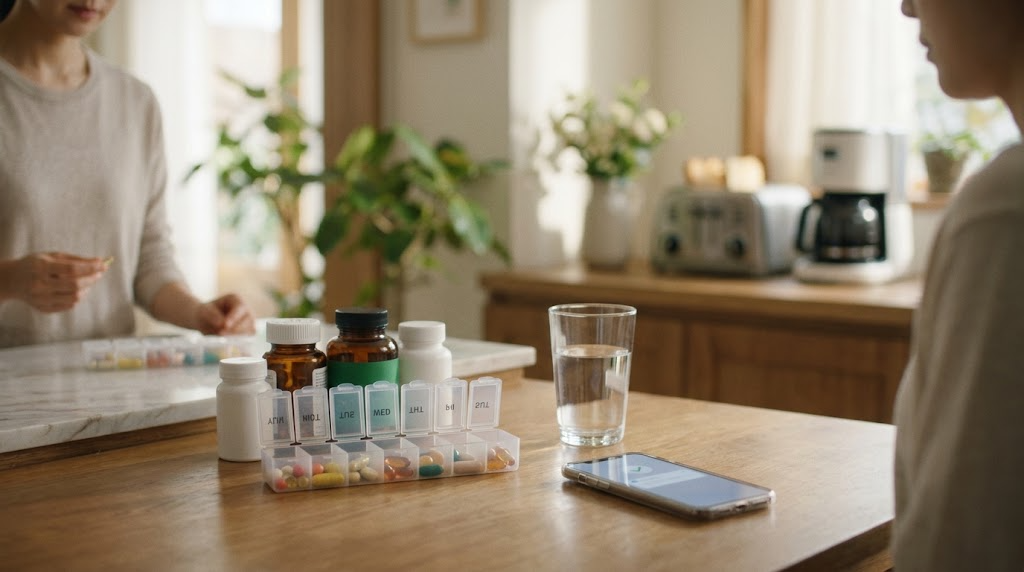
Utilizing Digital Tools to 200%: Setting Smartphone Reminders and Routine Trackers
Even when combining visual triggers with existing daily routines, on days when movement lines are disrupted by going out, business trips, or irregular schedules, the chain of habits can easily break. At such times, the most powerful safety net is a digital system utilizing the smartphone always held in your hand.
Standard alarms that merely sound are prone to being dismissed unconsciously. To maximize the intake success rate, you need to intricately configure the smartphone’s built-in features and dedicated tracker apps.
- Utilizing Built-In Smartphone ‘Health & Reminders’ Apps Instead of Simple Clock Alarms
Simple alarms from a smartphone’s clock app make it difficult to verify whether you completed the task the moment you turn off the alarm, and it is easy to forget while doing other things. Instead, default tools integrated with checklist features are recommended.
iOS ‘Health’ app (Medications): Registering the name, formulation, and dosing schedule of a medication or supplement brings up a reminder at the designated time. The notification remains until you tap ‘Logged,’ and your intake history is recorded to prevent duplicate dosing.
Android ‘Google Keep’ or ‘Samsung Reminders’: You can set not only specific times but also ‘location-based reminders.’ For example, if you set the location to “upon arriving at work” or “upon arriving home,” an alert appears the moment you enter that location, preventing routine lapses.
- Building Visual Accomplishment with Habit Trackers
Gamifying and visualizing your intake behavior stimulates the brain’s reward circuit, providing motivation for long-term consistency.
Maintaining Streaks: Try leaving a checkmark every day using apps such as todo mate, Routine Jeju, or Habit. As consecutive days of achievement accumulate numerically, the psychology of “not wanting to break the streak by missing today” kicks in, rapidly increasing your intake success rate.
Placing Widgets on the Home Screen: Without needing to launch the app directly, display a large medication checklist widget on your smartphone’s home screen or lock screen. Every time you turn on the screen, it serves as an intuitive digital visual trigger.
- Designing ‘Snooze’ Rules to Reduce Alarm Fatigue
If you don’t have water right away or are in a meeting when the alert sounds, establish a rule to always press ‘Snooze’ for 10–15 minute intervals rather than turning off the alarm completely.
Check Off Immediately Upon Completion Principle: Apply a strict rule where you only press the complete button right after actually putting it in your mouth and swallowing it with water, rather than thinking, “I took the pill, so I’ll check it off later.”
Grouping Excessive Notifications: If alarms go off constantly 56 times a day, you end up ignoring the alarms altogether. Bundling the supplements you need to take into 23 sessions a day—such as ‘morning after meal,’ ‘lunch after meal,’ and ‘before bed’—to process them in single notifications is the trick to reducing fatigue.
The essence of digital tools is not to monitor you, but to serve as an external hard drive that relieves the memory burden on your brain even during hectic moments.
To continue drafting the next intake routine article:
Drafting daily pill organizer utilization and storage precautions
Drafting closing conclusion and summary for the entire blog post
Epilogue: Consistency Over Perfection, Completing a Sustainable Intake Routine Tailored to You
Taking supplements or medication, which began with a commitment to take care of one’s health, can at some point feel like stress or homework. Anyone has likely experienced blaming themselves by thinking, “I really can’t stick to anything consistently,” or shoving the pill bottles back deep into a drawer just because they missed taking them a few times.
However, the biggest trap in habit formation is ‘perfectionism.’ Skipping a day or two does not completely ruin all the health care efforts accumulated so far. What matters is not 100% flawless intake, but sustainability that allows you to return at any time, even if things become lax.
- The Rule of ’80 Points a Week’ Rather Than ‘100 Points a Day’
There is no need to be obsessive about the intake cycles or times recommended by experts.
If you forgot the vitamins you were supposed to take after lunch, it is fine to lightly supplement them after dinner; if it is already late at night, rather than forcing yourself to take them, you need the flexibility to coolly let it go and say, “Let’s take them again starting tomorrow morning.”
Even if you take them well for just 5 to 6 days out of the 7 days a week, your body fully enjoys the nutritional benefits. Rather than exhausting yourself trying to do it perfectly, the power to sustain it for months and years—even while allowing a few gaps—is far greater.
- A Routine Is a Process of ‘Experimentation and Adjustment’, Not a Fixed Rule
If the optimal timetable recommended by others does not match your lifestyle patterns, you should boldly adjust your trajectory.
If taking probiotics on an empty stomach in the morning keeps feeling burdensome, try moving them to before lunch; if you frequently miss the vitamins placed on your office desk, try relocating them to a pouch inside your work bag.
Among the methods explored earlier—such as linking to daily routines, visual triggers, and digital reminders—choosing and applying just 1 or 2 tools with the least resistance to your daily life is sufficient. A habit is not forcing yourself into clothes that do not fit your body, but a process of tailoring the clothes to fit your lifestyle.
The act of taking a small pill for your health goes beyond mere nutrient supply; it is the easiest declaration of self-care saying, ‘I will take care of myself today as well.’
Did you forget once today? It is completely fine. Without needing to be perfect, you can simply start again tomorrow morning by placing it lightly with a glass of water in a spot that catches your eye.
Next steps for completing the blog posting:
Recommend 5 Naver Blog SEO titles covering the entire post
Generate prompt for featured body image for posting
Korean version: 한국어로 읽기