
Must-Check Before Card Issuance! Eligible Applicants and Qualification Criteria
When learning new skills or preparing for a certification, the biggest initial concern is often the burden of tuition fees. The Tomorrow Learning Card is a solid government program that supports vocational skills development by providing 3 million to up to 5 million KRW per person in training expenses over a 5-year period from the account opening date.
For those wondering, “Am I eligible for this support?” before applying, here is a clear breakdown of the eligible recipients and exclusion criteria.
- Basic Eligible Group: Open to Almost All Citizens
Currently, the threshold for the Tomorrow Learning Card has been significantly lowered so that most Korean citizens with a willingness to work can apply, regardless of their current employment status.
- Job seekers (unemployed): Young adults preparing for employment, people seeking career transitions, women with career interruptions, etc.
- Employed individuals (workers): Employees at large corporations and SMEs, non-regular workers, dispatched/contracted/daily workers
- Self-employed individuals and special type contract workers: Sole proprietors with a business registration certificate, freelancers, delivery riders, home-study teachers, etc.
- University (and graduate) students: College and graduate students with 2 years or less remaining until graduation (e.g., eligible starting from prospective 3rd-year students in a 4-year degree course)
- Disqualified Groups to Check Carefully
While support is broad, card issuance is restricted for high earners above certain income thresholds or occupations that receive separate public benefits. Check whether you fall into any of the following categories before clicking the apply button.
| Category | Disqualification Criteria |
|---|---|
| Public office and military | Current civil servants, private school faculty and staff, military personnel (active-duty mandatory service members, etc.) |
| High-income large enterprise employees | Workers under age 45 at large enterprises whose monthly wage is 3 million KRW or more |
| High-income special type contract workers | Those whose average monthly income over the past 3 months is 5 million KRW or more |
| High-income self-employed individuals | Real estate leasing businesses and general self-employed individuals with annual sales of 150 million KRW or more over the past year |
| Enrolled students (early academic years) | College and graduate students with more than 2 years remaining until graduation, high school students (excluding prospective graduates) |
| Others | Individuals aged 75 or older, recipients of livelihood benefits subject to certain restriction criteria |
💡 Writing Tip / Check Point
Even workers at large enterprises may be eligible if they are 45 years of age or older, or on parental leave. Since submitting proof of income or enrollment certificates may be required, checking your recent income baseline in advance via NTS Hometax or company withholding tax receipts will facilitate a faster review process.
Accessing Employment24 Portal and Tomorrow Learning Card Issuance Procedures
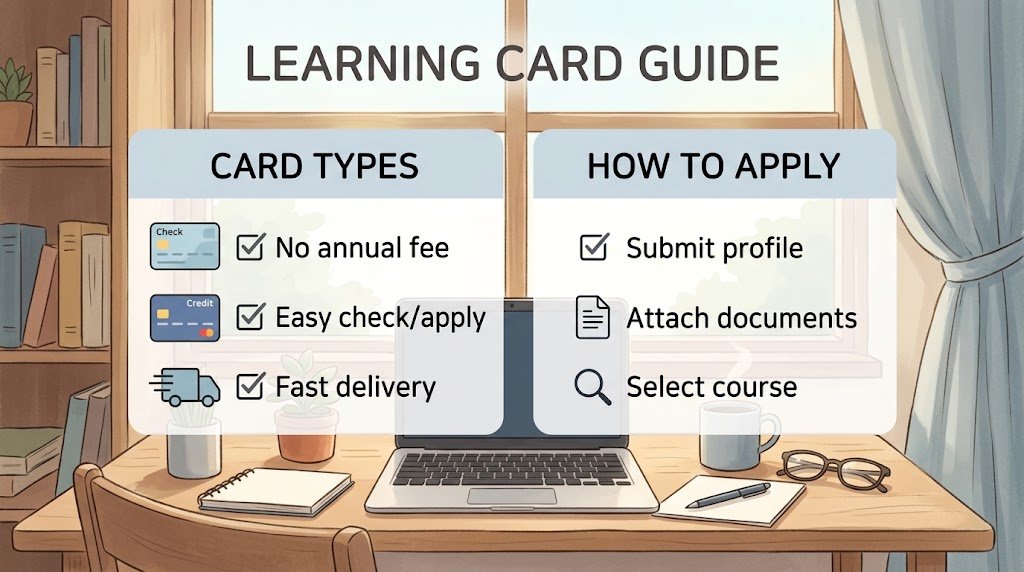
Once you have checked your eligibility, it is time to formally apply for the card. As employment services previously scattered across multiple websites—such as the Vocational Training Portal (HRD-Net) and Worknet—have been integrated into the single ‘Employment24’ portal, the application process has become significantly more intuitive and convenient.
Here are the key steps from application to receiving the physical card, explained in sequential order.
- Accessing Employment24 and Logging in with Simple Authentication
- Access the Employment24 portal (work24.go.kr).
- In addition to joint and financial certificates, you can quickly log in via simple authentication such as KakaoTalk, Naver, Toss, and PASS without installing complicated security software.
- Navigate through the top menu via [Vocational Competency Development] > [Tomorrow Learning Card] > [Card Application].
- Mandatory Steps Before Issuance: Watching the Orientation Video & Worknet Job Search Registration
There are two prerequisite steps before completing the application form.
- Watching the video training (takes approximately 10–15 minutes):
- This is a short video explaining the purpose of using the Tomorrow Learning Card, attendance management standards, penalties for dropouts, and more.
- You must watch the video to the end for the application form button to be activated.
- Job search registration (applicable to the unemployed/job seekers):
- If applying as an unemployed job seeker, completing job search registration (resume registration) within Employment24 beforehand is required for a smooth approval process.
- Completing the Application Form and Tips for Entering the Training Plan
Select your eligible support category (employed worker, unemployed job seeker, self-employed individual, etc.) alongside personal details, then attach the required documents.
- Attaching supporting documents:
- Upload documents verifying your status and income (PDF or image files), such as a certificate of enrollment for university students or a certificate of VAT taxable base for the self-employed.
- Selecting fields of training interest:
- Select the occupation field you wish to study (e.g., IT/software, accounting/taxation, cooking/baking, etc.).
- Note: You can freely take courses in fields other than the selected one once the card is issued, so feel free to choose whichever area you currently desire.
- Selecting the Card Receipt Method (Debit vs. Credit)
The Tomorrow Learning Card is issued as a financial card with actual payment capabilities (Shinhan Card or NH Nonghyup Card).
| Issuance Type | Features and Receiving Method |
|---|---|
| Debit Card | No annual fee; out-of-pocket expenses can be paid within the linked account balance. Mobile simple application or postal delivery recommended |
| Credit Card | Subject to card issuer screening; credit payments possible. Can be linked to benefits based on existing spending records with the corresponding card company |
| Receiving Method | Select between postal delivery (home/workplace) or direct in-person pickup at a designated bank branch |
💡 Issuance Processing Time and Tips
After completing the online application, review by the competent employment center typically takes 3 to 7 business days. As it takes an additional 2 to 3 days for the physical card to arrive by mail after receiving the approval notification talk (SMS), it is recommended to apply at least 1 to 2 weeks before the start date of the academy course you wish to attend.

Fail-Safe Know-How for Finding Tailored Academies and Training Courses
Once you have successfully received your card, you are now at the most important step: ‘finding the training course and academy that are the perfect fit for you.’ Because tens of thousands of government-subsidized courses are registered on the Employment24 portal, choosing one through indiscriminate searching is not easy.
Here is a summary of the 3-step core search strategy to prevent wasting time and government subsidies, tailored to your desired goals (obtaining certifications, enhancing practical skills, employment, etc.).
- Narrowing Down the Search Scope with 3-Stage Filtering
Applying precise filter settings in the [Vocational Competency Development] > [Search and Apply for Training Courses] menu on the Employment24 main screen is the first step.
- Setting Location and Commuting Distance:
- Since the attendance rate (at least 80% or higher) determines course completion and subsidy deductions for in-person classes, narrow down the region to municipal district units that are easy to travel back and forth from home or work via public transportation.
- Filtering Weekend / Night Classes (Essential for Employed Workers):
- Weekday daytime courses are mostly full-time (6–8 hours a day) bootcamps aimed at job seekers. If you are an employed worker or freelancer, check the ‘Weekend’, ‘Night’, and ‘Short-term’ filters to prevent schedule conflicts.
- Actively Utilizing Online (Remote) Courses:
- If commuting is difficult or you want to review basic concepts quickly, select ‘Internet Remote Training’. In particular, K-Digital Credit courses that cover basic IT or coding skills are very useful because a separate additional subsidy limit (500,000 KRW) is often provided.
- How to Check Verified Indicators Instead of Advertisements: Course Reviews and Employment Rates
Data from actual graduates is the most honest indicator compared to promotional copy displayed on the portal. Be sure to check the following 3 items on the training course details page.
| Item to Check | Check Point |
|---|---|
| Satisfaction and Course Reviews | Star ratings and subjective reviews left by actual students. Allows an unvarnished assessment of instructor teaching ability, practice environment, textbook quality, and administrative support responsiveness |
| Completion Rate & Employment Rate | An excessively low completion rate signals curriculum difficulty adjustment failure or a large number of dropouts. If the goal is employment linkage, checking the average employment rate of the course over the past 3 years is essential |
| Training Institution Certification Grade | Check whether it is an excellent training institution (3-year to 5-year certification mark) designated by the Korea Institute for Technical and Vocational Training Assessment. The more publicly verified an institution’s facility management and training outcomes are, the more stable its operating system |
- Know-How for Comparing Curriculum, Equipment, and Practice Environments
Even for the same certification (e.g., Computer Specialist in Spreadsheet & Database, computerized tax accounting, barista, video editing), software versions covered or hands-on practice proportions differ by academy.
- Checking NCS (National Competency Standards) Levels:
- Checking the NCS level stated in the curriculum table allows an objective assessment of whether it is an introductory foundational course or an in-depth practical project-oriented course.
- Availability of Practice Software and Textbook Support:
- For graphics, video, and coding courses, check the computer lab PC specifications and software license provision, and review detailed notices to see whether textbook or material fees are charged separately outside the tuition fee.
- Prior Phone Consultation or Visit:
- Before pressing the course application button, calling the academy’s administrative office to inquire in advance about whether the course opening is definitively confirmed (risk of cancellation if minimum enrollment is not met) and class placement criteria can prevent schedule disruptions.
💡 Search Tips
Check the ‘View only courses from excellent training institutions’ option in the Employment24 advanced search window, and try setting the sorting criteria to ‘Highest satisfaction’ or ‘Highest employment rate’. This significantly reduces unnecessary search time while lowering the probability of failure.
Self-Pay Expense Calculation and Practical Course Enrollment Guide
Receiving the Tomorrow Learning Card does not mean that all courses are 100% free. To increase participants’ sense of responsibility and completion rates, the government implements a self-pay expense (trainee out-of-pocket cost) system based on employment rates by occupation and income types.
For those confused about “How much do I actually need to pay?”, here is a summary of the self-pay ratio calculation methods by occupation, preferential support recipients, and the practical course enrollment steps on Employment24.
- Calculation Principles of Training Self-Pay Expenses and Rates by Occupation
Within the basic support limit of the Tomorrow Learning Card (3 million to 5 million KRW), the government subsidy ratio varies according to the average employment rate of each occupation. Promising occupations with higher employment rates receive higher government support rates and lower self-pay ratios.
- General Occupation Self-Pay Ratio Standards (15% to 55%):
- Occupations with an employment rate of 70% or higher: Self-pay ratio of approx. 15% (85% government support)
- Occupations with an employment rate of 60% to under 70%: Self-pay ratio of approx. 20%
- Occupations with an employment rate of 50% to under 60%: Self-pay ratio of approx. 45%
- Occupations with an employment rate under 50%: Self-pay ratio of approx. 55%
- Specialized Courses with 0 KRW Self-Pay (Fully Free):
- K-Digital Training (KDT): Intensive training courses in new digital technologies such as AI, big data, and cloud provide full government support (0 KRW self-pay) once, along with monthly training incentives.
- National Key and Strategic Industry Occupation Training: National key industry fields such as machinery, welding, and electricity can also be taken completely free of charge.
- Preferential Support Recipients Significantly Reducing Self-Pay Expenses
If you belong to a specific vulnerable group or support program beneficiary, you can receive additional reductions from the basic self-pay ratio.
| Target Category | Self-Pay Reduction and Benefit Requirements |
|---|---|
| National Employment Support Program Type I | Exemption from self-pay (100% support) or minimal burden |
| National Employment Support Program Type II (Specific Groups/Youth) | Additional reduction in self-pay ratio compared to standard criteria (10%p to 20%p reduction) |
| Earned Income Tax Credit (EITC) Recipients | 50% reduction of standard self-pay ratio (applied upon submitting proof of income) |
| Maternity/Parental Leave Takers and Small-Scale Sole Proprietors | Eligible for partial self-pay ratio reduction |
💡 How to Check:
Clicking the [View Out-of-Pocket Cost] button on an individual training course details page on the Employment24 portal allows you to immediately simulate the actual payment amount by selecting your type, such as ‘General Job Seeker’, ‘Employed Worker’, ‘EITC Recipient’, or ‘Employment Support Program Participant’.
- 3-Step Procedure for Employment24 Online Course Enrollment
Once you have selected a preferred course and verified your out-of-pocket cost, proceed with the course application following the steps below.
- Online Course Enrollment (Based on Training Hours):
- Long-term courses of 140 hours or more: Diagnosis and consultation (online or in-person) with the Employment Center are required, and registration is possible after consultation approval.
- Short-term courses under 140 hours: Direct online application is possible immediately on the Employment24 portal without Employment Center consultation.
- Academy (Training Institution) Prior Confirmation and Selection Interview:
- Once the online application is received, the corresponding academy contacts you individually.
- Popular IT bootcamps or certification preparation classes select final trainees through basic tests or preliminary interviews.
- Payment of Self-Pay Expenses with the Physical Tomorrow Learning Card:
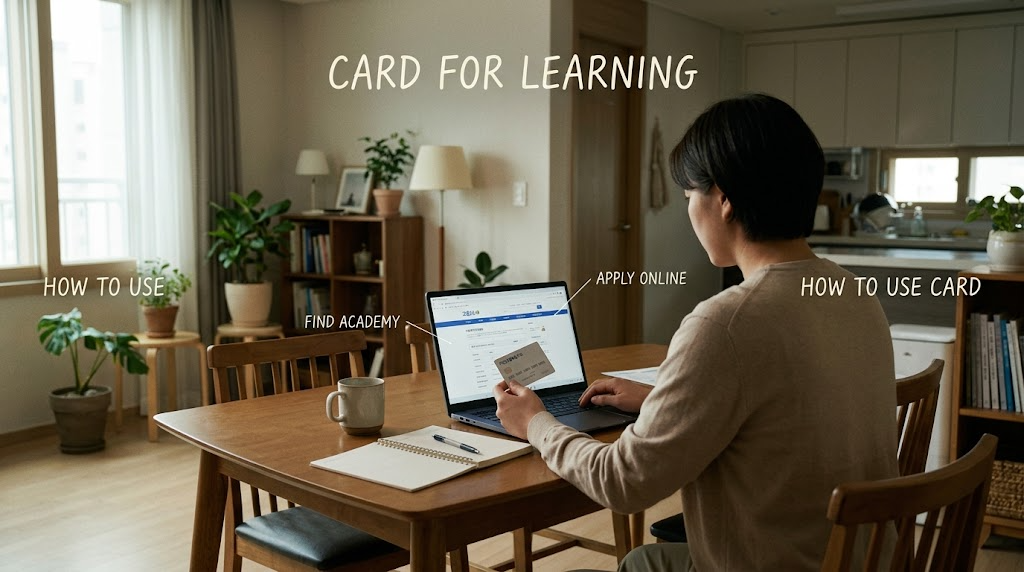
- Once selection is confirmed, final registration is completed only when you pay the self-pay amount directly with the Tomorrow Learning Card (debit/credit) via an on-site visit or an online payment portal according to the academy’s instructions. (Government subsidy cannot be applied if paying with regular third-party cards)

Must-Know Course Precautions and Penalty Prevention Methods
As the Tomorrow Learning Card is funded by precious government budget, attendance standards and course completion are managed strictly. Failing to complete a course faithfully, dropping out midway, or falling short of attendance rates can result in disadvantages such as support limit deductions and future card usage restrictions.
To fully enjoy the hard-earned government subsidy benefits, here is a summary of the core attendance standards and penalty prevention tips that must be kept in mind.
- The Absolute Standard for Completion: The 80% Attendance Rate Rule
The completion requirement for all Tomorrow Learning Card training courses is an actual attendance rate of 80% or higher.
- Attendance Check Methods:
- Offline academies: Attendance is recognized only by authenticating directly via tagging the physical Tomorrow Learning Card or using the Employment24 mobile app (QR code/beacon) upon entry and exit. (Treated as an absence in cases of proxy attendance or missed tags)
- Online (remote) lectures: Achieving a progress rate of 80% or higher for each session and meeting standard passing scores on mandatory evaluations (progress step evaluations, final evaluations, assignment submissions) are required.
- Accumulation Standards for Tardiness, Early Departure, and Going Out:
- Tardiness, early departure, and going out are treated as 1 day of absence when accumulated 3 times. Particular care must be taken regarding commuting time and personal schedule management.
- Penalties Incurred Upon Midway Dropout and Expulsion
If you drop out midway due to a simple change of mind or personal reasons, or are expelled due to insufficient attendance, phased disadvantages will occur.
| Number of Violations | Support Limit Deduction Amount | Account Usage Suspension (Course Restriction) |
|---|---|---|
| 1st Violation | 200,000 KRW deducted from card balance | No separate course restriction (applications for other courses possible within remaining balance) |
| 2nd Violation | 500,000 KRW deducted from card balance | Card usage suspended for 60 days from the end date of the corresponding course |
| 3rd or More Violations | 1,000,000 KRW deducted from card balance | Card usage suspended for 180 days from the end date of the corresponding course |
⚠️ Caution:
Even if the deduction amount exceeds the remaining limit on the card, it is processed as a negative balance, and the deduction history carries over to future additional support or re-issuance.
- Recognized Exception Reasons Relieved Without Penalty
If attendance is difficult or the course must be discontinued due to unavoidable circumstances, supporting documents must be prepared immediately before taking unexcused absences.
- Excused Absence (Official Attendance Recognition) Reasons:
- Illness or injury of oneself or immediate family members (verified by hospitalization certificates or medical diagnosis certificates)
- Family events such as one’s own marriage, spouse’s childbirth, or death of an immediate family member
- Reserve forces/civil defense training, natural disasters, official exams on public duty, etc.
- Midway Dropout Penalty Exemption Criteria:
- Cases where attending the academy is no longer possible due to early employment or business startup (penalty fully waived upon submission of employment certificate or 4 major social insurances enrollment certificate)
- Cases where continuing studies is impossible due to pregnancy, childbirth, military enlistment, or illnesses requiring long-term treatment
- 3 Practical Tips for Successful Completion
- Avoid Overly Dense Scheduling: If you unreasonably enroll in a 5-day-a-week night/weekend course without considering your current workplace workload or personal schedule, it is easy to fail attendance management due to physical fatigue.
- Make Tagging Entry/Exit a Daily Habit: Even if you tapped your entry card and attended the entire class, forgetting to tag upon exit can result in an absence for that day, so setting an alarm for exit time is safe.
- Communicate Constantly with the Academy Administrative Office: On days when absence is unavoidable, notify the academy administrative manager in advance and check the necessary official excused absence documentation forms beforehand.
Korean version: 한국어로 읽기