
Waste Disposal Company Selection: Why Are Careful Comparison and Verification Essential?
When cleaning up a house or office, there are many times when you feel overwhelmed by the pouring trash and waste that are hard to handle. There are not a few cases of suffering misfortune after carelessly choosing and entrusting any company just to solve it easily. Selecting a waste disposal company is an important issue directly tied to legal responsibility and safety, going beyond simply paying money to clear things out. We highlight the core reasons why careful comparison and thorough verification are essential during the company selection process.
- Preventing illegal dumping and damage from passing on disposal costs
The biggest risk that occurs when entrusting waste to unlicensed small-scale companies or some bad companies that do not go through official procedures is ‘illegal dumping’.
Risk of fines and legal responsibilities: If discharged waste is illegally dumped in secluded places, responsibility can in principle return to the initial generator (owner), leading to unexpected legal disputes or fine bombs.
Additional fee bombs: Thorough verification is essential even to prevent damage from unscrupulous companies that lure you with cheap costs at first, but then make excuses on-site after loading luggage saying “the amount has increased” or “it is special waste” and demand absurd additional fees.
- The necessity of specialized processing tailored to homes, moves, and demolition sites
Waste disposal methods and regulations completely differ depending on its type and nature.
Compliance with emission regulations by item: From general household waste to large furniture, home appliances, and large amounts of waste coming out during interior remodeling or moving processes, proper disposal locations and procedures are designated for each.
Safe and speedy work: You must select a company equipped with skilled professional personnel and dedicated equipment (ladder trucks, 1-ton trucks, etc.) to quickly clear the site without building damage or safety accidents.
- Securing peace of mind through a legal and transparent process
Using a formally licensed company is the surest way to be guaranteed a transparent and safe conclusion.
Subscription to liability insurance: When a breakage accident occurs while moving heavy furniture during work—such as torn wallpaper or dented flooring—only a company officially subscribed to insurance can properly receive compensation.
Accurate transfer and disposal: It greatly reduces mental stress since you can trust and leave it to ensure waste is safely and finally disposed of in accordance with regulations.
💡 Please note!
When choosing a waste disposal company, it is wiser to examine “whether they received official permission from the jurisdiction’s local government and whether contract conditions are transparent” rather than looking for “the cheapest place.” Thorough prior comparison and verification are the shortcut to protecting your precious money and completing clean organization without stress.
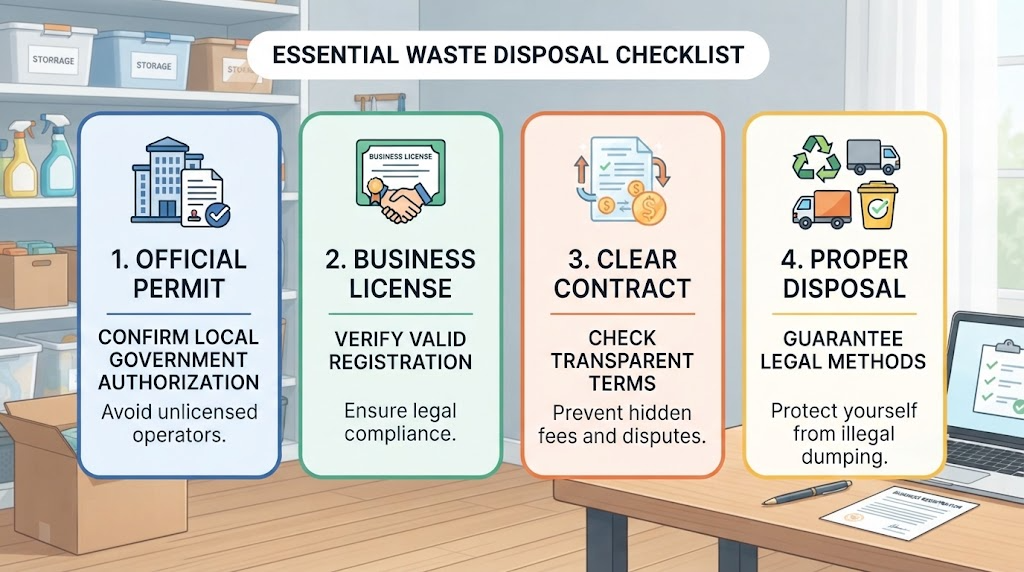
4 Core Conditions You Must Check When Choosing a Company
If you make a decision based only on cost or distance when selecting a waste disposal company, you may suffer unexpected damage such as involvement in illegal dumping or additional fee bombs. To dispose of waste safely and legally, we highlight 4 core conditions you must check when choosing a company.
- Checking for ‘official permission’ from the jurisdiction’s local government and business registration
The absolute standard that must be checked first is whether the company is a formally licensed company equipped with legitimate qualifications.
Prevention of illegal dumping: In the case of unlicensed small-scale companies, there are instances where collected waste is illegally dumped in secluded places, and the damage returns to the initial generator (owner).
Official business verification: You must request and check the business registration certificate and license before signing a contract to see if normal business registration has been made through the National Tax Service Hometax, etc., and if it is a company that has properly acquired a waste collection and transportation business license from the jurisdictional local government.
- Checking suitability of collection items and processing capabilities
Since disposal methods and regulations completely differ depending on the type of waste, you must examine whether they are equipped with specialized processing capabilities suited to the nature of your house’s luggage.
Classification by item: You must check whether the company can process the items you intend to discharge without problems, such as general household waste, large furniture, home appliances, and interior demolition waste.
Special waste processing capability: If special waste rather than general trash or large amounts of building materials are included, you must coordinate in advance whether it is a place where matching equipment (ladder trucks, 1-ton trucks, etc.) and personnel can be deployed.
- Transparent cost calculation and measures to prevent additional fees
You must screen out unscrupulous companies that lure you with cheap amounts at the staging stage and then demand absurd additional money on-site.
Detailed visiting or untact estimates: To accurately grasp the amount of luggage and cargo volume, places that conduct untact estimates through photos or videos or visiting estimates are safe.
Specification of estimate inclusion details: You must clearly state in the contract or text message whether the total estimate cost includes large waste sticker fees, ladder truck usage fees, labor costs, and value-added tax (VAT), or which items are billed separately.
- Checking for subscription to ‘Liability Insurance’ for accident compensation
This is whether safety devices are prepared to prepare for potential accidents or property damage that may occur during the work process.
Property damage compensation: Accidents can occur during the process of lowering heavy furniture or home appliances with a ladder truck or moving them, such as scratches or breakages on wallpaper, flooring, or elevators.
Checking insurance subscription: Since only companies officially subscribed to liability insurance can smoothly receive damage compensation in the event of an accident, it is wise to check whether insurance subscription is proven before signing a contract.

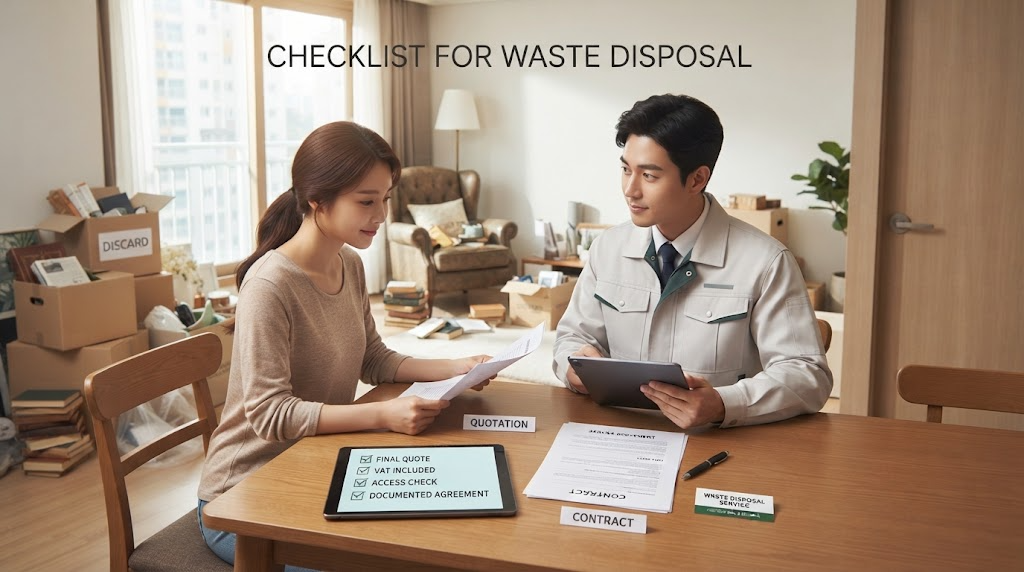
Contract and Cost Review Tips to Prevent Estimate Bombs and Additional Fees
One of the most anxious things when using a house organization service is the ‘additional fee’ problem where the amount differs when receiving the estimate and when the work is actually finished. To prevent unnecessary spending and use services at reasonable costs, we highlight contract and cost review tips to prevent estimate bombs and additional fees.
- Asking in detail about ‘conditions for incurring additional fees’ during preliminary estimates
When comparing estimates, rather than blindly chasing only the cheap total amount, you must carefully examine exception clauses on under what situations additional fees are attached.
Preparing for increased luggage amounts: You must check in advance how much additional labor costs or truck costs occur if there is actually more luggage at the site than notified during consultation to prevent panicking on-site.
Checking special environments: You must be notified in advance if there are additional costs arising due to the specificity of the work environment, such as high floors without elevators or structures where ladder truck entry is impossible.
- Checking whether Value-Added Tax (VAT) and incidental costs are included
You must make it clear whether the amount written on the estimate is the final amount or if separate taxes or incidental costs are added.
Presence of separate VAT: Sometimes VAT is omitted from the quoted amount, leading to extra costs when paying by card or issuing a cash receipt on-site. Be sure to check whether it is “the final amount including VAT.”
Incidental supply costs: It is safe to check in advance whether auxiliary material costs used on-site, such as trash bag prices or storage baskets, are included in the estimate or billed separately.
- Leaving conditions in writing (contract or text message) instead of verbal promises
Verbal promises made with the person in charge on-site carry a high risk of being overturned on the day of work. All agreements must be documented.
Specification of final estimate confirmation: Specify or receive confirmation in the contract or text message that “this is the final estimate where no additional personnel input or additional fees occur on-site.”
Concrete specification of work scope: Recording the number of personnel input, work start and end times, and large waste disposal scope in detail can prevent unnecessary friction.
- Utilizing waste disposal agency costs and separate discharge
If you unilaterally entrust all waste disposal to a company, disposal agency costs can swell like a snowball.
Cost reduction through preliminary discharge: Empty large home appliances in advance using the waste home appliance free visiting collection service, and directly separately discharge small trash and recyclables or utilize neighborhood sharing.
Coordination of waste disposal scope: Since the proportion of waste disposal agency costs in the company’s estimate is large, you can greatly save costs by coordinating the estimate excluding parts you can handle yourself.
💡 Please note!
The surest way to avoid estimate bombs is “nailing down all conditions and the final amount in a contract or text message.” Complete a wise house organization without additional costs through meticulous preliminary coordination and transparent contract review!
If you need content written for the next subheading, ‘On-site Inspection and Final Settlement Tips’, please feel free to tell me anytime!

Reliability Verification Tips Responsible for Accident Compensation and Post-Finishing
When selecting a waste disposal company or house organization company, a part that must be examined as importantly as cost is reliability and safety devices after work completion. Even if you finish work at no matter how cheap a cost, if items are broken during work or the finishing is a mess, you end up receiving even greater stress. We highlight reliability verification tips responsible for accident compensation and post-finishing.
- Checking ‘Liability Insurance’ to prepare for breakage accidents during work
The process of moving heavy furniture or home appliances or moving them with a ladder truck always carries the risk of minor accidents.
Whether property damage compensation exists: During ladder truck work, damages can occur such as torn wallpaper, dented living room flooring, or scratches on high-priced home appliances or furniture.
Verification of official insurance subscription: Small unlicensed companies often evade responsibility or cut off contact when an accident occurs. You must check whether the company is officially subscribed to ‘liability insurance’ to safely receive compensation when future disputes arise.
- Issuance of a legal and transparent waste disposal confirmation (manifest)
The procedure to check whether waste was properly disposed of after being collected is also an important standard determining reliability.
Legal final disposal: Look into whether the company is one that manages whether collected waste is disposed of without illegal dumping through legal procedures such as authorized landfills or incinerators.
Checking disposal proof: For large business sites or special waste, it is safe to choose a place equipped with the capability to transparently provide waste disposal manifests or evidentiary documents in accordance with relevant laws and regulations.
- Thorough on-site inspection and final settlement tips
When company staff try to withdraw saying “it’s finished,” meticulous inspection is absolutely necessary before paying the full cost right away.
Checking status by space: Open and check directly whether the storage and organization of each space—such as the kitchen, living room, dress room, etc.—were conveniently completed as initially requested.
Final check for breakage: It is the rule to settle the remaining balance after finishing a final check with the team leader for any damaged areas on wallpaper, flooring, home appliances, etc.
- Examining A/S and after-management regulations after work
Even if it looks neat right after organization finishes, there are cases where traffic flows become inconvenient or things return to their original state just a few days later.
Free A/S period support: Check the terms to see if they support feedback or revisit A/S if storage is inconvenient or modification is needed within a certain period after work completion.
Clarifying the scope of finishing cleaning: If you agree in advance on how far post-cleanup includes—such as final floor cleaning and designation of trash sorting locations beyond simple storage—you can prevent friction.
💡 Please note!
The core of choosing a reliable company is examining “whether safety devices (liability insurance, A/S regulations) that do not evade responsibility when problems arise are certain.” Complete your organization comfortably and neatly through thorough preliminary verification!
Korean version: 한국어로 읽기