
Long-Term Care Insurance Application Eligibility and Target Verification
Long-Term Care Insurance for the Elderly is a social insurance system that provides long-term care benefits, such as physical activity support or housekeeping assistance, to senior citizens who have difficulty carrying out daily life activities on their own due to advanced age or geriatric diseases.
Before adult children or family members proceed with a proxy application, they must first verify whether the parents meet the statutory application eligibility criteria to reduce unnecessary document rejections or administrative errors.
Basic Eligibility Requirements (Health Insurance Enrollment Criteria)
Applicants must basically fall under one of the following:
- National Health Insurance subscribers or their dependents
- Medical Aid recipients (including National Basic Living Security recipients and the near-poverty group)
Note: Overseas Koreans or foreigners residing in Korea are also included in the application target if they have completed alien registration and are enrolled in National Health Insurance.
Target Criteria by Age and Health Status
Under the Long-Term Care Insurance Act for the Elderly, applicants are categorized based on the age of 65.
- Seniors Aged 65 or Older
- Standard: Those aged 65 or older who have significant difficulty moving around or are deemed unable to perform daily life activities on their own for at least 6 months due to conditions such as dementia, regardless of the type of disease.
- Application Examples: There are no restrictions on the underlying disease, such as stroke, arthritis, chronic disease sequelae, or weakness due to senility.
- Persons Under Age 65
- Standard: For individuals under age 65, limited mobility alone is not sufficient to apply; they must be diagnosed with a geriatric disease designated by Presidential Decree.
- Major Recognized Geriatric Disease Groups:
- Dementia: Dementia in Alzheimer’s disease, vascular dementia, other dementias, etc.
- Cerebrovascular disease: Cerebral infarction, cerebral hemorrhage, subarachnoid hemorrhage, sequelae of cerebral infarction, etc.
- Parkinson’s disease and related diseases: Parkinson’s disease, secondary parkinsonism, other degenerative diseases of the basal ganglia, etc.
- Precautions: When applying for someone under age 65, it is essential to check in advance whether the disease classification code (KCD code) on the medical diagnosis or physician’s statement falls within the scope of designated geriatric diseases by the Service.
Self-Diagnosis Table for Application Eligibility
| Classification | Aged 65 or Older | Under Age 65 |
|---|---|---|
| Core Criteria | Inability to perform daily life activities independently (lasting 6 months or longer) | Diagnosis of geriatric disease + Inability to perform daily life activities independently |
| Disease Type | No restriction (general illness, trauma, senility, etc.) | Limited to geriatric diseases (dementia, cerebrovascular disease, Parkinson’s, etc.) |
| Supporting Documents | Application for Long-Term Care Recognition + Physician’s Statement | Application for Long-Term Care Recognition + Physician’s Statement (geriatric disease indicated) |
| Determination Core | Evaluation of physical and cognitive function decline | Confirmation of geriatric disease and evaluation of functional decline |
Pre-Application Self-Diagnosis Checklist
If you meet 3 or more of the following items, you may actively consider applying for long-term care recognition.
- [ ] Help from others is required for personal hygiene management, such as changing clothes, washing the face, brushing teeth, or bathing.
- [ ] Support is definitely needed when walking from the room to the living room or getting out of bed.
- [ ] Has experienced a fall within the last 6 months or is at an extremely high risk of falling.
- [ ] Symptoms of cognitive decline have become frequent, such as leaving the gas stove on and forgetting it, or getting lost.
- [ ] Unable to control urination or defecation independently, or has difficulty managing toileting cleanup alone.
- [ ] Assistance is needed in preparing meals or holding a spoon to eat independently.
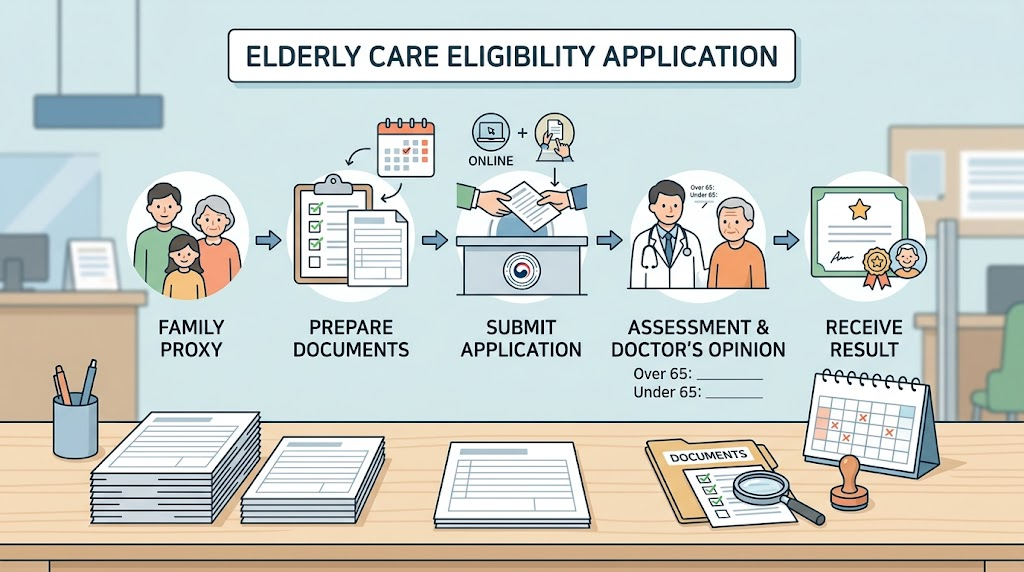
Complete Summary of Required Documents for Family Proxy Application
When adult children or family members apply on behalf of parents with limited mobility, ‘official documents proving proxy eligibility’ must be added to the ‘applicant’s own application documents.’ If even one document is omitted, the grade determination schedule may be delayed by 1 to 2 weeks or more due to requests for supplementation, so it must be thoroughly checked in advance.
List of Required Documents for Family Proxy Application
| Classification | Submitted Document | Issuing Authority & Preparation Method | Remarks |
|---|---|---|---|
| Application Form | Application for Long-Term Care Recognition | National Health Insurance Service website or local branch | Attached Form No. 1-2 |
| Proof of Identity | Copy of the applicant’s (senior’s) ID | Resident registration card, driver’s license, passport, etc. | Front copy or clear photo image |
| Proof of Proxy | Copy of proxy’s ID | ID of the family member applying as a proxy | Bring original when applying in person |
| Proof of Relationship | Family Relationship Certificate or Resident Registration Certificate | Government24 online issuance, Community Service Center | For verifying the relationship between the senior and the proxy |
| Medical Document | Physician’s Statement | Hospital/clinic doctor, Korean medicine doctor | Can be submitted after receiving notice from the Service |
Detailed Preparation Guide and Key Checkpoints by Document
1
Completing the Application for Long-Term Care Recognition
Accurately enter the proxy section’s signature and contact number to receive calls from the Service
Download the form from the Form Archive of the National Health Insurance Service Long-Term Care Insurance website, or use the form provided at the branch civil service office.
- Applicant section: Fill in the personal details of the parent who will receive care (name, resident registration number, actual residence address, phone number).
- Proxy section: Enter the personal details of the family member applying on their behalf and their relationship to the applicant (child, spouse, etc.), then sign or seal. Since the Service calls the proxy’s mobile phone to arrange the on-site survey, entering accurate contact details is critical.
2
Issuance of Family Relationship Verification Documents
The resident registration number must be issued with all rear digits fully disclosed
Prepare supporting documents to legally verify that the proxy is a family member.
- Co-residing family: If registered in the same household on the resident register with the parent, 1 copy of the Resident Registration Certificate can substitute for it.
- Children living separately: If households are separated on the resident register, 1 copy of the Family Relationship Certificate (Detailed) issued under the parent’s name must be obtained.
- Issuance Tip: It can be issued immediately online with zero fee through Government24 or the Supreme Court Electronic Family Relationship Registration System.
3
Preparing Copies of ID Cards
Be sure to bring the proxy’s original ID card when applying in person
Identity verification is required for both the senior and the proxy applicant.
- Prepare a copy of the front side of the parent’s resident registration card or driver’s license.
- When applying online, you can upload a mobile phone photo file (at a legible resolution); when applying via fax, check the contrast carefully before transmitting.
4
Checking the Submission Timing of the Physician’s Statement
For those aged 65 or older, obtaining it after receiving notice from the Service is recommended rather than in advance
The physician’s statement is a core document medically proving the applicant’s physical and cognitive status. The preparation timing varies depending on age.
- Aged 65 or older: Submit the recognition application first, and once the Service employee’s visit survey is completed, the Service will issue a Request for Submission (Submission Notice). Visit a hospital to obtain and submit it within the designated deadline.
- Under age 65: When filing the application, a physician’s statement explicitly stating a designated geriatric disease (dementia, cerebrovascular disease, etc.) must be submitted simultaneously to complete the filing.
Additional Verification Documents by Proxy Eligibility Type
- Direct family/relatives (children, spouse, siblings, etc.): Can apply with a Family Relationship Certificate and a copy of the ID card.
- Legal representatives (adult guardians, etc.): Submit 1 additional copy of the Certificate of Guardian Registration Matters (Full) or court judgment.
- Social welfare public officials: Must prepare a written consent from the senior and an official document verifying identification.

3 Ways for Family Proxy Application (Online, In-Person, Fax)
Depending on your situation and preferred method, you can choose a convenient channel among online, visiting a local branch, or fax for submitting a long-term care insurance proxy application. Here is a summary of the application route for each method and practical tips to pass at once without document omission.
Application Methods at a Glance
| Application Category | Primary Target | Required Items | Processing Speed and Convenience |
|---|---|---|---|
| Online Application | Guardians comfortable using a PC or smartphone | Proxy’s Joint Certificate or Simple Authentication, document image files | Available 24/7 all year round, most convenient |
| Branch Visit Application | Guardians who want document review and consultation at the same time | Original application form, original ID, Family Relationship Certificate | Immediate on-site document review, requires travel time |
| Fax (FAX) Application | Guardians who find it difficult to visit a branch and have printing access | Completed application form, copies of all supporting documents | Must confirm receipt by phone after transmission |
Method 1. Online Application (Website and Mobile App)
This is the most recommended method, allowing you to attach documents as files and submit immediately regardless of time and place.
- National Health Insurance Service Long-Term Care Insurance Website (PC)
- Access route: Log in to the NHIS website → Civil Complaints & Consultations / Applications → Long-Term Care Insurance → Long-Term Care Recognition Application
- Log in using the proxy’s own authentication (Simple Authentication or Joint Certificate).
- Enter the applicant information (senior’s personal details, actual residence) and proxy relationship in order.
- Upload the parent’s ID copy and Family Relationship Certificate files, then submit.
- The Health Insurance Mobile App (Smartphone)
- Open the app and log in → From the menu, select Civil Complaints Here → Long-Term Care → Long-Term Care Recognition Application.
- You can photograph ID cards and supporting documents directly with your smartphone camera and attach them immediately, which is useful when a scanner is not available.
Online Application Tip: The actual residence address must be accurately entered so that the competent NHIS branch is automatically assigned based on the senior’s residence, speeding up the on-site visit survey.
Method 2. In-Person Application at a National Health Insurance Service Branch
If internet filing is difficult or you need consultation and verification from Service staff during document preparation, visiting the civil service office of the competent branch in person is the most reliable option.
- Check jurisdiction before visiting: Look up the National Health Insurance Service branch having jurisdiction over the senior’s resident registered address or actual residence.
- Bring the required items:
- Completed Application for Long-Term Care Recognition (also available at the branch for on-site completion)
- Proxy’s ID card (bring original resident registration card, driver’s license, etc.)
- Copy of the senior’s ID card
- 1 copy of the Family Relationship Certificate (Detailed) or Resident Registration Certificate
- Submission and consultation: Take a ticket for the long-term care dedicated counter, submit the documents, and receive on-site guidance regarding the estimated visit survey schedule and physician’s statement issuance procedures.
Method 3. Fax (FAX) Application
A useful alternative when visiting a branch is difficult and obtaining a Joint Certificate is inconvenient.
- Check the branch fax number: Look up the fax number for long-term care at the competent branch covering the senior’s address via the National Health Insurance Service customer center (1577-1000) or website.
- Send documents:
- Application for Long-Term Care Recognition (completed with hand-written signature)
- Copies of both the proxy’s and applicant’s ID cards (check contrast so ID copies are not too dark to be legible)
- Family Relationship Certificate
- Confirmation of receipt is essential: Call the relevant branch department directly about 10 to 20 minutes after sending the fax to verify that documents arrived clearly and without omissions, preventing rejection.
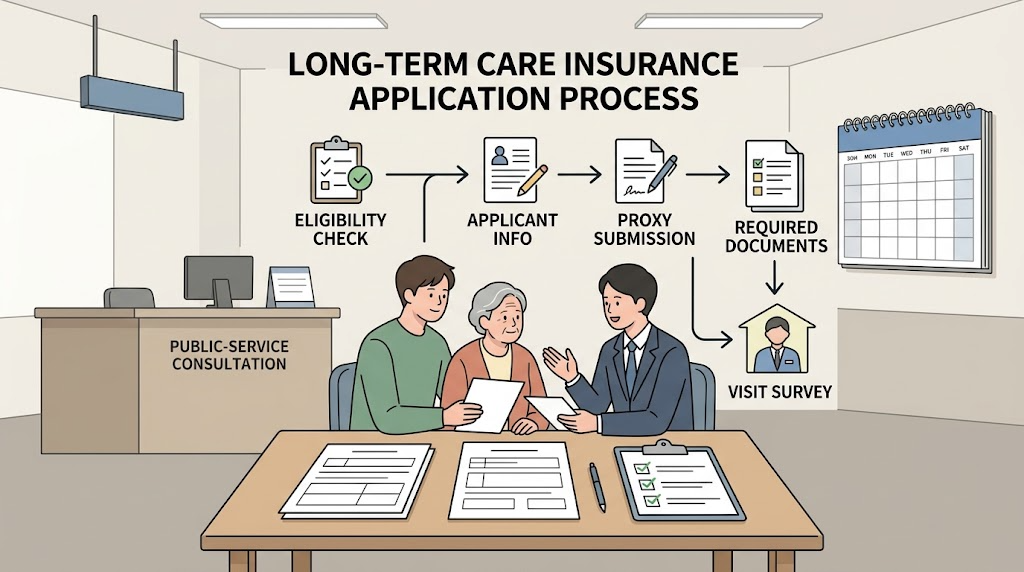
Essential Step After Application: Preparation Guide for the Service Staff Visit Survey
Once the Application for Long-Term Care Recognition is submitted, professional assessors such as nurses or social workers affiliated with the National Health Insurance Service will visit the senior’s actual residence to conduct a visit survey (recognition survey) evaluating physical and cognitive functions.
Because this survey serves as core baseline data for determining the final grade (Grades 1 to 5, Cognitive Support Grade), thorough preparation and proper handling on the day by guardians are crucial.
Scheduling the Visit Survey and Principles of Guardian Presence
- Scheduling: Once the application is received, a phone call to arrange the visit date usually comes within 1 week to 10 days to the contact number of the proxy (family member) provided on the application form.
- Guardian presence is essential: If the survey is conducted while the senior is alone, there is a high risk that their routine condition will be distorted. Be sure to set the date and time when the primary caregiver, who knows the senior’s daily living patterns and care difficulties well, can be present.
5 Major Evaluation Areas of the Assessment Form
The assessor objectively evaluates the senior’s condition based on the Long-Term Care Recognition Survey Form (a total of 52 detailed items, etc.) set by Ministry of Health and Welfare regulations.
- Physical Function (12 items)
- Taking off and putting on clothes, washing face, brushing teeth, bathing, eating meals
- Changing posture (rolling over in bed), sitting up, leaving the room, walking, using the toilet, and managing toileting cleanup
- Cognitive Function (7 items)
- Decline in short-term memory (remembering something that happened a short while ago)
- Orientation check (recognizing today’s date, season, current location)
- Ability to state one’s own age and name correctly
- Behavioral Changes (14 items – dementia-related symptoms)
- Delusions, hallucinations, repetitive questioning, and repetitive actions
- Getting lost or wandering, aggressive verbal or physical behavior
- Hiding items or sleep disorders (day-night reversal)
- Nursing Procedures (9 items)
- Tracheostomy tube care, suction (The ‘Service staff visit survey’ conducted after applying for Service programs like Senior Long-Term Care Insurance or Disability Activity Support is the critical gateway that determines the grade. Here is a practical guide to prepare calmly and objectively convey regular conditions when the assessor visits.
- Preparations Before the Visit Survey: Presence of Guardian is Essential
- Scheduling primary caregiver (family) presence: Seniors with impaired mobility or cognition often cannot accurately explain their actual difficulties in daily living. Family members who know daily care conditions best must be present.
- Prepare diagnosis and medication records: Gather recent hospital clinic records, medication guides, prescriptions, dementia diagnosis (if applicable), etc., in one place in advance.
- Keep a daily care journal (notes):
- “How many times they go to the bathroom at night”
- “Frequency of spilling food or choking during meals”
- “Specific cycles of problem behaviors such as wandering, aggression, or repetitive questioning”
Relying only on memory can lead to omissions, so organizing unusual observations over the past 1 to 2 weeks into brief notes is advantageous.
- 5 Core Evaluation Areas on the Day of Survey
The Service staff checks items based on a standardized assessment sheet (physical, cognitive, behavioral changes, nursing procedures, rehabilitation, etc.).
| Classification | Key Verification Items | Preparation Tips |
|---|---|---|
| Physical Function | Dressing/undressing, face washing, eating, posture change, toilet use | The standard for ‘can do alone’ means a state without any assistance. If observation or hand-holding is needed, describe it as ‘partial assistance’ or **’complete assistance’**. |
| Cognitive Function | Date/place orientation, short-term memory, calculation, communication | The assessor directly asks about the date, season, address, grandchild’s name, etc. Do not answer for them; watch their responses, and explain separately to the assessor if it differs from usual. |
| Behavioral Changes | Delusions, wandering, aggressive words/actions, day-night reversal, hiding objects | Seniors often hide symptoms in front of strangers. Guardians should state abnormal behaviors occurring routinely using concrete examples (time periods, frequencies). |
| Nursing Procedures | Bedsores management, feeding tubes (nasogastric), urinary catheters, ventilators, etc. | Show clearly whether specialized medical procedures are needed, along with actual dressing schedules and conditions. |
| Rehabilitation Area | Joint range of motion, motor paralysis (hemiplegia, etc.) | Assessors verify limb-raising and bending motions directly. Guide the senior not to hold back pain forcefully if they feel it. |
- Common Mistakes and Precautions During the Visit Survey
- Beware of the “I can do it all” syndrome: Many seniors, out of pride in front of a stranger, may push themselves to walk or pretend they are fine, saying, “I eat alone and go to the bathroom just fine.” If this is a temporary burst of energy rather than their daily condition, the guardian should calmly add explanations such as, “Normally, they always need support to move due to fall risks.”
- Deliver facts without exaggeration or downplaying: Exaggerating to secure a grade may cause discrepancies between questioning and observation, while downplaying will prevent receiving needed care support. Speak honestly about the gap between ‘the worst moments’ and ‘daily life.’
- Check residential hazards: Help the assessor check environmental fall hazards such as bed rails, presence of non-slip bathroom mats, door threshold heights, etc.
- Post-Survey Procedures
- Visit survey completion: Assessor inputs the survey form into the system
- Submission of Physician’s Statement: Obtain the physician’s statement from a designated hospital and submit it to the Service within the notified deadline (strictly adhering to the deadline is essential)
- Deliberation by the Grade Determination Committee: Final grade determination combining the visit survey score and physician’s statement (takes approximately 30 days from application date)
Would you like me to also outline the physician’s statement issuance procedure and submission deadlines after the visit survey?

Grade Determination Criteria and Available Benefits After Result Notification
The Grade Determination Committee makes the final long-term care grade decision based on the visit survey results by Service staff and the physician’s statement submitted by the medical institution. It usually takes about 30 days from the application date to the notification of results; once a grade is assigned, you will receive the Long-Term Care Certificate and the Individual Long-Term Care Plan from the Service.
Criteria for Grades 1 to 5 and Cognitive Support Grade
Long-Term Care grades are classified into 6 levels based on the Long-Term Care Recognition Score, which quantifies how much assistance from others is needed in daily life due to physical and mental functional impairments.
| Grade | Recognition Score | Mental and Physical Status & Key Characteristics | Primary Available Benefits |
|---|---|---|---|
| Grade 1 | 95 points or higher | A person who completely requires help from another person in daily living (bedridden state, etc.) | Home-care benefits, Institutional benefits |
| Grade 2 | 75 points to less than 95 points | A person who requires help from another person for a significant part of daily living (wheelchair dependent, etc.) | Home-care benefits, Institutional benefits |
| Grade 3 | 60 points to less than 75 points | A person who partially requires help from another person in daily living (basic mobility support) | Home-care benefits (Conditional institutional benefits) |
| Grade 4 | 51 points to less than 60 points | A person who requires help from another person for a certain part of daily living (early-to-mid stage functional decline) | Home-care benefits (Conditional institutional benefits) |
| Grade 5 | 45 points to less than 51 points | Dementia patients who need daily life support due to cognitive decline | Home-care benefits (Cognitive activity home care, etc.) |
| Cognitive Support Grade | Less than 45 points | Mild dementia patients with good physical function but exhibiting cognitive decline | Day/Night Care cognitive support programs |
Caution for Institutional Benefits: Beneficiaries of Grades 3 to 5 are in principle eligible for home-care benefits. However, nursing home admission is possible if approval for a ‘Change to Institutional Benefits’ is granted by the Service after proving reasons requiring admission, such as family hardship in caregiving, inadequate living environment, severe wandering, or aggression.
Key Benefit Types Available After Result Notification
Upon receiving a grade, you can use home-care or institutional care services with substantially reduced co-payments within the designated monthly benefit ceiling (government subsidy limit).
- Home-Care Benefits (Living at home while receiving care)
- Visiting Care: Level-1 care workers visit the senior’s home to support physical activities (washing, meal assistance, posture changes) and domestic/daily living (cleaning, cooking, hospital accompaniment).
- Day and Night Care (Senior Kindergarten): Protects the senior at a center for a certain period of the day (usually 8 to 10 hours), providing meals, rehabilitation exercises, cognitive programs, and shuttle transport services.
- Visiting Bath / Visiting Nursing: Bathing support by care workers with dedicated bath vehicles/equipment, or care for bedsores and urinary catheters by nurses following a doctor’s prescription.
- Welfare Equipment Rental and Purchase: Within an annual limit of 1.6 million KRW, items such as electric beds, wheelchairs, bath chairs, walkers (silver cars), and non-slip mats can be purchased or rented with more than 85% government subsidy.
- Institutional Benefits (Admission to care facilities)
- Nursing Homes, Group Homes for the Elderly: Admission to specialized facilities with resident care workers and nursing staff to receive 24-hour caregiving, meal management, and physical activity support.
Co-payment Rates and Reduction Criteria
Long-Term Care service costs are mostly covered by the state (National Health Insurance Service), and guardians only pay co-payments determined by income level.
- General beneficiaries: 15% co-payment for home-care benefits, 20% for institutional benefits (nursing homes).
- Reduction beneficiaries (based on median income and health insurance premium tier):
- 40% reduction group: 9% for home-care, 12% for institutional
- 60% reduction group: 6% for home-care, 8% for institutional
- National Basic Living Security recipients (Medical Aid Type 1): 0% co-payment (fully exempt) (However, non-benefit items such as meal expenses at nursing homes are borne out of pocket).
Next Steps for Guardians Right After Grade Notification
- Selecting and Contracting with a Long-Term Care Provider: Bring the received Individual Long-Term Care Plan and sign a service agreement with a visiting care center, day/night care center, or nursing home.
- Applying for Welfare Equipment: If mobility is unstable or there is a risk of falling, apply for items like beds and safety handrails in advance through an NHIS-designated welfare equipment store even before contracting.
- Checking the Appeal Deadline: If you object to the result (grade omission or rejection), you may file a request for review (objection) with the Service within 90 days from the date of knowing the disposition.
Would you like help writing an ‘Epilogue and Final Checklist’ to cleanly conclude the entire post?