
Key Types of 2026 Youth Housing Support Compared at a Glance
This is the first section body draft neatly organized to match Naver Blog’s readability and mobile scrolling environment.
- Key Types of 2026 Youth Housing Support Compared at a Glance
Suitable policies vary completely depending on the housing type and asset status of a youth single-person household. The core systems currently operated by the government and local governments are largely divided into three types: monthly rent support, deposit loan, and public rental.
3 Major Youth Housing Support Policies at a Glance
| Category | Youth Monthly Rent Temporary Special Support | Youth-Dedicated Beotimmok Jeonse Loan | Youth Purchased Rental · Happy Housing |
|---|---|---|---|
| Type | Monthly rent support type (Cash support) | Deposit loan type (Low-interest loan) | Public rental type (Housing supply) |
| Core Benefit | Up to 200,000 KRW per month (Up to 24 months, total 4,800,000 KRW) | Low-interest loan of 1.3% to 3.3% per year within a maximum limit of 200 million KRW | Affordable rent at 30% to 80% of market price |
| Target Audience | Independent non-homeowning youth aged 19 to 34 | Non-homeowning householders (including prospective) aged 19 to 34 | Non-homeowning unmarried youth aged 19 to 39 |
| Income Criteria | 60% or less of the youth household median & 100% or less of the original household median | Annual income of 50 million KRW or less (Relaxed for newlyweds and multi-child households) | Differentiated by priority tier (Based on previous year’s average monthly income per urban worker household) |
| Where to Apply | Bokjiro (Online) / Dong Community Service Center | Gigeum e-Deundeun / Housing and Urban Fund trustee bank | LH Cheongyak Plus / SH Internet Subscription System |
Features and Customized Recommendations by Type
① Monthly Rent Support Type: Youth Monthly Rent Temporary Special Support
- Support Details: Directly deposits monthly rent into your account at up to 200,000 KRW each month for up to 24 months (total 4,800,000 KRW).
- Notable Point: It has transitioned from the previous temporary batch recruitment to an open-ended, ongoing application system, so you can apply anytime throughout the year as long as you meet the eligibility requirements.
- Recommended Audience: New members of society and college students who find it difficult to prepare a jeonse deposit and want to immediately reduce pure monthly rent expenditures going out every month.
② Deposit Loan Type: Youth-Dedicated Beotimmok Jeonse Fund Loan
- Support Details: Supports low-interest loans ranging from an annual 1.3% to 3.3% for up to 80% of the jeonse deposit, up to a maximum limit of 200 million KRW.
- Notable Point: Compared to commercial bank jeonse loan interest rates (annual 3% to 4% range or higher), the interest burden is reduced to half, making it a key policy that drastically lowers fixed housing costs.
- Recommended Audience: Youth who want to switch from high monthly rent to jeonse to minimize fixed monthly expenses in the form of deposit loan interest.
③ Public Rental Type: Youth Purchased Rental Housing & Happy Housing
- Support Details: Public institutions such as LH and SH purchase or newly build houses near subway stations and supply them long-term to the youth at 30% to 50% (Purchased Rental) or 60% to 80% (Happy Housing) of market prices.
- Notable Point: You can reside stably for up to 6 to 10 years without worrying about frequent moves, and it is safe from the risk of “can jeonse” (unbacked deposits) or jeonse fraud.
- Recommended Audience: Single-person households that establish long-term independence plans and want to secure an independent living space in a safe environment.
💡 Writing Tip (Guide for Blog Posting)
Adding guide text explaining which policy to check as the first priority according to the youth’s own residence type (living on monthly rent vs. planning a jeonse contract vs. waiting for public rental) is advantageous for securing dwell time.
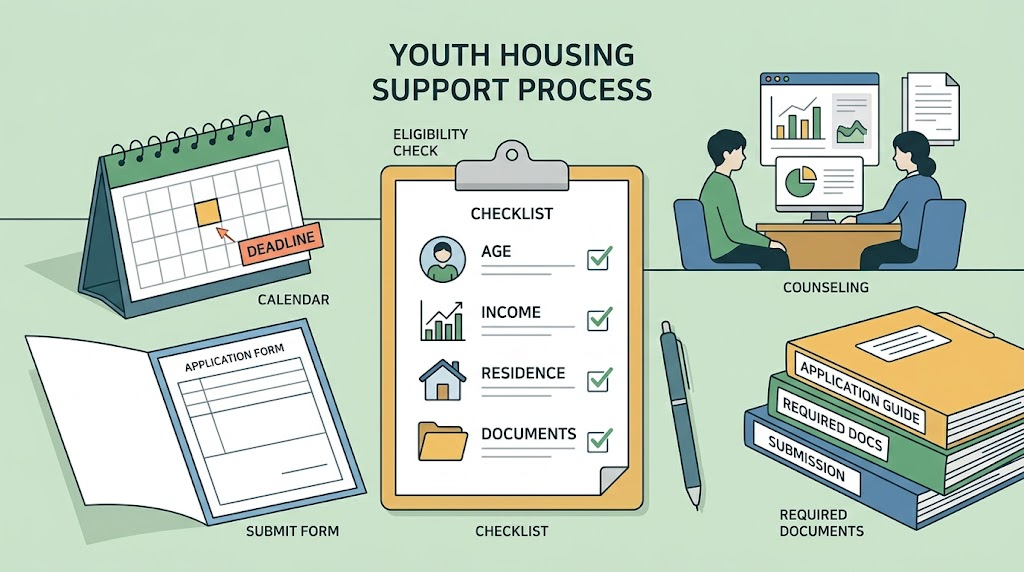
Am I Eligible for Support? Essential Qualification Requirements Checklist
This is the second section body draft structured so that Naver Blog readers can check their personal situation directly while scrolling down.
- Am I Eligible for Support? Essential Qualification Requirements Checklist
Because government housing support policies offer substantial benefits, their screening criteria are meticulous. Centering on the most demanded programs—Youth Monthly Rent Special Support and Youth-Dedicated Beotimmok Jeonse Loan—we have organized age, income, and housing criteria into a checklist.
[Check 1] Youth Monthly Rent Special Support Qualification Requirements
As this is a project providing housing expenses in cash every month, the core is that not only the youth themselves, but also the income and assets of the parents (original household) are evaluated together.
- [ ] Age: Non-homeowning youth aged 19 to 34 as of the application date
- [ ] Residence Type: Single-person household residing separately from parents on the resident registration (Moving-in report mandatory)
- [ ] Youth Household Income and Asset Criteria:
- Income: 60% or less of the standard median income (Around the 1.4 million KRW range for a single-person household)
- Assets: Total asset value of 122 million KRW or less
- [ ] Original Household (Including Parents) Income and Asset Criteria:
- Income: 100% or less of the standard median income
- Assets: Total asset value of 470 million KRW or less
- [ ] Eligible Housing: Housing with a lease deposit of 50 million KRW or less and monthly rent of 700,000 KRW or less
📌 Exceptions Where Original Household Income Is Not Examined
If the youth is aged 30 or older, married (or divorced), or recognized as maintaining an independent livelihood with regular income of 50% or more of the median income even if aged 19 to 29, the income and asset screening of parents (original household) is exempt.
[Check 2] Youth-Dedicated Beotimmok Jeonse Fund Loan Qualification Requirements
A low-interest loan product to help prepare a jeonse deposit; parents’ income is not examined, and evaluation is based on the income and credit rating of the applicant themselves (single householder).
- [ ] Age: Aged 19 or older to 34 or younger as of the loan application date
- [ ] Householder Requirement: Non-homeowning single householder (Including prospective householders; proof of moving-in report required within 1 month after loan execution)
- [ ] Income Criteria: Combined annual income of couple (Applicant alone for unmarried single-person households) of 50 million KRW or less
- [ ] Asset Criteria: Net asset value of 345 million KRW or less (Combining real estate, automobiles, and financial assets)
- [ ] Target Housing Requirements:
- Exclusive Rental Area: 85㎡ or less (However, 60㎡ or less for single householders under age 25)
- Lease Deposit: Housing with a jeonse deposit of 300 million KRW or less
- Down Payment: Receipt proving payment of at least 5% of the deposit after signing a lease agreement is required
Summary Comparison of Qualification Requirements
| Screening Item | Youth Monthly Rent Special Support | Youth Beotimmok Jeonse Loan |
|---|---|---|
| Applicant Criteria | Independent non-homeowning youth aged 19 to 34 | Householders (including prospective) aged 19 to 34## Am I Eligible for Support? Essential Qualification Requirements Checklist |
Checking the core items below in order prior to application helps prevent ineligibility rejection and saves unnecessary document preparation time.
- Basic Qualification Requirements Check
| Category | Key Verification Criteria | Check |
|---|---|---|
| Age Criteria | Aged 19 or older to 34 or younger (Check whether extension up to age 39 is possible depending on military service period) | [ ] |
| Residence Requirement | Whether registered as a resident within the jurisdiction of the relevant local government as of the announcement date | [ ] |
| Nationality and Status | Holders of Republic of Korea nationality (Individual guidelines apply for overseas nationals, registered foreigners, etc.) | [ ] |
- Income and Asset Requirements Check
- Household Recognized Income Amount: 150% or less of standard median income (Verification of single-person household or household combined basis required)
- Asset Criteria:
- Whether meeting the general asset value limit by residential area, such as metropolitan cities or small-to-medium cities
- Whether financial assets and vehicle values (luxury vehicles exceeding standard values are excluded) are factored in
- Debt Deduction: Whether prepared with verifiable debt documentation such as financial institution loans
- Duplicate Benefits and Participation Restrictions Check
- Participation in Similar Projects: History of receiving government or local government grants for identical or similar purposes within the past 1 to 2 years
- Employment Status: Enrollment in 4 major social insurances and weekly working hours (Check satisfaction of detailed criteria per project, such as short-time workers, unemployed persons, employed persons, etc.)
- Excluded Targets: Whether falling under statutory exclusion categories such as public officials, private school faculty and staff, active military personnel, or basic livelihood security cash grant recipients
Tip. It is safest to accurately look up median income criteria and asset calculation methods in advance through the ‘Health Insurance Payment Confirmation Certificate’ or ‘Income Amount Certificate’ as of the announcement date.

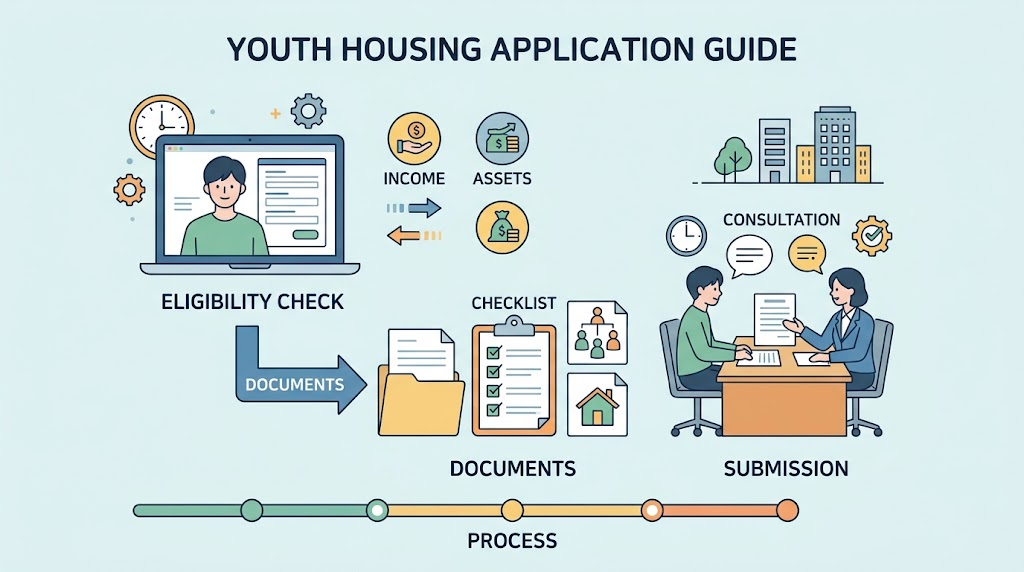
Foolproof Step-by-Step Application Procedure (Step-by-Step)
If screening is rejected due to incomplete documents or confusion over application paths, reapplication takes at least 2 weeks or more. By following the 4-step procedure in order, from preliminary diagnosis to final disbursement and loan execution, you can complete your application without bottlenecks.
Step 1. Preliminary Eligibility Diagnosis (Using Simulation Calculations)
Prior to application, simulate on the portal first to see whether you meet the standard median income and asset value requirements.
- Monthly Rent Support Type: Access Bokjiro (bokjiro.go.kr) → Welfare Services → Simulation Calculation → Select Youth Monthly Rent Support, then enter income and assets for both the youth household and original household
- Loan Type (Beotimmok): Access Housing and Urban Fund (nhuf.molit.go.kr) or Gigeum e-Deundeun portal → Check expected available loan limit and interest rate bracket in advance via Calculate Housing Jeonse Funds
Step 2. Preparation of Required Supporting Documents
Documents must be issued within the last 1 month from the application date, and printed so that all 13 digits of the resident registration number are displayed.
| Category | Prepared Document List | Issuing Agency |
|---|---|---|
| Common Documents | Resident Registration Certificate/Abstract, Family Relation Certificate (Detailed) | Gov24, Supreme Court Electronic Family Relationship Registration System |
| Housing Proof | Copy of Lease Agreement with Fixed Date, Certified Copy of Leased Building Register | Community Service Center, Internet Registry Office |
| Payment Proof | Transfer confirmation of monthly rent or down payment (5% or more) for the past 3 months | Transacting bank (Bank transfer receipt) |
| Income/Asset Proof | Income Amount Certificate, Health Insurance Payment Confirmation Certificate, Certificate of Employment (Workers) | NTS Hometax, National Health Insurance Service |
⚠️ 2 Mandatory Checks When Preparing Documents
- The lease agreement must bear a Fixed Date stamp or have a Housing Lease Agreement Report Certificate attached.
- The Family Relation Certificate must be issued based on parents as a Detailed Certificate for original household separation verification to be processed normally.
Step 3. Proceeding with Online and Offline Application
Because designated receiving institutions differ by policy, you must confirm the dedicated window accurately before applying.
- Youth Monthly Rent Special Support:
- Online: Log in to Bokjiro website or mobile app → Apply for Service → Apply for Welfare Benefits → Fill out Youth Monthly Rent Support form and upload documents
- Offline: Visit the welfare counter of the Eup/Myeon/Dong Administrative Welfare Center (Community Service Center) having jurisdiction over your address
- Youth-Dedicated Beotimmok Jeonse Loan:
- Online: Apply for loan on the Korea Housing & Urban Guarantee Corporation (HUG) Gigeum e-Deundeun (enhuf.molit.go.kr) site
- Offline: Visit a branch of an entrusted fund bank (Woori, Kookmin, Shinhan, Hana, NongHyup) for consultation and application
Step 4. Asset and Income Screening and Result Notification
- Screening Period: Normally takes 30 to 45 days from the application date (Including electronic inquiries and clarification procedures for income and assets)
- Checking Results:
- Monthly Rent Support: When deemed eligible, an Alimtalk (SMS) notification is sent, and payments are retroactively calculated from the month containing the application date and deposited into an account under your own name on the 25th of each month
- Jeonse Loan: Deemed eligible in preliminary asset screening → On-site bank document review and guarantee certificate issuance → Direct execution of loan disbursement into the lessor’s (landlord’s) account on move-in day
💡 Core Tip to Prevent Failure
In preparation for unexpected disqualification in the loan review after executing a jeonse contract, be sure to include the statement “This contract shall return the contract deposit in full without penalty if the Youth Beotimmok Jeonse Loan is unavailable” in the special terms section of the standard real estate contract.

Precautions and Pro Tips to Know Before Applying (FAQ)
Even if you meet application qualifications and prepare documents perfectly, missing administrative procedures or exceptional provisions that frequently occur in practice can lead to suspension or clawback of benefits. We have gathered core questions and practical tips that blog readers ask most frequently.
Frequently Asked Questions (FAQ)
Q1. Address sepaPrecautions and Pro Tips to Know Before Applying (FAQ)
Missing a single small detail during the application process can delay screening or cause exclusion from support entirely. Here is a summary of essential cautions and frequently asked questions to check before proceeding.
Must Check! Core Precautions Before Applying
Check document validity period (Issued within the last 1 month): Submitted documents such as Resident Registration Certificates and Income Amount Certificates must be the latest versions issued within 1 month of the announcement date to avoid rejection risks.
Consistency between resident registration address and actual residence: Address-based benefits are judged based on the moving-in report date and the documented address, so if you have moved recently, check administrative database reflection first.
Check duplicate benefit restriction rules: If you are already using similar government or local government subsidies or programs from other institutions, duplicate support may be blocked or existing benefits may be terminated.
Prepare for traffic right before deadline: On the afternoon of the deadline day, identity verification errors or server delays are likely due to surging visitor traffic. It is safe to complete the application at least one day before the deadline.
Frequently Asked Questions (FAQ) & Practical Tips
Q1. Do I have to start over from the beginning if the page crashes or encounters an error during application?
A. Make proactive use of the temporary save function. Most public and administrative websites have short session durations. It is recommended to click [Temporary Save] frequently whenever entering basic personal information, and verify in advance that browser pop-up blockers are disabled for joint certificates or simple authentication.
Q2. Can unemployed persons or freelancers provide proof of income?
A. Yes, it is possible. You can use the ‘Income Amount Certificate’ or ‘Certificate of Fact (Document proving absence of income)’ that can be issued from Hometax. For freelancers, check beforehand with the receiving agency whether withholding tax receipts (3.3%) for the past 3 to 6 months or bank transaction statements can be used as substitutes.
Q3. Which is easier to use for applying, the mobile app or PC web?
A. The PC environment is recommended. While simple authentication (Kakao, Naver, PASS, etc.) itself is fast on mobile, mobile browsers often cause file size excess and file format errors during the process of attaching PDF documents or uploading scanned files. Preparing and saving documents on a PC in advance is the smoothest route.
Q4. When and how will selection results be announced?
A. After the application closes and the document screening period (typically 2 to 4 weeks) passes, individual notifications are sent via KakaoTalk Alimtalk or text message (SMS). Keep contact information updated on My Page so you do not miss notifications due to spam filtering or changed phone numbers.
Korean version: 한국어로 읽기