
The Big 3 Core Youth Housing Support Policies at a Glance
Here are the three representative youth housing policies supported by the government to ease the burden of monthly housing costs. It is important to choose the system that is most advantageous to you according to the support method (deposit loan vs. monthly rent subsidy vs. savings linkage).
| Category | Youth-Exclusive Beotimmok Jeonse Loan | Special Youth Monthly Rent Support | Youth Housing Dream Subscription Savings & Loan |
|---|---|---|---|
| Key Benefits | Low-interest jeonse deposit loan at 1.5% to 2.7% per year (up to KRW 200 million limit) | Monthly rent support up to KRW 200,000 per month (once in a lifetime, supported for up to 12 to 24 months) | Subscription with up to 4.5% preferential interest rate + linked to long-term pre-sale loan at the lowest 2.2% level upon winning |
| Nature of Support | Deposit preparation (financing support) | Monthly rent cash subsidy (non-repayable support) | Preparation for home ownership & pre-sale linkage (savings + loan) |
| Main Target | Non-homeowning youth single household head aged 19 to 34 (annual income of KRW 50 million or less) | Independently living non-homeowning youth aged 19 to 34 (60% or less of standard median income) | Non-homeowning youth aged 19 to 34 (annual income of KRW 50 million or less) |
| Where to Apply | Visit Housing and Urban Fund Gigeum e-Deundeun or entrusted banks | Visit Bokjiro (bokjiro.go.kr) online or Community Service Centers | Counters of participating commercial banks or mobile apps |
- Youth-Exclusive Beotimmok Jeonse Fund: The basics of preparing a jeonse deposit
It provides an overwhelmingly lower fixed and variable interest rate compared to commercial banks, greatly reducing the burden of jeonse or semi-jeonse deposits. Up to KRW 200 million is supported within 80% of the lease deposit, and there is no prepayment penalty, so the advantage is that you can repay freely whenever you have a lump sum of money.
- Special Youth Monthly Rent Support: Cash subsidy for monthly rent paid each month
It is a welfare system that directly relieves the monthly rent actually spent each month, rather than a deposit loan. Both the income requirements of the independent youth household and the original household (parents) must be met at the same time, and upon selection, support funds are directly deposited into the bank account every month, which is effective for protecting living expenses.
- Youth Housing Dream Subscription Savings: One-stop from savings to home ownership
This is a system that significantly expanded the benefits of the existing youth preferential subscription savings. It provides high interest rates and tax-exempt benefits, and if you win a subscription in the future, you can borrow up to 80% of the pre-sale price at an interest rate as low as 2.2% through a dedicated mortgage loan (Youth Housing Dream Loan).
Please select the next task to proceed:
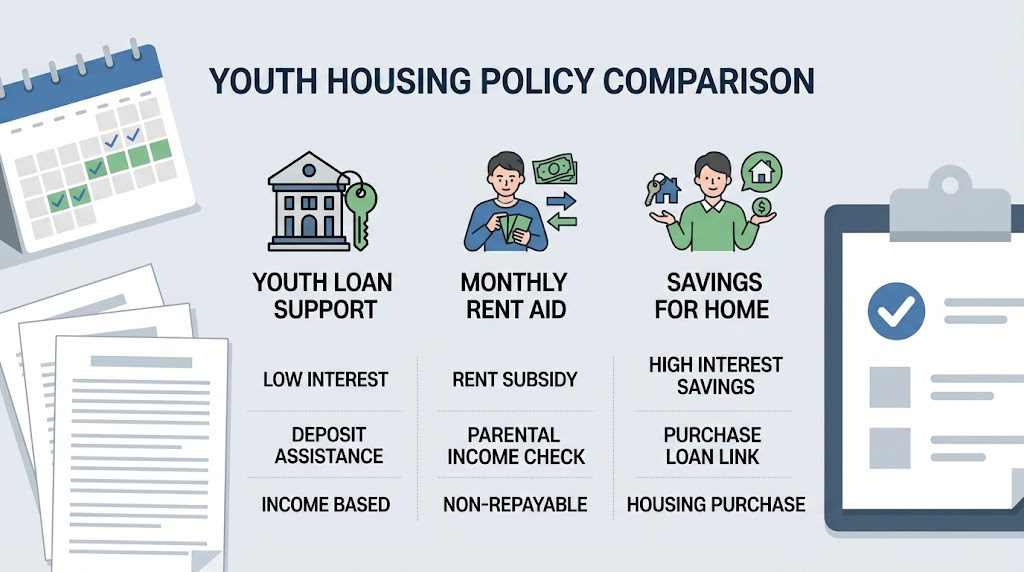
Comparison of 2026 Core Conditions (Comparison Table at a Glance)
We intuitively compared and organized the core qualification requirements (age, income, assets) and loan/support limits that young adults entering society and youth are most confused about when looking into housing support policies.
| Classification Item | Youth-Exclusive Beotimmok Jeonse Loan | Special Youth Monthly Rent Support | Youth Housing Dream Subscription Savings & Loan |
|---|---|---|---|
| Age Criteria | Aged 19 to 34 or younger (up to age 39 if completed military service) | Independently living youth aged 19 to 34 | Non-homeowning youth aged 19 to 34 (up to age 39 if completed military service) |
| Income Requirement | Annual income of KRW 50 million or less (KRW 75 million for newlyweds, multi-child, or 2 or more children) | 60% or less of median income for youth households & 100% or less of median income for original households (parents) | Reported income of KRW 50 million or less in the immediately preceding year (earned, business, other income) |
| Net Asset Criteria | Net assets of KRW 345 million or less based on 2026 | Assets of KRW 122 million or less for youth households & KRW 470 million or less for original households | No separate asset criteria (centered on income and non-homeownership status) |
| Support Limit | Within 80% of jeonse deposit (up to KRW 200 million) | Up to KRW 200,000 per month (up to 24 months, total limit of KRW 4.8 million) | Monthly payment limit of KRW 1 million / 80% of pre-sale price upon loan |
| Applied Interest Rate/Benefits | 1.8% to 2.7% per year (differentiated by income bracket, preferential rate separate) | Non-repayable cash subsidy (no obligation to repay) | Savings interest rate up to 4.5% / pre-sale loan linked to the lowest interest rate from 2.2% per year |
| Target Housing Requirements | Exclusive area of 85㎡ or less & deposit of KRW 300 million or less | Housing with deposit of KRW 50 million or less and monthly rent of KRW 700,000 or less | Housing with pre-sale price of KRW 600 million or less & exclusive area of 85㎡ or less |
| Guarantee Agency / Handler | Korea Housing & Urban Guarantee Corporation (HUG) / Korea Housing Finance Corporation (HF) | Community Service Centers nationwide and Bokjiro online | Counters and apps of 9 participating commercial and regional banks |
💡 3 Core Points to Check at a Glance
- Check the details of income criteria
- Youth Beotimmok: Based on one’s own gross income (annual salary) before tax. However, for married persons, combined income of the couple is considered.
- Youth Monthly Rent Support: Assets and income of not only one’s own household but also ‘parents (original household)’ are checked together. (However, parents’ income can be excluded if aged 30 or older, married, or maintaining an independent livelihood)
- Choice of guarantee agency between HUG vs HF
- HUG (Korea Housing & Urban Guarantee Corporation): It mainly evaluates the officially announced price and mortgage setup of the ‘house (target property)’ rather than the loan applicant’s income, so unemployed persons and young adults entering society also tend to get good limits.
- HF (Korea Housing Finance Corporation): Because the limit is determined based on the applicant’s personal ‘annual income and credit score’, the loan limit may be reduced if the employment period is short or income is low.
- Possibility of duplicate benefits
- In the case of semi-jeonse where you use ‘Youth Beotimmok’, which is a deposit loan, while paying part of the monthly rent, you need to check with the competent local government to see if you can meet the requirements for concurrent application if you meet the deposit/monthly rent requirements of the Special Youth Monthly Rent Support.
Please select the next section to write or required task:
Which Policy Is Right for Me? Customized Recommendation Guide by Situation
As youth housing support policies offer significant benefits, the eligibility requirements and screening criteria for each target are clearly divided. We have organized the most advantageous options according to your current employment status, income, and size of saved seed money.
CASE 1. New employees of small and medium-sized enterprises (SMEs) / middle-market companies & first-time independence
Recommended Policy: Youth-Exclusive Beotimmok Jeonse Loan (HUG Safe Loan)
Reason for Choice:
During the period when employment duration is short or annual salary is not high shortly after joining a company, the HUG guarantee method, which mainly looks at the rights relationship of the target property (house), is much more advantageous for securing limits than the HF (Korea Housing Finance Corporation) guarantee, which mainly looks at personal income.
With an ultra-low interest rate in the 1% to 2% range per year, loans up to KRW 200 million (within 80% of the deposit) are possible, minimizing monthly interest expenses when preparing jeonse deposits for officetels or villas in Seoul and the metropolitan area.
CASE 2. Employees of large corporations/public enterprises & youth on the borderline of income brackets
Recommended Policy: Youth-Exclusive Beotimmok (HF Guarantee) or commercial bank youth-tailored jeonse loan
Reason for Choice:
If annual income does not exceed KRW 50 million (KRW 75 million for newlyweds, 2 or more children, etc.), you can still apply for Youth Beotimmok. In this case, since proof of employment and proof of income are solid, it is easier to use HF guarantee to lower fees and receive prompt screening.
If you slightly exceeded the income criteria, it is suitable to broaden your perspective to general Beotimmok (relaxed income criteria type) or youth-tailored jeonse loans for youth aged 34 or younger from commercial banks such as KakaoBank and Toss Bank (requirements such as income of KRW 70 million or less).
CASE 3. Freelancers / job seekers & monthly rent residents lacking deposit capacity
Recommended Policy: Special Youth Monthly Rent Support + Youth Deposit-Backed Monthly Rent Loan
Reason for Choice:
If saved deposits are small at around KRW 5 million to 10 million and monthly rent paid every month is a burden, Special Youth Monthly Rent Support, which returns up to KRW 200,000 per month for up to 24 months, is most effective for immediate cash flow improvement.
If the deposit is also partially insufficient and monthly rent is also burdensome, it is good to concurrently consider the Youth Deposit-Backed Monthly Rent Loan, which loans deposit (up to KRW 35 million) and monthly rent funds (up to KRW 500,000 per month) as a package at an ultra-low interest rate in the 1% range per year.
CASE 4. Youth aiming for subscription and owner-occupied home purchase within 2 to 3 years
Recommended Policy: Join & convert to Youth Housing Dream Subscription Savings
Reason for Choice:
Even if you are currently using a deposit loan, subscription savings must be operated separately. Converting an existing comprehensive housing subscription savings to Youth Housing Dream allows you to enjoy up to 4.5% annual preferential interest rate and income deduction benefits on paid amounts.
If you fulfill the conditions of paying for 1 year or more and depositing KRW 10 million or more to win a public/private pre-sale in the future, you can borrow up to 80% of the pre-sale price at an interest rate as low as 2.2% for the long term, making it essential as a long-term housing ladder.
💡 One-line Summary Guide
Lacking lump-sum money (deposit) but want to reduce interest burden? ➜ Youth Beotimmok (HUG)
Having almost no deposit and want to reduce monthly rent spending right away? ➜ Special Youth Monthly Rent Support
Having solid proof of income and want fast approval? ➜ Youth Beotimmok (HF)
Want to gather seed money for home purchase starting now? ➜ Youth Housing Dream Subscription Savings
Please select the blog part to proceed next:
Subheading 4: Writing essential checklists & precautions
Subheading 5: Writing application procedures and required document organization
Extracting SEO-optimized titles and meta descriptions that tie the whole article together
Preventing Wasted Trips! Essential Checklist & Precautions Before Applying
Youth housing policy loans (Beotimmok, etc.) Preventing Wasted Trips! Essential Checklist & Precautions Before Applying
For administrative welfare benefits, policy finance, and various support programs, if even a single document is missing or application requirements are mistaken, the application itself is easily rejected, leading to wasted time. Before visiting in person or pressing the online application button, make sure to check the 4 items below.
- Check application eligibility base date and household member aggregation requirements
Income and asset calculation criteria: You must check whether it is based on yourself alone or aggregated across all household members. In the case of health insurance premium payment standards, you must clearly verify whether it is based on the average of the last 3 months or the previous month to prevent disqualification.
Address on resident registration: In many cases, moving-in notification (jeonip) must be completed in the relevant local government as of the announcement date. If you transferred your address right before applying, check whether you meet the period-of-residence requirements (e.g., residing within the jurisdiction for 1 year or longer, etc.).
- Validity period of supporting documents and display of Resident Registration Number
1-month issuance principle: Major civil petition documents such as the Resident Registration Certificate (deungbon), Abstract (chobon), and Family Relations Certificate are usually accepted only if issued within 1 month (or 3 months) from the date of issuance. Documents obtained long ago become grounds for rejection.
Display of the latter digits of the Resident Registration Number: Documents for submission to public institutions must be issued as detailed certificates with all 13 digits of the Resident Registration Number exposed for all household members to avoid requests for resubmission.
- Preparation of bank account in one’s own name and authentication methods
Prohibition of seizure-protected accounts and third-party accounts: In principle, the subsidy deposit account must be a deposit/withdrawal bank account under the applicant’s own name. Savings accounts, subscription accounts, and seizure-protected accounts (when applying for general subsidies rather than dedicated accounts like Haengbok Jikimi accounts) may have deposits rejected.
Check joint certificates / simple authentication: When applying through online portals such as Government24 or Bokjiro, if you do not have mobile phone authentication under your own name or a joint certificate, the process will halt at the final signing stage, so you must set them up in advance.
- Check restrictions on duplicate benefits and deadline closing times
Check duplication of similar support programs: Youth monthly rent support, job search activity subsidies, living expense loans, etc. are strictly prohibited from duplicate benefits with national or local government programs of similar nature. If there is another support system you are currently participating in, cross-reference the announcement to see if you fall under exclusion targets.
Server congestion on the deadline day and closing hour: There are frequent announcements where the application deadline closes at ‘6:00 PM (18:00)’ rather than ‘midnight (24:00)’. One to two hours before the deadline, document uploads may fail due to heavy access congestion, so it is safe to finish the application at least the day before the deadline.
Would you like me to also organize countermeasures and objection procedures when an application is rejected?
Yes

Finishing Application Procedures and Required Document Preparation in One Go
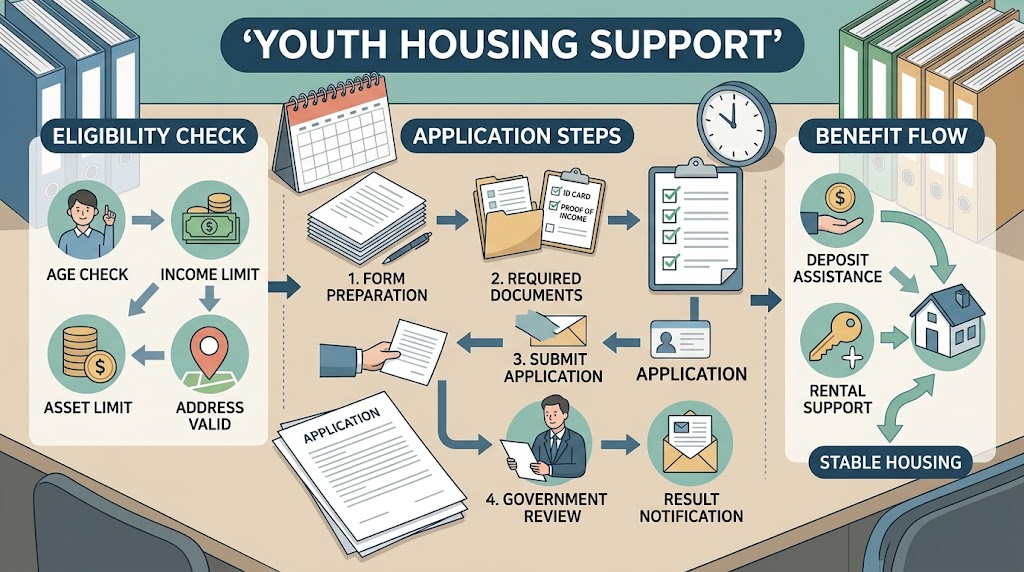
For youth housing support loans (such as Youth-Exclusive Beotimmok), if even one document is omitted, you have to revisit bank counters multiple times, so the key is to prepare the procedure sequence and document lists by issuing agency bundled in advance.
- 5-Step Procedure at a Glance
- Pre-qualification check and property search (40 to 50 days before the balance payment)
- Proceed with mock calculation of personal income and assets on the Housing and Urban Fund portal or My Home portal.
- Find a house after clearly stating to the real estate agent that it must be a “house eligible for Beotimmok (HUG or HF) loans.”
- Lease contract execution and fixed date assignment (30 to 40 days before the balance payment)
- Receive a receipt for paying 5% or more of the deposit and execute the contract specifying loan safety special agreements.
- Immediately obtain a fixed date on the contract date by visiting a Community Service Center or via the Supreme Court Internet Registry Office.
- Online pre-qualification screening application on Gigeum e-Deundeun
- Submit qualification screening on the Housing and Urban Fund ‘Gigeum e-Deundeun’ website or mobile app.
- Usually, the ‘eligible (pre-qualification passed)’ determination is completed within 2 to 3 business days.
- Bank visit and submission of main screening documents (20 to 30 days before the balance payment)
- Visit a branch of an entrusted bank (Woori, Kookmin, Shinhan, NongHyup, Hana Bank, etc.) to formally apply for the loan.
- Tip: Visiting a branch near the leased house or your primary transaction bank branch makes the process smoother.
- Post-asset screening and loan execution (on the day of balance payment)
- After screening approval, sign the loan agreement, and on the balance payment day, the loan amount is remitted directly to the landlord’s account.
- Submit the Resident Registration Certificate with completed move-in registration to the lending bank within 14 days after moving in.
- Mandatory Document Checklist by Issuing Agency
All civil petition documents must be issued within 1 month based on the application date, and must be printed as ‘detailed’ certificates with all 13 digits of the Resident Registration Number exposed.
| Issuing Agency Category | Preparation Document List | Remarks and Precautions |
|---|---|---|
| Identity Verification and Family
(Government24 / Community Service Center) |
• Resident Registration Certificate (including address change history for the past 5 years)
• Resident Registration Abstract (including military service details) • Family Relations Certificate (Detailed) |
Even for unmarried individuals, Family Relations Certificate (Detailed) is mandatory to check single household head requirements and parental information |
| Proof of Income and Employment
(Company and Hometax) |
• Certificate of Employment (stamped with company seal)
• Withholding Tax Receipt for Earned Income (past 2 years) • Certificate of Health Insurance Eligibility Acquisition/Loss • Salary Bankbook Deposit Transaction Statement |
New employees with less than 1 year of service prepare Class A Earned Income Withholding Tax Receipt or wage ledger (with company seal) |
| Regarding Leased Housing
(Realtor / Registry Office) |
• Original lease contract stamped with a fixed date
• Receipt of payment of 5% or more of lease deposit • Certified copy of register of leased house (including cancelled matters) • Building Ledger |
Check whether ‘violating building’ is marked on the building ledger and check residential officetel/house designation |
- 3 Practical Tips Even Officials Don’t Tell You
- Income calculation for new employees with less than 1 year of service: Since annual income is calculated by converting the recently received monthly salary (based on base pay) into 12 months, checking whether incentives or bonuses are reflected with the bank officer in advance reduces limit errors.
- Prior examination of target property conditions for HUG guarantee: Check directly on the Ministry of Land, Infrastructure and Transport’s Official Price Alert site whether it does not exceed the 126% standard of the official price (official price × 140% × mortgage recognition rate 90%) before drafting the contract.
- Preferential interest rate when using electronic contract system: If you enter into a lease contract through the Ministry of Land, Infrastructure and Transport’s Real Estate Electronic Contract System, you can receive a preferential interest rate benefit of 0.1%p.
Please select the blog component to proceed next: