Introduction: Why Complex Housing Support Needs to be Compared at a Glance
This is the draft of the introduction body for a Naver blog post titled [1. Introduction: Why Complex Housing Support Needs to be Compared at a Glance]. It was written to empathize with the reality of housing cost burdens experienced by youths and introduce the necessity of comparative analysis.
[Body Draft]
Hello to young office workers and college students who are dreaming of independence or have already started living on their own, every time you let out a sigh at the soaring jeonse and monthly rent prices and the monthly rent bill grazing past your bankbook!
For youths taking their first steps into society or balancing studies and work, housing costs take up the largest portion of overall expenses and are an unavoidable burden. Every year, governments and local governments pour out various support policies to ensure housing stability for these youths, but when you actually look into the systems, the names are unfamiliar and the conditions are all different, making it feel baffling as to where and how to look.
Have you ever worried, “Should I get a jeonse loan, or would it be more advantageous to apply for a monthly rent subsidy?”
Even for seemingly similar policies, the size of the benefits you can receive varies wildly depending on the support target, income criteria, and whether duplicate benefits are allowed. There is nothing more regrettable than applying blindly only to be rejected because the conditions don’t match, or missing out on a more advantageous benefit.
In this post, we will clearly organize a practical guide to compare complex and confusing youth housing support systems at a glance and smartly choose the policy that best fits your situation. We hope you will thoroughly compare and analyze to surely lighten your precious housing cost burden!
If you have any drafts for the next chapter or additional content needed, please feel free to let us know anytime!

Youth Housing Support Policies Comparison at a Glance
This is the draft of the second section body for a Naver blog post titled [2. Youth Housing Support Policies Comparison at a Glance]. It is organized with a clean table so that youths can easily grasp and compare the core details of various housing support policies at a glance.
[Body Draft]
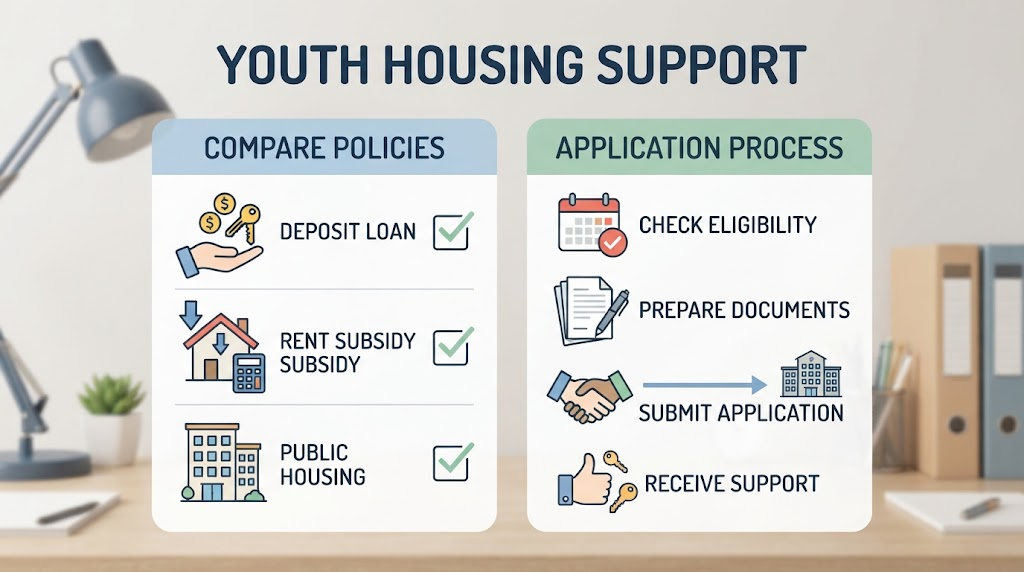
Youth housing support systems are largely divided into three fields: ‘deposit and loan support’, ‘monthly rent and direct housing cost support’, and ‘public rental and housing welfare’. Although it sounds complicated in words, when you organize the core details into a table, which policy is most necessary and suitable for you comes into view at a glance.
Shall we check the major youth housing support policies right now through a comparison table?
📋 Major Youth Housing Support Policies Comparison at a Glance
| Category | Major Support Policy Name | Core Support Details and Benefits | Major Application Qualification Requirements |
|---|---|---|---|
| Deposit & Loans | Youth-Exclusive Beontimmok Jeonse Fund Loan | Low-interest (lower than market rates) loan support to prepare for jeonse and monthly rent deposits | Homeless youths aged 19 to 34 (combined spouse annual income below a certain standard) |
| Deposit & Loans | Local Government Lease Deposit Interest Support | Local government subsidizes a certain ratio (or full amount) of interest when taking out a loan from a bank partnered with the local government | Homeless youths and newlyweds with resident registration in the local government of residence |
| Monthly Rent Support | Youth Monthly Rent Limited Special Support | Cash support for monthly rent of a certain amount every month (up to 200,000 KRW limit per month) for the longest period | Homeless youths living separately from parents (satisfying self and parent income/asset criteria) |
| Monthly Rent Support | Local Government’s Own Monthly Rent Support Project (e.g., Seoul, etc.) | Payment of monthly rent subsidies and housing cost vouchers according to local government criteria | Homeless youths residing in the relevant local government (satisfying standard median income and deposit/monthly rent limits) |
| Public Housing | Youth Purchased Rental & Happy Housing | Provision of public housing where you can live stably for a long period at rent lower than market price | College students, job seekers, and youths satisfying homeless requirements and income/asset criteria |
💡 Comparison Table Tip!
- Depending on whether you urgently need to ‘secure a jeonse or monthly rent deposit (loan)’ right now or desperately need to ‘reduce monthly fixed rent costs’, you should first select the category to focus on from the table above.
- Since there may be minor differences in support criteria (such as income calculation methods) between central government projects and local government projects, the trick is to get a general direction through the table and then cross-reference the detailed conditions.
Comparing Deposit Preparation & Jeonse Fund Loan Support
This is the draft of the third section body for a Naver blog post titled [3. Comparing Deposit Preparation & Jeonse Fund Loan Support]. It compares and organizes representative loan and interest support systems that help youths with jeonse and monthly rent deposits, which youths find most burdensome.
[Body Draft]
Among housing support policies, the field that provides the most practical help to youths preparing for independence or moving soon is ‘deposit preparation and jeonse fund loan support’. Let’s compare two representative systems that allow youths lacking lump-sum funds to borrow money under much more advantageous conditions than commercial banks.
- Comparison of Youth-Exclusive Beontimmok Jeonse Fund Loan vs. Local Government Lease Deposit Interest Support
Youth-Exclusive Beontimmok Jeonse Fund Loan (Government-led type)
Support Nature: A representative government support product that lends jeonse funds at a remarkably low interest rate compared to commercial rates to youths experiencing difficulties in preparing jeonse deposits through the Housing and Urban Fund.
Application Qualifications: Homeless youths aged 19 to 34 or younger who have concluded a housing lease contract and paid a certain amount of the lease deposit (e.g., 5% or more) (must satisfy combined spouse annual income and net asset criteria).
Key Benefits: Available to use loans of around up to 200 million KRW (within a certain ratio of the deposit) depending on metropolitan and regional standards at a very low annual interest rate.
Recommended for: Youths who desperately lack lump-sum money when finding a jeonse and want to maintain a stable government-guaranteed low-interest loan for a long time!
Local Government Lease Deposit Interest Support Project (Local government partnership type)
Support Nature: A system where the local government of residence joins hands with partner banks to subsidize (pay on behalf) part (or all) of the interest generated when a youth receives a jeonse or monthly rent deposit loan with local government budgets. (e.g., Seoul Youth Lease Deposit Interest Support, etc.)
Application Qualifications: Homeless youths (or newlyweds) who have resident registration or are scheduled to move into the relevant local government, satisfying income criteria and target housing requirements (jeonse deposit below a certain amount).
Key Benefits: The local government supports a significant portion of the loan interest (e.g., annual 1-2% or more or full interest support), making it possible to lower the actual interest burden close to zero (0).
Recommended for: Practical-minded youths who want to drastically save on the interest expenses going out every month in connection with regular commercial loans or Beontimmok loans!
- Key Checkpoints When Utilizing Deposit Loan Support
Must check target housing requirements: Both Beontimmok loans and local government interest support have set lease deposit limits (e.g., 300 million KRW or less in the metropolitan area) and exclusive area criteria (e.g., 85 square meters or less), so you must pre-inquire whether a loan is possible before signing a contract for a house.
Duplicate loans and housing count restrictions: You must be a homeless person to apply, and if you are already using another Housing and Urban Fund loan or living in public rental housing, duplicate use may be restricted, so prior confirmation is essential.
💡 Deposit Preparation Loan Tip!
Loan applications should be submitted with plenty of time, 3 weeks to 1 week before the balance payment date (move-in date), through Fund e-Deundeun or partner banks so that there are no hitches on the moving date.

Comparing Monthly Rent and Direct Housing Cost Support Policies
This is the draft of the fourth section body for a Naver blog post titled [4. Comparing Monthly Rent and Direct Housing Cost Support Policies]. It compares and organizes representative direct support systems from the government and local governments that alleviate the burden of monthly rent going out as a fixed expense every month.
[Body Draft]
Along with deposit loans, the fixed expense that weighs most heavily on youths’ hearts is the ‘monthly rent’ that arrives unfailingly every month. Let’s compare the monthly rent and direct housing cost support systems that youth office workers and college students who find it difficult to find jeonse or have started living alone should pay the most attention to.
- Comparison of Youth Monthly Rent Limited Special Support vs. Local Government’s Own Monthly Rent Support
Government-led ‘Youth Monthly Rent Limited Special Support’
Support Nature: A representative welfare project that directly supports monthly rent with cash every month at the central government level to ease the housing cost burden of youths experiencing economic difficulties.
Application Qualifications: Homeless youths (aged 19 to 34, etc.) living separately from their parents and residing in a monthly rent housing, who satisfy both the youth’s own and parents’ income and asset criteria.
Key Benefits: Direct cash payment of monthly rent up to a certain amount per month (e.g., 200,000 KRW limit per month) into the bank account for the longest period.
Recommended for: Youths who want to receive reliable monthly rent subsidies with common standards and stable government resources anywhere in the country!
Local Government’s Own ‘Youth Monthly Rent Support Project’ (e.g., Seoul Youth Monthly Rent Support, etc.)
Support Nature: A customized monthly rent support system operated with independent budgets by each city/province and city/county/district local government for the housing stability of youths residing in the region.
Application Qualifications: Homeless youths with resident registration residing in the relevant local government, eligible to apply when meeting local government-specific income criteria and lease deposit/monthly rent limit criteria (e.g., deposit of 50 million KRW or less, monthly rent of 80 million KRW or less, etc.).
Key Benefits: The maximum monthly support amount or selection scale varies depending on the local government’s financial conditions, and compared to central government projects, income criteria or support methods are sometimes relatively flexible.
Recommended for: Youths aiming for practical housing cost vouchers or cash support provided by the local government tailored to the characteristics of the region where they actually reside!
- Key Checkpoints When Comparing Monthly Rent Support Policies
Restriction on duplicate benefits between similar projects: In most cases, simultaneous duplicate benefits are impossible because the support nature of the central government’s youth monthly rent support and the local government’s own monthly rent support project overlaps. You must strategically apply by choosing one main project under your conditions that has a larger support amount and a higher selection probability.
Differences in income criteria calculation methods: Government support often examines parents’ income together, while some local government projects base it solely on the youth’s own (or household) income, so you must accurately cross-reference which side fits your conditions through the announcement notice.
Tips for Choosing Housing Support That Fits You Perfectly Using the Comparison Table (Core Checklist)
This is the draft of the fifth section body for a Naver blog post titled [5. Tips for Choosing Housing Support That Fits You Perfectly Using the Comparison Table (Core Checklist)]. Based on the comparison table and policies examined earlier, we have organized the know-how for wisely selecting the housing support system most advantageous to yourself into a core checklist.
[Body Draft]
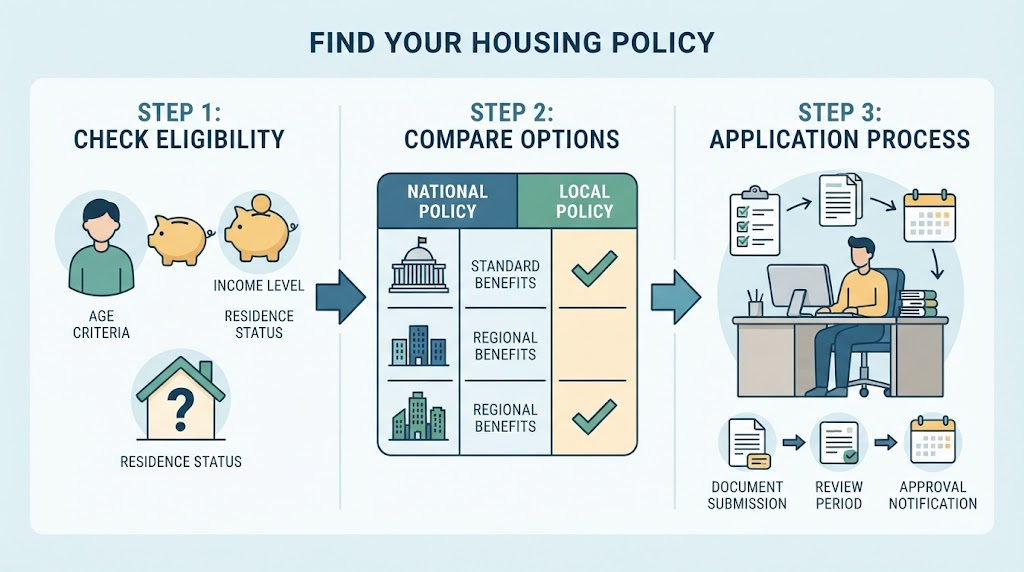
From the jeonse fund loans to direct monthly rent support we looked at earlier, housing support systems for youths are this diverse. “Then, out of all these policies, what on earth should I choose to get the most benefit for myself?” We reveal a practical checklist to choose the housing support that fits you perfectly by 100% utilizing the comparison table reviewed earlier!
- 3 Core Criteria for Choosing Housing Support That Fits You Perfectly
Step 1: Understand your housing type (jeonse vs. monthly rent) and financial situation
If you are in the stage of gathering lump-sum money to find a jeonse, place ‘deposit preparation and interest support’ as your top priority, and if monthly fixed rent expenses are choking your breath right now, place ‘direct monthly rent support’ at the very top priority.
Step 2: Check income criteria (individual alone vs. parents combined)
Screening criteria differ for each policy. Accurately cross-reference through National Tax Service Hometax data whether it is a project that looks at parents’ income together like government monthly rent support, or a project that only looks at the youth’s own (or spouse’s) income.
Step 3: Utilize ‘Bokjiro’ and customized inquiries on your place of residence’s youth portal
By accessing welfare portal sites or your residential local government’s youth portal and entering your residence and income, you can narrow down the housing policies you can apply for in just 1 minute.
- Precautions You Must Never Miss When Choosing Housing Support
Remember the principle of no duplicate benefits among similar housing support
Since government monthly rent support and local government’s own monthly rent support can often not be received in duplicate, you must compare the support amount and payment period to strategically choose the side that gives greater benefits.
Check public rental housing residence status and duplicate restrictions
If you are already enjoying public rental benefits such as Happy Housing or purchased rental housing, there may be restrictions on using some cash-type monthly rent support or loan products, so you must carefully read the exception clauses in the announcement notice in advance.
💡 Smart Housing Support Selection Tip!
Since most housing support projects close early when the budget is exhausted or have fixed application periods during the year, writing down the application schedule of policies you are interested in on your calendar in advance and preparing quickly like an open-run is the secret that decides success or failure.
With this, the draft for the Naver blog post is being solidly completed! If you need the last chapter [6. Conclusion] draft, English SEO meta tags, HTML conversion, etc., please feel free to let us know anytime.

Conclusion: Reduce Housing Cost Burdens with Thorough Comparison and Fast Application!
This is the draft of the final section for a Naver blog post titled [6. Conclusion: Reduce Housing Cost Burdens with Thorough Comparison and Fast Application!]. It was written to offer warm encouragement to readers and urge action.
[Body Draft]
We have carefully examined everything about youth housing support systems, from deposit loans to direct monthly rent support, and the core criteria for choosing the policy that fits you.
In the midst of soaring housing costs and monthly rent burdens, finding the most advantageous benefits for yourself is by no means an easy task, but if you put in a little bit of legwork based on the contents compared today, you will surely discover great opportunities that will robustly protect your precious wallet. Putting it off by thinking “I’ll do it when I have some free time later” often leads to missing precious application periods, so why not start a light inquiry right now through the comparison table checked today and ‘Bokjiro’ and your residential portal?
We sincerely cheer for the housing stability and better future of all youths who fiercely endure the day and build their own tomorrow!
We hope today’s posting content was a small help to your smart housing cost savings. If you found it informative, please leave a neighbor add, sympathy, and a comment! We will come back with more fruitful and practical living information next time. Thank you!
If you need English SEO meta tags (description and keywords), HTML conversion for Naver blog publishing, or AI image generation prompts suitable for the posting in relation to the completed blog body, please feel free to let us know anytime!
Korean version: 한국어로 읽기