Introduction: Why Should You Prepare Your Moving Decluttering in Advance?
When packing boxes ahead of a move, you’ll be newly surprised, thinking, “I’ve lived piling up this much trash.” If you rush to pack your things only when the moving date is imminent, you fail to properly dispose of items you need to throw away, inflating moving costs or throwing away precious items entirely, making it easy to suffer financial losses.
Particularly, large home appliances, furniture, and household items neglected for a long time require more time and effort to process than expected. There are countless cases where you regret it only after loading them onto a moving truck on the day of the move, thinking, “I shouldn’t have brought this,” or break into a sweat hastily attaching stickers due to non-standard disposal.
Then how should you handle moving waste most wisely while minimizing losses? From now on, let’s examine one by one the step-by-step disposal procedures and money-saving tips you must know when you have a lot of items to throw away.

Step 1: Categorizing Items to Throw Away vs. Items to Take (Core Tips)
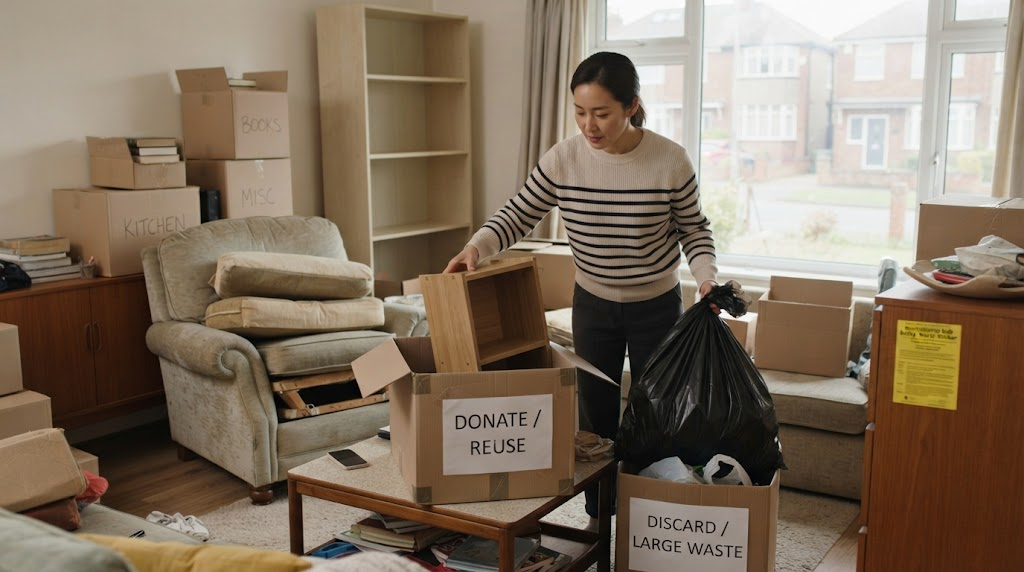
The success or failure of moving waste disposal depends on how clearly you distinguish between “things to throw away” and “things to take” before full-scale packing begins. Because taking everything unconditionally and disposing of it after entering your new home takes twice the effort and cost, sorting work before moving is an essential dieting process.
- Establishing criteria for boldly clearing out unused items
Utilize the 1-year rule: Items you haven’t laid hands on or used even once over the past year have a very low probability of being used in your new home either. Boldly put them on your disposal list.
“I’ll use it later” is taboo: Miscellaneous items or storage boxes collected while thinking “I’ll use them someday” are mostly left neglected in corners even after moving. If you don’t need them right now, clearing them out boldly is the shortcut to saving space and costs.
Broken or expired items: Non-working small appliances, torn or frayed bedding and clothing must be excluded from moving targets and organized in advance to reduce moving truck capacity.
- Separation tips by home appliances, furniture, clothing, and household goods
Large appliances and furniture: Identify in advance furniture that does not fit your current home’s layout or your new home’s interior and size. In particular, it is advantageous to dispose of appliances that are old and whose relocation and installation costs would be higher, matching the timing of your move.
Clothing and fabrics: Outdated clothes or clothes you haven’t worn for several years because they are out of season should be cleared out in advance through home collection bins, donations to Beautiful Store, or clothing collection bins.
Remaining daily necessities and food ingredients: Use them up as much as possible during the moving preparation period, and sort out remaining seasonings or canned goods in advance to reduce unnecessary weight.
Now that the sorting work is finished, let’s look step-by-step at free collection methods where you can dispose of items without spending money.
Step 2: How to Dispose of Items for Free Without Spending Money
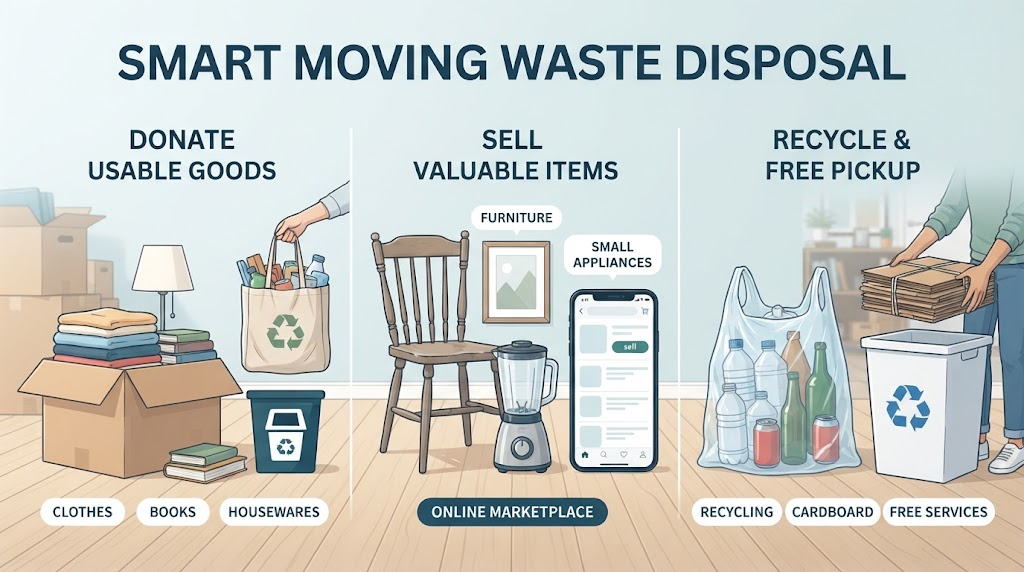
One of the most regrettable costs during the moving preparation process is waste disposal fees. Even if you have many items to throw away, depending on their condition and category, there are ways to dispose of them for free or even gain benefits without spending money. Let’s find out the core tips you should check first before buying stickers to throw things away.
- Applying for Free Home Collection of Large Appliances via e-Circular Governance
Target items: Large home appliances such as refrigerators, washing machines, air conditioners, and TVs, as well as small and medium-sized home appliances meeting a certain quantity or more, are included in the target.
How to use: You can easily make a reservation through ‘e-Circular Governance (Waste Home Appliance Free Collection)’, the official waste home appliance free collection site recognized by the Ministry of Environment.
Key benefits: Because collection technicians directly visit homes to pick up home appliances, there is no need to suffer while moving heavy appliances, and it is the most economical because separate large-waste sticker costs are not incurred at all.
- Recommendations for Free Sharing and Sales Outlets for Furniture and Used Goods in Good Condition
Utilizing used transaction platforms: By utilizing local-based communities like Danggeun Market or Junggonara, you can quickly dispose of usable furniture and household goods ahead of your move. If you set prices low or list them as “free sharing,” transactions are completed quickly, effectively reducing your moving luggage.
Precautions for direct transactions: In the case of large furniture, if you list them under the condition that the buyer picks them up directly (“bring-it-yourself condition”) or coordinate disposal schedules to match your moving date, you can save on moving truck costs and waste costs at the same time.
- Utilizing free collection services for clothing and small household goods
Clothing, shoes, bags, and other items can be disposed of through neighborhood clothing collection bins or home collection companies. Since some companies provide a small cash compensation if items exceed a certain weight, it is a good idea to check whether items are recyclable before throwing them away.
Large furniture, damaged furniture, and large quantities of household waste that are difficult to process for free must go through the local government reporting procedure. We will look at the detailed methods in the next step.
Step 3: Purchasing Large Waste Stickers and Reporting Procedures to Local Governments
Large waste such as large furniture, mattresses, and bicycles that are not eligible for free sharing or home appliance collection must be reported and disposed of through the competent local government. Since fines can be imposed for illegal dumping, it is safe to follow the established procedures.
- Methods for visiting a community center or reporting online (district office website)
Online reporting (recommended): Access the official website of the district office of your residential area or the local government’s dedicated waste reporting page. It is convenient because you can apply anytime, 24 hours a day, via PC or mobile.
Offline reporting: If online use is difficult, you can visit the competent administrative welfare center (community center) in person to apply. However, when visiting the community center, you must know the exact specifications and types of items in advance for smooth processing.
- Checking exact fees by item and disposal tips
Entering specifications and types: Fees for beds, wardrobes, sofas, etc. vary depending on specifications (single/queen, number of feet, etc.). If reported with the wrong item, collection may be delayed or rejected, so you must measure dimensions accurately and enter them.
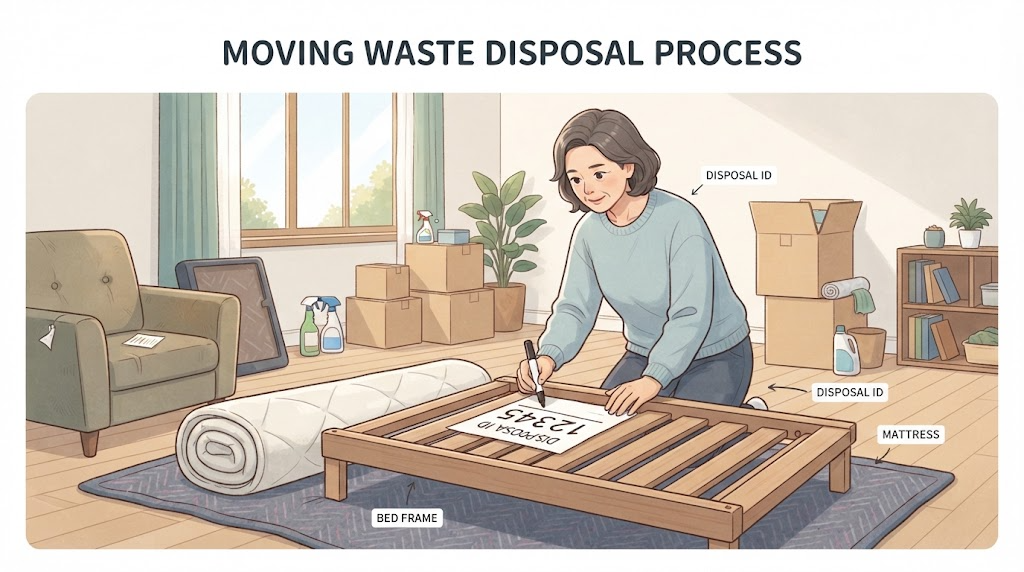
Attaching payment certificates (stickers) or writing down numbers: After reporting online and completing payment, a payment certificate number is issued. You must write this number largely in handwriting on a blank piece of paper and firmly attach it to the waste, or print and attach the sticker issued depending on the local government. (※ Nowadays, in many cases, items are collected just by writing the number clearly even without printing a sticker.)
- Precautions when discharging
Compliance with discharge date and time and location: You must place items out on the designated discharge date and location specified during reporting (usually in front of your house or at a designated collection spot). Rather than rushing to put them out on the morning of the moving day, it is better to coordinate the collection schedule and moving schedule to discharge them in advance.
Prohibition of arbitrary discharge: If you discard items without a report certificate, it is regarded as illegal dumping and becomes subject to a fine, so please make sure to discharge items after going through the normal reporting procedure.
What should you do if an overwhelming amount of items to throw away pours out all at once, making it difficult to handle even with local government reports? In the next step, let’s learn about precautions when using bulk waste and professional companies.
Step 4: Precautions When Using Bulk Waste and House Cleaning Companies
If you are immigrating, doing a large-scale move, or have accumulated household items for a long time so that an overwhelming amount of waste pours out that you cannot handle alone, there is a limit to individuals attaching stickers one by one to throw them away. Useful at times like this are professional house organizing companies or moving waste disposal agency services. However, if you choose the wrong company, you may pay unnecessary additional costs or run into disputes, so you must carefully check the following items.
- Criteria for selecting waste treatment companies (house cleaning, memento sorting companies, etc.)
Whether they are officially licensed companies: In the case of unlicensed companies, they may illegally dump collected waste or leave it unattended arbitrarily, which can later bounce fines or legal liabilities back onto the client. You must check whether they are legal companies officially registered with the competent district office.
Checking company portfolios and reviews: It is a good idea to check in advance through actual user reviews and work photos whether their work handling is prompt and neat, and whether they professionally handle furniture disassembly or demolition work.
- Tips for comparing estimates and preventing rip-offs on additional costs (ladder trucks, labor costs, etc.)
Receiving visit estimates or detailed photo estimates: If you roughly ask for estimates over the phone, there are many cases where they demand excessive additional fees on-site later under the excuse that “there is more luggage than expected” or “the floor is high.” It is safe to receive estimates from at least two companies and compare them (including non-face-to-face photo estimates).
Pre-specification of additional cost items: You must receive a clear confirmation in advance before contracting—via documents or text messages—whether ladder truck usage fees, elevator usage fees, special waste (stone beds, marble, etc.) disposal costs, worker labor costs, etc., are included in the estimate, or if there are any additional costs incurred on-site.
- Management on the day of work and final confirmation
Pre-separating valuables and essential stored items: Before the company collectively collects and organizes your belongings, you must directly pack important documents, valuables, cash, etc. in advance to prevent loss accidents.
On-site inspection: After the work is completed, it is a rule to settle the final balance only after finally confirming that items to throw away were not omitted and were handled cleanly.
If you have wisely utilized even the help of professional companies, it is now time to wrap up your move while lightly summarizing the entire process. We will summarize the core contents in the final concluding remarks.
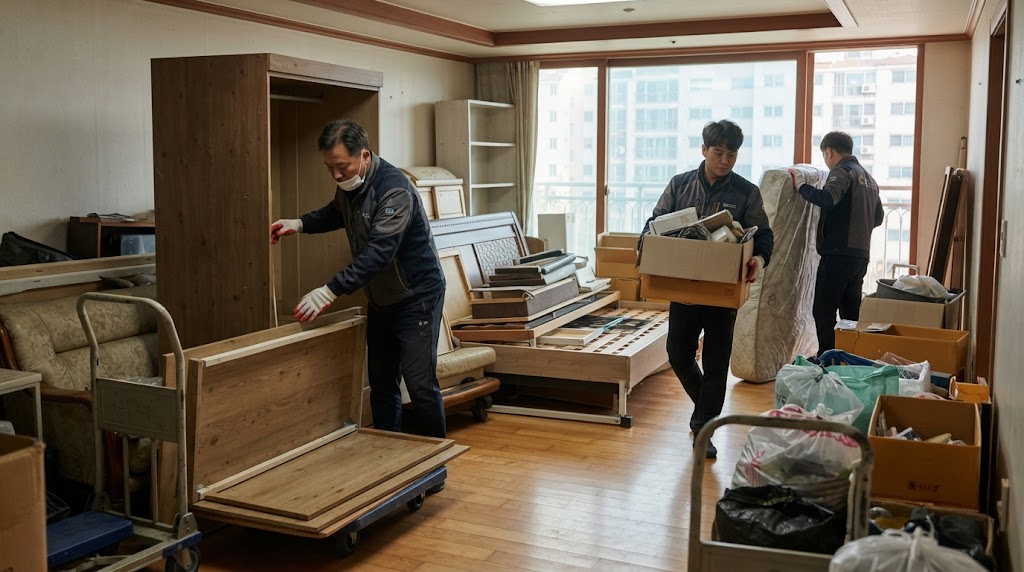
Conclusion: Saving Costs Through Wise Moving Waste Arrangement
When facing mountains of accumulated luggage ahead of a move, it is easy to feel overwhelmed first. However, if you step-by-step apply the step-by-step procedures examined today, you can empty your house neatly with much less cost and effort than expected.
Step 1 (Sorting): Boldly weeding out unnecessary items utilizing the 1-year rule and reducing moving truck capacity
Step 2 (Free Collection): Processing home appliances and furniture without spending money through e-Circular Governance and used sharing platforms
Step 3 (Local Government Reporting): Accurately reporting and discharging remaining bulk waste through the district office website or community center
Step 4 (Professional Companies): Resolving safely without rip-off costs through officially licensed companies when the quantity is too large
Moving is an exciting process preparing for a new start. Rather than delaying the sorting of items to throw away and experiencing confusion on the day of the move, we hope you will make plans in advance with leisure, save unnecessary costs, and prepare for a wise move with a light body and mind.
Korean version: 한국어로 읽기