Introduction (Prologue)
“The inside of the house has become clean, but the moment you step outside the door, dirty looks from neighbors pour in.”
After finishing a move, major cleaning, or interior renovation, you feel refreshed as you clear out worn-out furniture and broken home appliances that had piled up throughout the house. However, the moment you carry the heavy load downstairs and place it outside the front door or at the corner of an alley, unexpected conflicts often begin.
“This is a walkway people use, so what are you doing blocking it like this?”
“There’s no room to turn a car around, so why are you piling waste up here?”
Even though you clearly bought a waste sticker or completed the reporting via a mobile app, it is a very common occurrence to have awkward confrontations with neighboring residents or have complaints filed with the district office just because of the disposal location. This is because the disposal process is not entirely finished simply by attaching a sticker and setting items out.
Mattresses blocking walkways, large wardrobes obstructing line of sight, and chests of drawers protruding into the middle of sidewalks not only block the movement of strollers and wheelchairs, but also easily lead to tripping accidents for pedestrians on dark night roads or vehicle scratching accidents. In severe cases, they may obstruct the entry of emergency fire trucks, or you could even face illegal dumping fines (up to 1,000,000 KRW) for violating local government ordinances.
Because it is a shared space used together with neighbors even if it is in front of your own house, ‘where, how, and in what condition you set it down’ is just as important for bulky waste as the collection procedure.
In this post, we will systematically explain legal waste disposal locations by housing type and the 4 major disposal safety rules to help you achieve a neat finish free of friction with neighbors, without worrying about traffic obstruction or safety accidents.
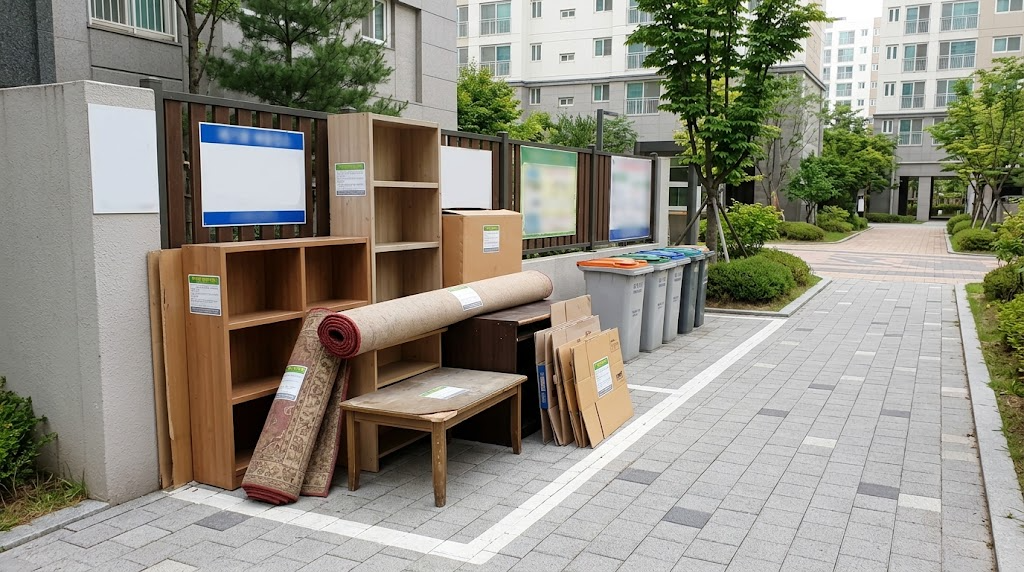
Standards for Legal Bulky Waste Disposal Locations by Housing Type
The primary reason most civil complaints and conflicts between neighbors arise during bulky waste disposal is ‘not knowing the correct disposal location suited to the housing type.’
Places equipped with dedicated collection stations, like apartments, and multi-family or detached houses adjacent to alleyways have completely different collection routes and management entities. Here is a summary of legal disposal locations by residence type and boundary criteria that require caution.
- Apartments and Large Officetel Complexes: Designated Collection Zones Within the Complex
For apartments or large-scale officetels, local government collection vehicles do not enter deep inside the complex; rather, collection takes place based out of designated bulky waste collection stations within the complex.
- Confirming Designated Locations: The ‘bulky waste storage area’ prepared on one side of the recyclable sorting station or an open space designated by the management office serves as the disposal location.
- Disposal Procedures: If you place items arbitrarily on the sidewalk in front of a residential building, around flowerbeds, or at the entrance to an underground parking lot, you will receive an immediate removal request for violating complex management bylaws and obstructing fire access.
- Core Check: You must first visit the management office to record the building/unit number and item names in the waste handling ledger, attach an internal sticker or obtain confirmation of the district office disposal number according to complex-specific rules, and then neatly set the items inside the collection station on the designated date and time.
- Villas, Row Houses, and Multi-Family Houses: 1st Floor Piloti Parking Corner vs. Next to Common Entrance
Villas or multi-family houses without a separate management office are the housing types where friction between residents occurs most frequently.
- Basic Disposal Location: As a basic rule, an inner spare space (corner area) of the 1st floor piloti parking lot or beneath the exterior building wall, where collection vehicles can access easily without obstructing pedestrians, serves as the spot.
- Locations Requiring Caution:
- Directly in Front of the Common Entrance Door: Absolutely prohibited, as it directly blocks the ingress and egress of delivery couriers and residents.
- Inside Parking Bays: May cause disputes over vehicle scratches or damage by obstructing other residents from parking. You must find an idle space that does not intrude into parking lines.
- Prior Understanding with Neighbors: Briefly sharing the scheduled disposal date and items via the resident group chat or the 1st-floor bulletin board before attaching the disposal certificate (reception number) can prevent unnecessary misunderstandings or false reports of illegal dumping.
- General Detached Houses and Commercial-Residential Buildings: Rule of in Front of One’s Own Main Gate, Under the Wall
In areas densely populated with detached houses, ‘disposal in front of one’s own house (curbside disposal)’ is the grand principle under local government ordinances.
- Observing One’s Own Property Boundary: Waste must be placed closely ‘directly in front of one’s own main gate’ or ‘under the exterior wall of one’s own building.’
- Common Mistakes and Conflict Factors:
- “The space in front of our house is narrow, so let’s put it in the vacant lot across the street or under a utility pole”: A representative case mistaken for illegal dumping. If placed under a utility pole or beneath a neighbor’s wall, it is deemed ‘unauthorized dumping’ even if it is your own waste, and you may be subjected to fines.
- Encroaching on Sidewalk and Roadway Boundaries: Items should be stacked vertically as close as possible to the building wall to prevent passing vehicles from hitting side mirrors in alleyways or pedestrians from tripping.
Disposal Locations and Key Precautions by Housing Type at a Glance
| Housing Type | Recommended Disposal Location | Strictly Prohibited Disposal Area | Key Checkpoints |
|---|---|---|---|
| Apartments / Officetels | Designated bulky waste collection area within the complex | Apartment entrances, flowerbeds, hallways, and emergency stairs | Prior report to management office and check internal disposal permit |
| Villas / Multi-family | Corner of 1st-floor piloti parking lot, under exterior walls | In front of common entrance doors, inside active parking spaces | Check for obstruction to parked vehicles, share notice with residents in advance |
| Detached / Commercial houses | Directly in front of one’s own gate, tight against building exterior walls | Under neighbors’ walls, vacant lots, middle of the road, around utility poles | Adhere to ‘curbside disposal in front of one’s house’, minimize road encroachment |
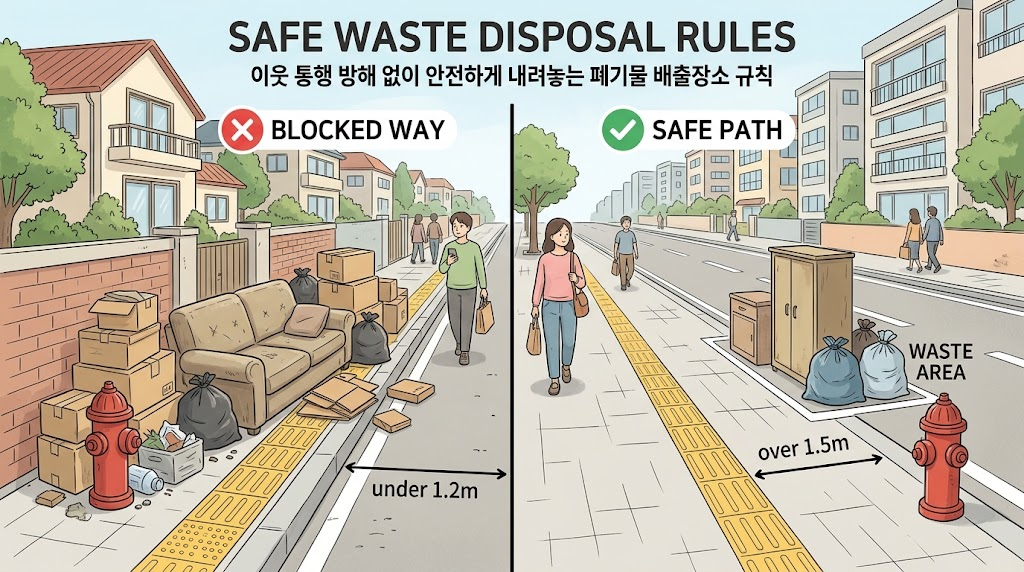
4 Core Disposal Rules to Avoid Obstructing Pedestrians and Vehicle Traffic
When putting out bulky waste, simply leaving it in an ’empty lot’ or ‘by the street’ is not enough. A carelessly placed mattress or drawer chest can infringe upon neighbors’ right of passage, cause serious safety accidents, and even lead to legal penalties.
Here are 4 core disposal rules to follow so that waste is collected safely without causing inconvenience to pedestrians and vehicle traffic.
- Secure a Valid Sidewalk Width of at Least 1.5m: Protecting Walkways for Vulnerable Pedestrians
When placing waste near sidewalks or pedestrian pathways, the travel routes of strollers, wheelchairs, and visually impaired individuals must be prioritized above all, not just regular adults.
- Securing minimum walkway width: Place waste flush against the wall, but always secure an effective sidewalk width of at least 1.5m (or at least 1.2m under unavoidable circumstances) for people to pass through.
- Strictly prohibit encroaching on tactile paving: Piling items on yellow tactile paving that guides visually impaired pedestrians is a clear infringement of pedestrian rights that causes severe tripping accidents. Never place waste on tactile paving or within a 50cm radius around it.
- Prohibit Piling Near Fire Truck Access Routes and Firefighting Water Facilities
Do not block the routes of emergency vehicles where every second counts during fires or emergency situations.
- Prohibit piling within 5m around fire hydrants: According to the Road Traffic Act and the Framework Act on Firefighting Services, items cannot be piled within 5m of firefighting water facilities such as outdoor fire hydrants and emergency fire extinguishing equipment. Violations may result in administrative fines.
- Secure fire engine access zones: Never stack bulky furniture or appliances even temporarily inside the ‘fire engine access zone (yellow rectangle markings)’ painted on the ground of apartment or villa complexes.
- Consider Blind Spots and Turning Radii in Alleys: Securing Vehicle Line of Sight
Piling waste on alley corners or intersection turns obstructs drivers’ line of sight, creating a high risk of pedestrian collisions or damage to the waste by vehicles turning through the alley.
- Prohibit piling at corners: Alley corners or curved sections are points where turning radii (off-tracking) increase as vehicles turn. Avoid areas directly in front of corners and place items against walls along straight sections.
- Ensure accessibility for collection vehicles (1-ton to 2.5-ton trucks): If waste is discharged deep inside landlocked parcels or dead-end alleys, collection trucks from the district office contractor may not be able to enter, causing delays in collection. Verify that there is enough clearance for large trucks to stop and load items.
- Prohibit Piling in Apartment Hallways and Emergency Stairs: Beware of Violating the Fire Facility Act
People often stack bulky waste temporarily in front of entrance doors, hallways, or stair landings (emergency staircase corners) because moving it down to the 1st-floor collection area is cumbersome. This is not just a neighborly nuisance, but a violation of the law.
- Article 16 of the Act on Fire Prevention and Installation, Maintenance, and Safety Management of Firefighting Systems (Maintenance and Management of Evacuation Facilities, etc.): Hallways, stairs, and exits of multi-family housing such as apartments and officetels are evacuation facilities that serve as escape routes during fires.
- Fine imposition criteria: If caught stacking items or placing obstacles in evacuation facilities that hinder evacuation, fines of up to 3,000,000 KRW can be immediately imposed following an inspection by the fire department. Once you decide to dispose of items, keep them indoors and move them directly to the designated 1st-floor zone on the day of disposal.
Disposal Checklist to Prevent Obstruction of Traffic
| Inspection Item | Criteria | Pass Status |
|---|---|---|
| Walkway Width | Secured at least 1.5m so strollers and wheelchairs can pass without difficulty | [ ] Confirmed |
| Tactile Paving | Yellow guide lines on sidewalk blocks completely cleared | [ ] Confirmed |
| Firefighting Facilities | 5m around fire hydrants avoided and fire engine exclusive areas avoided | [ ] Confirmed |
| Vehicle Visibility | Positioned flush against straight walls outside the turning radius of alley corners | [ ] Confirmed |
| Common Evacuation Routes | Apartment hallways, areas in front of elevators, and emergency stairwells completely cleared | [ ] Confirmed |
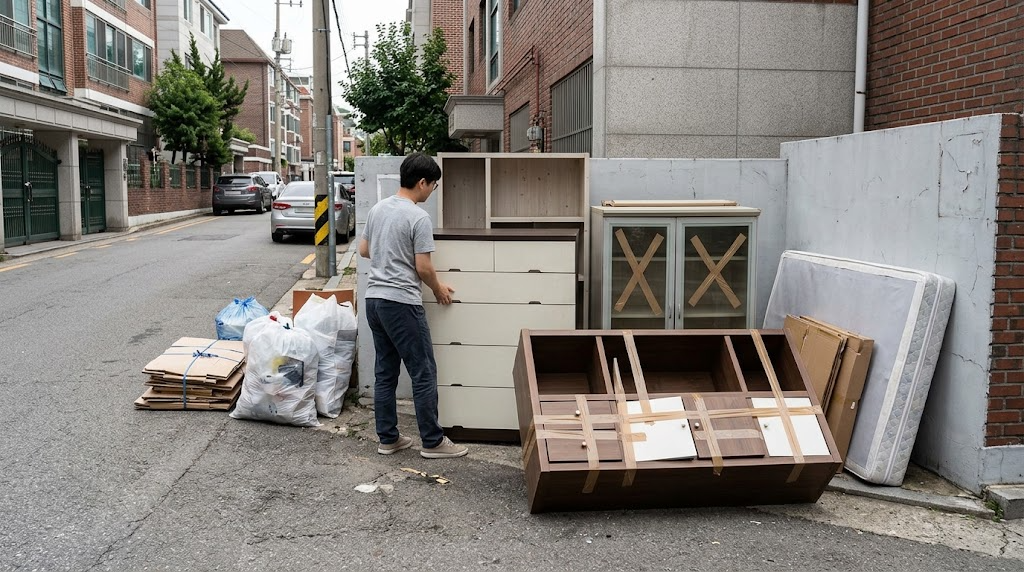
Stacking and Finishing Tips to Prevent Secondary Safety Accidents (Damage and Toppling)
Even if bulky waste is placed in a safe location, if the condition of the object itself is unstable, secondary safety accidents where items topple or break due to strong winds or slight contact from neighbors can occur.
To prevent mishaps such as children getting injured while playing or scratching passing vehicles, here is a summary of 4 stacking and hazard-finishing tips that must be applied before disposal.
- Preventing Furniture Toppling (Falling Over): Placement Methods for Chests of Drawers, Bookcases, and Wardrobes
Tall wooden furniture or pieces with a high center of gravity easily spill forward when the wind blows or when balance is lost.
- Taping to Prevent Drawers from Opening: For chests of drawers or storage units, there is a high risk of tipping over as the center of gravity shifts when drawers slide forward during transport. Secure drawer tracks and hinged doors firmly across with paper tape or packing tape.
- Placing in a Low Stance or Laying Flat:
- Tall chests of drawers with 3 or more tiers and 5-tier bookcases must be placed standing with their backs completely flush against a wall.
- On flat ground without suitable wall support, rather than leaving items standing, laying them completely flat so that the wider surface touches the ground is the safest way to stack them.
- Securing Disassembled Shelves: Removable shelves inside bookcases or interior panels of wardrobes easily detach and rattle around, so bind and secure them inside the main body using string or tape.
- Mirrors, Glass Tables, and Full-Length Mirrors: Measures to Prevent Breakage and Scattering
The items that cause the most fatal injuries during waste collection or while piled up are fragile glass and mirrors.
- Tape ‘X’ Marking: To prevent shards from scattering in all directions in the event of breakage, thoroughly apply packing tape in an ‘X’ shape or grid pattern across the entire front surface of the mirror or glass tabletop.
- Corner Cushion Packaging: Glass is especially vulnerable to corner impacts. Fold thick corrugated cardboard from delivery boxes, pad it across all 4 corners, and wrap it with tape.
- Warning Sign: “Caution: Fragile Glass”: Write a large “Caution: Glass / Handle with Care” warning in permanent marker on the front so night pedestrians and collection workers can easily identify it.
- Removing and Cushioning Protruding Nails, Screws, and Hinges
Hardware protruding while disassembling furniture or dismantling bed frames can tear pedestrians’ clothing or puncture skin, causing injuries such as tetanus.
- Completely Removing or Hammering Screws and Nails: Completely unscrew protruding screws using an electric drill or screwdriver, and hammer unremovable nails to bend them completely flat against the wood.
- Wrapping with Cushioning Material: If sharp iron hinges, angle brackets, or handles protrude, cover them with bubble wrap, newspaper, or scrap cardboard, and wrap them thickly with tape to block exposure.
- Preparing for Strong Winds and Rain: Covering with Waterproof Tarps and Sealing Stickers
If waste is exposed to rain while left outdoors, furniture plywood absorbs water and swells, becoming 2 to 3 times heavier, which not only delays collection work but also causes disposal stickers to get wet and peel off.
- Using Plastic Sheets or Kimchi Plastic Bags: Mattresses or fabric sofas become heavily soiled, heavy, and emit foul odors when soaked with rain. It is best to cover them with large plastic sheets or waterproof covers to block moisture.
- Waterproof Attachment of Disposal Certificates (Stickers):
- Stickers issued by the district office or A4 sheets with written registration numbers easily get wet from rain or blown away by wind.
- Place the paper inside a transparent ziplock bag or transparent plastic bag, and seal all 4 edges firmly to the front of the furniture using clear packing tape. This ensures collection workers can immediately scan barcodes and registration numbers even on rainy days.
Guide to Preventing Secondary Safety Accidents by Item
| Waste Item | Major Risk Factors | Essential Safety Measures |
|---|---|---|
| Chests of drawers / Wardrobes | Doors opening, tipping over due to shifted center of gravity | Secure doors and drawers with tape, place flush against a wall or lay flat on the ground |
| Mirrors / Glass furniture | Impact breakage, sharp glass shards scattering | X-shape taping, corner box padding, mark ‘Caution: Glass’ |
| Beds / Ready-to-assemble furniture | Punctures caused by protruding screws, nails, and metal hinges | Hammer nails down flat, wrap protruding sections with cardboard |
| Mattresses / Sofas | Weight increase from rainwater absorption, mold and foul odors | Cover with plastic sheeting, seal and attach disposal certificate with plastic |
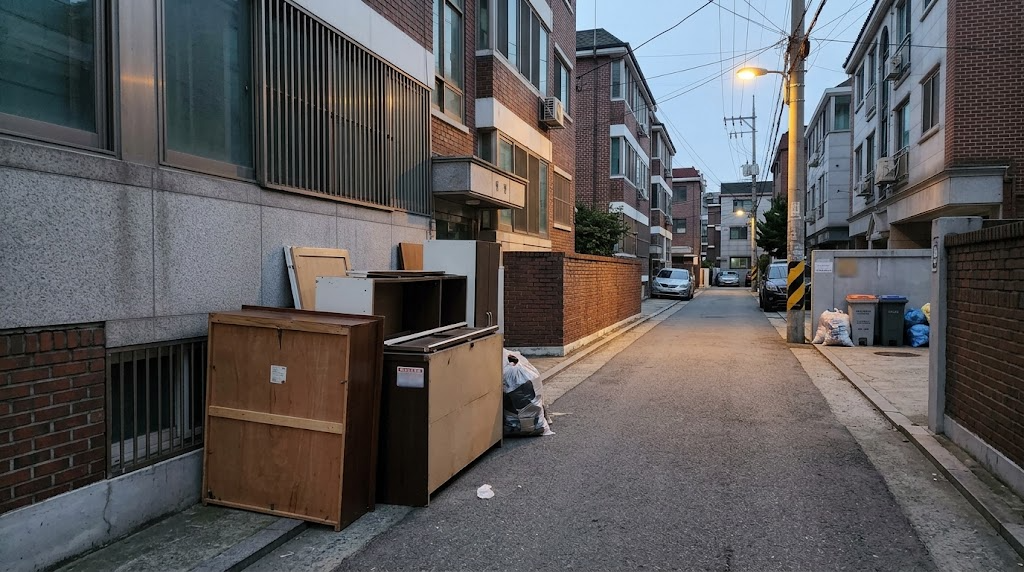
Observing the Golden Time for Disposal Tailored to Local Government Collection Schedules
In bulky waste disposal, what is just as important as attaching stickers and selecting locations is the ‘timing (time slot) of setting items out.’
Even if you have completed reporting, placing items on the street several days in advance makes them easily turn into unauthorized dumping sites or targets of neighborhood complaints due to exposure to rain and wind. Here are 3 golden time rules for disposal aligned with local government cleaning administration systems.
- “Disposal Immediately After Reporting” Is Prohibited: The Rule of Disposal After Sunset
In many cases, people drag furniture outside in broad daylight as soon as they complete their waste disposal registration online or via mobile apps. This is a disposal habit to avoid.
- Waste Induction Effect (Broken Windows Theory): Even if furniture is properly reported, if left on the street in broad daylight, passersby toss paper cups, cigarette butts, and standard trash bags around it, quickly turning it into an ‘unauthorized dump site.’
- Standard Local Government Disposal Hours: Most municipal ordinances nationwide designate the official disposal time as ‘from after sunset on the scheduled disposal date (after 18:00–20:00 in the evening) until midnight or before 06:00 early the next morning.’
- To prevent pedestrian inconvenience during the day and preserve alley aesthetics, the rule is to store items indoors or in idle building spaces and place them outside after it gets dark on the evening before the collection day.
- Check Collection Void Periods on Weekends and Public Holidays: Minimize Idle Time
Putting waste out on Friday afternoons or Saturday mornings can result in items being left on the street throughout the entire weekend.
- Collection Contractor Days Off: Most waste collection contractors designated by district offices do not conduct collection operations from Saturday afternoons through Sundays and statutory public holidays.
- Check Collection Day Rotation: The days bulky waste is collected vary by neighborhood (dong/ri units). (e.g., Mon/Wed/Fri collection zones vs. Tue/Thu/Sat collection zones)
- When designating the scheduled disposal date, choosing ‘Monday through Thursday evenings’ rather than the day right before the weekend ensures that collection trucks promptly haul away items during the next morning without delays.
- Prompt Verification and Response Tips When Collection Delays Occur
If items remain sitting for more than 2 to 3 days after the scheduled disposal date, do not leave them unattended; take proactive verification steps.
- Main Causes of Missed Collection:
- Discrepancy in Reported Details: Reporting a 3-seater sofa but putting out a 4-seater couch sofa, resulting in insufficient fees
- Incorrect Location Entry: The collection driver failed to locate items because the disposal location stated on the application differed from where the items actually sat
- Damage to Stickers/Registration Numbers: Paper was torn off by wind or rain, causing items to be classified as suspected illegal dumping
- Verification Steps:
- Check whether the current progress status is ‘Awaiting Collection’ or ‘Collection Completed (or Suspended)’ in the mobile app (Ppagi, Yeogiro, etc.) or on the district office website under [Application History Lookup].
- Contact the competent district office Cleaning Administration Division or the assigned collection contractor phone number and provide the location again, stating, “My disposal registration number is OOOO, but it is currently uncollected,” to arrange priority collection on the same day or the following day.
Key Checkpoints for the Disposal Golden Time
| Category | Ideal Disposal Timing | Disposal Timing to Avoid |
|---|---|---|
| Disposal Time | After sunset on the evening before collection day (19:00–24:00) | Broad daylight on weekdays, commute rush hours |
| Disposal Day | Monday, Tuesday, Wednesday, Thursday evenings (no collection void) | Friday evening, Saturday morning (left unattended all weekend) |
| Delay Handling | Immediately verify via phone with the contractor if uncollected by the afternoon of the collection date | Indefinite street abandonment (risk of suspected illegal dumping and fines) |
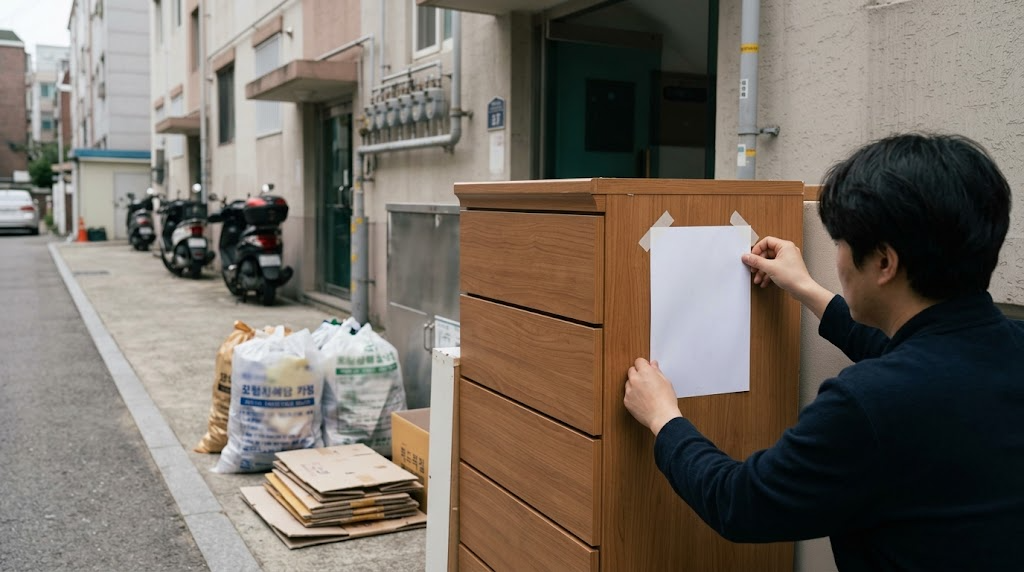
Tips for Attaching Mobile Waste Disposal Certificates and Taking Verification Photos
If you applied for bulky waste disposal via the district office website or a mobile app (Ppagi, Yeogiro, etc.) without visiting the community center in person, you must write down and attach the ‘mobile registration number (disposal certificate)’ directly instead of a physical sticker.
If a piece of paper is casually attached and gets soaked by rain or blown away by the wind, it may be mistaken for unauthorized dumping and collection may be refused. Here are tips on attaching disposal certificates and taking verification photos to display information legibly for both collection workers and neighbors, as well as to prevent potential disputes.
- 4 Mandatory Items to Write When Hand-Writing on A4 Paper
Even without a printer, writing the details clearly and largely with a permanent marker on a blank piece of paper or A4 sheet holds the exact same validity as an official sticker. However, if mandatory information is missing, collection workers cannot look up the record electronically, resulting in collection delays.
Registration Number (Report Number): Write the full alphanumeric combination in the largest font. (e.g., Registration Number: 2026-A12345678)
Disposal Item and Quantity: The exact specifications of the items actually placed out (e.g., 1 unit of 5-tier chest of drawers)
Discharger’s Name and Contact Info: Applicant’s name and the last digits of their mobile phone number (e.g., Gildong Hong / 010-XXXX-5678)
Scheduled Disposal Date: The disposal date registered in the report (e.g., Disposal Date: October 15, 2026)
Writing Tip: Ballpoint pens or pencils cannot be seen from a distance and smudge easily with water. Always use a thick black permanent marker (name pen) to write large enough so that it can be identified even from afar.
- ‘Plastic Seal Attachment Method’ Resilient Against Wind and Rain
While left outdoors for a day or two, paper is very likely to tear if it rains or dew forms.
- Place the written note inside a clear ziplock bag or transparent plastic bag.
- Face the opening downwards or seal the zipper thoroughly so rainwater cannot enter.
- Use clear packing tape to firmly adhere all 4 edges of the note flush against the furniture surface. (If casually attached only in the center, it will flutter in strong winds and tear off.)
- Attachment Location: Attach it at the ‘front center of the furniture’ or ‘upper eye level’, directly visible from alley walkways or the approaching direction of the collection truck, so collection workers can identify it immediately upon getting out of the vehicle.
- 3 Types of ‘On-Site Verification Photos’ to Preemptively Prevent Collection Disputes and Fines
The habit of taking on-site photos with a smartphone right after placing items out is crucial. It serves as definitive proof of compliance during unexpected situations where a passing pedestrian peels off the sticker or the collection driver marks “item missing” after failing to find the location.
Photo 1. Close-up Shot of Disposal Certificate:
A super close-up photo taken so that the attached registration number, item name, and date writing can be read clearly
Photo 2. Full-Body Shot of Item Condition:
A photo capturing the overall external appearance of the waste, damage-prevention taping, and the location where the disposal certificate is attached all within a single frame
Photo 3. Long-Distance Background Shot of Disposal Location (Most Important):
A long-distance photo where surrounding backgrounds of the disposal location—such as one’s own front gate, building address plate, nearby commercial signs, or parking lot pillars—can be identified together
- Keeping Photos and App Notifications Until Collection is Completed
Taken photos should be kept without being deleted until the collection truck actually loads the items and ‘Collection Completed’ appears on the local government’s electronic network.
Organize the photos once a notification arrives via mobile app or text message stating “Collection has been completed.”
If items still remain after the scheduled disposal date, calling the district office’s Cleaning Administration Division and sending the previously taken ‘Disposal Completion On-Site Photo’ will allow immediate rescheduling and collection processing without requiring an additional visit for verification.
These are the next steps to complete the blog post:
Write Section 7 ‘Conclusion (Summary and Next Episode Preview)’
Write English 16:9 thumbnail and body AI image generation prompts matching this post
Extract target keywords, 10 hashtags, and meta description for Naver top search exposure
Conclusion (Summary and Next Episode Preview)
Bulky waste disposal is not merely about clearing unused items out of the house; it is the final courtesy of safely considering neighbors and streets encountered every day.
Even if proper reporting procedures have been followed, neglecting disposal locations and methods even slightly can cause traffic inconveniences and safety accidents. Conversely, paying close attention to just a few basic rules ensures collection is completed in the cleanest and fastest manner without unpleasant friction between neighbors.
Summary of 3 Core Rules for Safe Waste Disposal
| Core Area | Action Practice | Expected Benefit |
|---|---|---|
| 1. Securing Location and Walkways | Disposal tight against one’s own front gate, securing an effective sidewalk width of 1.5m and fire access routes | Preventing obstruction to pedestrians and vehicles, preventing fines under the Fire Facility Act |
| 2. Finishing to Prevent Toppling and Damage | Taping chests of drawers, X-shape marking and corner padding on mirrors, removing protruding nails | Preventing secondary personal injuries caused by falling/toppling accidents and scattering shards |
| 3. Observing Disposal Golden Time | Disposal after sunset on the day before collection, attaching plastic-sealed disposal certificate, and keeping on-site photos | Preventing deterioration into unauthorized dump sites, providing complete proof of compliance in collection disputes |
A single piece of waste neatly put out in accordance with established rules protects our neighborhood’s walking environment and safeguards the safety of collection workers who work hard from dawn. If you have bulky furniture or home appliances to clear out this time, make sure to check the disposal rules detailed today.
[Next Episode Preview]
Have you been buying expensive waste stickers to throw away large home appliances like refrigerators, washing machines, and air conditioners?
In the next post, we will share in detail: “Bulky Waste Disposal Tips to Make Disposal Costs 0 KRW by Linking Free Home Appliance Collection (e-Circulation Governance Visiting Collection Application for Waste Home Appliances and Bulk Small Appliance Disposal Tips).”
These are the next steps to complete the blog post:
Korean version: 한국어로 읽기