Introduction (Prologue)
“I’m completely exhausted after work, so is it really possible to give up my weekends to study?”
This is a realistic concern that anyone preparing for a job change or wanting to upgrade their job skills considers at least once. It is by no means easy to readily take on self-development amidst working more than 8 hours a day at a main job, frequent overtime, and energy drained during commutes.
Moreover, the Tomorrow Learning Card, a government-funded support program by the Ministry of Employment and Labor, often feels like a benefit reserved only for unemployed individuals preparing for jobs or prospective university graduates. This is due to the preconception that the majority of programs are full-time bootcamps or vocational training courses operating during weekday daytime hours.
In reality, however, numerous office workers are smartly utilizing evenings after work and weekends by taking advantage of government subsidies. The Tomorrow Learning Card is also open to employed workers covered by employment insurance, and customized courses concentrated on weekday nights (7 PM to 10 PM) or Saturdays and Sundays are actively operated.
Studying as an office worker, which is difficult to sustain on mere willpower alone, requires above all an efficient route design that minimizes physical exhaustion and realistic study tips that prevent dropping out midway.
In this article, we will systematically examine practical ways to use the Tomorrow Learning Card tailored for office workers, helping you wisely divide your time after work and weekends to absorb 100% of the government funding benefits, and successfully complete everything from earning certifications to leveling up practical job skills.

Summary of Basic Eligibility and Benefits of the Tomorrow Learning Card for Office Workers
The Tomorrow Learning Card is a representative government support program that can be issued and utilized identically not only by the unemployed, but also by office workers (employed workers) covered by employment insurance. Before formally applying for courses, you should clearly understand the support limit you can receive and the qualification criteria by company size to set an appropriate plan.
- Basic Support Limit and Validity Period
- Basic Subsidy: A basic training fee of 3,000,000 KRW per person is provided in the form of a virtual voucher.
- Additional Support (Up to 5,000,000 KRW): An additional 1,000,000 to 2,000,000 KRW is provided if you belong to vulnerable groups such as low-income workers, non-regular workers, or workers in employment crisis zones, or if you satisfy specific requirements, extending the limit up to 5,000,000 KRW.
- Validity Period: Valid for 5 years from the card issuance date. You can divide the support limit across multiple courses within the 5-year period, and you can also apply for reissuance after the period expires or the limit is exhausted.
- Criteria for Preferential Support Target Enterprises (SMEs) vs. Large Enterprise Workers
For the Tomorrow Learning Card for office workers, differences occur in issuance qualifications and self-pay copayment rates depending on the size of the affiliated company and employment type.
| Classification | Workers at Preferential Support Target Enterprises (SMEs) | Workers at Large Enterprises | Non-Regular Workers / Specially Employed Workers |
|---|---|---|---|
| Issuance Requirements | 100% issued regardless of age or income if covered by employment insurance | Age 45 or older, or average monthly wage under 3,000,000 KRW (if under age 45) | All fixed-term, part-time, dispatched workers, and specially employed workers such as delivery drivers and home-tutors are eligible |
| Self-Pay Rate | Standard self-pay rate applied by occupational category (relatively low) | Slightly higher self-pay rate applied based on general job-duty courses | Additional reduction benefits on self-pay provided compared to regular workers |
Even if you work at a large enterprise, you are included in the issuance eligibility if you are aged 45 or older, or if your average monthly wage over the past 3 months was less than 3,000,000 KRW.
- Are Hobby or Certification Courses Unrelated to Job Duties Also Supported?
You can freely apply for the Tomorrow Learning Card even for fields completely unrelated to your ‘current company job duties’.
- It is completely acceptable for an IT developer to acquire baking or barista certifications after work.
- Training for career change and job transitions (side hustles/N-jobs), such as a marketer taking tax accounting or data analysis (SQL, Python) courses using weekends, is supported identically.
- Will My Company Be Notified of the Application? (Guaranteed Confidentiality for Employed Workers)
Many office workers worry: “I want to prepare for a job change or study for certifications secretly from my company, but will a notification be sent to the business owner?”
- Individually Driven Issuance: The Tomorrow Learning Card is a voucher that the worker applies for individually and that the government pays directly to the individual.
- No Notification to Business Owners: Details of an individual applying for and taking night or weekend courses are never notified to the company’s HR department or CEO, so you can proceed with confidence.
- Simple Issuance Process via Mobile ‘Goyong24’
For employed workers, document verification is very simple. Because it is automatically linked electronically with the employment insurance database of the Korea Workers’ Compensation and Welfare Service, there is no need to prepare separate documents such as certificates of employment or employment contracts.
- Access the Goyong24 mobile app and log in with simple authentication (Kakao, PASS, Naver, etc.)
- Select [Vocational Skills Development] ➔ [Tomorrow Learning Card] ➔ [Apply for Issuance]
- Automatically confirm ‘Worker’ under the support target classification
- Designate the card company (Shinhan/Nonghyup) and type (debit/credit) to receive, then enter the postal delivery address (home/workplace)
- Submit an electronic signature after watching the approximately 10-minute preliminary orientation video
Approval notification arrives via mobile within 2 to 3 business days after submission, and the physical card is delivered via registered mail to your specified address, allowing you to prepare for your courses quickly without visiting your company or going through complicated approval procedures.
1-Minute Filtered Search Guide for Tailored Night and Weekend Training Courses on Goyong24
With tens of thousands of government-funded training courses registered on the Goyong24 mobile app, failing to set accurate search conditions mixes in full-time daytime courses, making it difficult to find the classes you want. Here is a practical filtering setup guide to pick out only night and weekend classes in 1 minute on your smartphone screen.
- 4 Steps for Precision Filtering of Night & Weekend Classes
After entering [Vocational Skills Development] ➔ [Find Training Courses and Apply] from the Goyong24 app home screen, tap the [Detailed Conditions (Filter)] icon at the bottom of the search bar and configure the settings in the following order.
- Training Category: Select ‘Worker (Employed)’ or ‘All’
- Designate Class Days/Times:
If you want weekday evening classes: Check ‘Night’ (typically starting after 18:30–19:00) in the training time slot options
If you want intensive weekend classes: Check ‘Saturday’, ‘Sunday’, or ‘Weekend Class’ in the day-of-the-week selection
- Set Regional Filter: Select the city/county/district level you can actually commute to (e.g., Gangnam-gu, Bundang-gu, etc.)
- Apply Results: Tap [Search] at the bottom
Once set this way, daytime 8-hour full-time job seeker courses are completely filtered out, and only 3- to 4-hour courses tailored to working professionals’ schedules are neatly displayed.
- Near Home vs. Near Work: Criteria for Choosing the Optimal Route
The key to completing educational courses for office workers lies in ‘fatigue management.’ You need to choose different academy locations depending on the class days and formats to avoid absences.
Weekday Night Classes: ‘Near Work’ (walking distance or within 1 to 2 subway stops) is recommended
Commuting to an academy near home after work makes it easy to be late due to rush hour traffic or crowded subways. A route where you can have a quick bite right in front of work and enter class immediately is the most reliable.
Weekend Classes (Sat/Sun): ‘Near Home’ is recommended
Traveling back into downtown near the office on your weekend off causes significant psychological resistance. A location within a 30-minute radius of home where you can visit in casual attire is ideal for consistency.
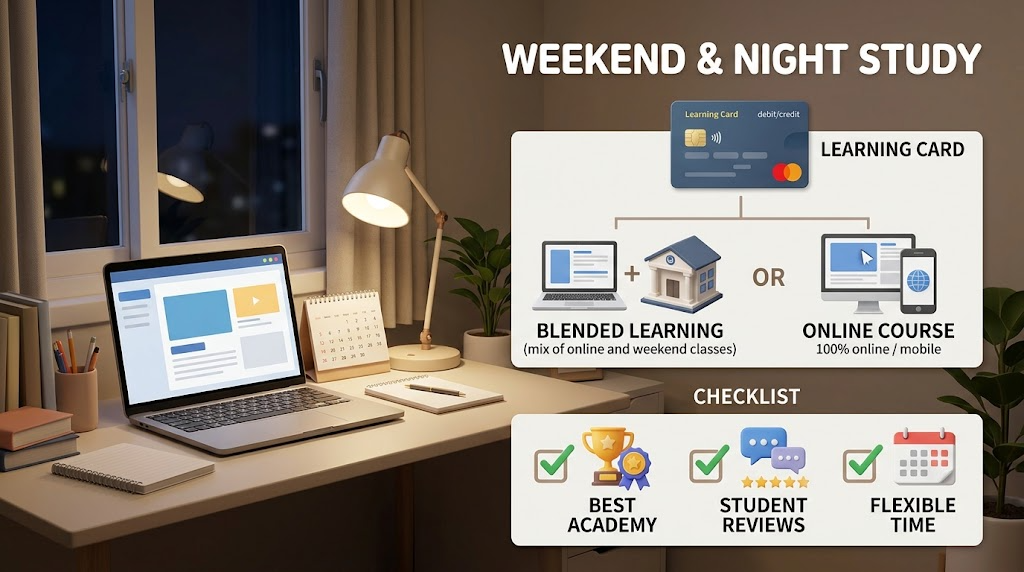
- Utilizing ‘Blended Training’ and ‘Remote Courses’ to Reduce Commute Burden
If you don’t have the bandwidth to travel to an academy 2 to 3 times every week, actively utilize the following two options in the class format filter.
Blended Training: A format where theory is taken via online lectures (VOD/live Zoom) after work on weekdays, and students gather at the academy only on Saturdays for hands-on practice and projects. It is favored most by office workers as it cuts the number of commutes by more than half.
Smart Vocational Training (STEP) & Remote Courses: Courses conducted 100% online via mobile/PC. Because you can study autonomously within a set period, it is ideal for office workers with frequent overtime or shift work.
- 3 Major Checkpoints to Select Fail-Proof Academies
Once the course list is narrowed down, navigate to the detailed page and make sure to review the following 3 factors before deciding to enroll.
Excellent Training Institution Certification Mark: Prioritize institutions with ‘3-Year Certification’ or ‘5-Year Certification’ marks granted by the Korea Institute for Skills Development and Quality after comprehensive evaluation of training performance, employment rates, and facilities.
Actual Course Reviews (HRD Course Reviews): Check the star ratings and descriptive reviews left by students of the immediately preceding cohort. Choose institutions that have ample practical comments such as “The instructor provides meticulous practical feedback” or “Assignments are adjusted to accommodate working professionals’ perspectives.”
Completion Rate of the Previous Cohort: A course that maintains a completion rate of 85% or higher proves that it has a systematic framework for managing office workers’ attendance and accommodating progress.
Recommended Night & Weekend Job Competency & Certification Courses Favored by Office Workers
Because night and weekend hours take a heavy physical toll, you should choose ‘courses that deliver definitive results in a short period’ or ‘skills that can be directly combined with current duties’ to ensure high completion rates and satisfaction.
Here are the 4 core categories and representative courses most frequently registered by office workers on Goyong24 with high completion rates.
- Directly Applicable to Work & Career Transition Specs: Tax Accounting & OA Certifications
This is the most popular field that not only boosts career transitions (job changes) but also immediately enhances salary negotiations and internal operational efficiency.
- Computerized Tax Accounting Level 1 & 2 / Computerized Accounting Level 1:
The undisputed #1 course for office workers aiming to move into finance, accounting, or HR teams, or looking to build management support capabilities. Because students directly use the KcLep software program alongside theory, practical night courses enjoy high popularity.
- Computer Specialist in Spreadsheet & Database (Level 1 & 2) Practical Prep Class:
A course designed to boost Excel (spreadsheet) and Access (database) formula application skills in a short timeframe. In addition to certification acquisition, many working professionals enroll to automate recurring daily manual Excel tasks and speed up clock-out times.
- IT and Data Competency: Practical Coding and Data Analysis for Non-Majors
Even without a complete career transition into development, this is an area where office workers intensively choose to increase their value as ‘planners and marketers who read and handle data.’
- Introduction to SQL-Based Data Analysis:
A practical skill for directly querying and processing necessary customer and sales data from internal corporate databases. Because it has a lower grammar barrier to entry than Python, it is ideal for humanities-background office workers to master in a short period through intensive weekend classes (4 to 6 hours on Saturdays).
- Python Basics & Task Automation:
Practical project-based courses that handle repetitive internal tasks such as web crawling, bulk Excel file merging, and automated email sending with a single script are actively offered as evening classes.
- Creative & Multi-Job (N-Job): Design, Video Editing, and Web Publishing
Targeted at office workers preparing for side hustles after work (YouTube, Smart Store, Kmong freelance gigs) or aiming to internalize marketing content production capabilities.
- Photoshop & Illustrator Practical Techniques:
Builds competencies to directly design visual assets for card news, product detail pages, and internal corporate reports. Portfolio-focused weekend classes that go beyond simple tool operation to create actual deliverables show strong demand.
- Premiere Pro & After Effects Video Editing:
Covers short-form (Reels/Shorts) and YouTube long-form content cut editing, subtitle templates, and motion graphics fundamentals. Due to the nature of video practice, a high proportion of students enroll in intensive weekend practice sessions at institutes equipped with high-spec PCs.
- Second Life and Retirement Preparation: Lifetime Certifications & Professional Skills
Customized courses for office workers in their 30s, 40s, and 50s who are preparing in advance for independent start-ups or freelancing transitions after retirement.
- Vocational Counselor Level 2:
A lifetime certification with no exam eligibility restrictions, opening paths into Employment Welfare Centers, university career centers, and headhunting sectors. Because students can steadily advance through theory-focused curricula on weekday evenings, the completion rate among employed workers is high.
- Barista Level 2 / Baking Craftsman Practical Class:
Steady preference among office workers as it allows both post-work relaxation and acquiring entrepreneurship techniques. Practical courses where students bake dough or extract espresso directly for 3 to 4 hours on weekend mornings are mainly opened.
Comparison of Recommended Training Courses for Office Workers at a Glance
| Category | Representative Recommended Course | Primary Purpose | Recommended Time Slot | Difficulty / Duration |
|---|---|---|---|---|
| Business & Administration | Computerized Tax Accounting, Computer Specialist Level 1 & 2 | Job change, practical Excel automation | Weekday evenings (2–3 times a week) | Intermediate / 1–2 months |
| Data & IT | SQL, Python task automation | Planning/marketing skill enhancement, N-jobs | Saturday intensive class (Once a week) | Intermediate / 4–8 weeks |
| Content & Design | Photoshop, Premiere video editing | Side gigs, internalizing content production | Weekend classes / Blended distance learning | Beginner–Intermediate / 1–2 months |
| Professional Certifications | Vocational Counselor Level 2, Barista | Retirement prep, freelancing, start-ups | Weekend morning / Weekday evening | Intermediate–Advanced / 2–3 months |

Know-How for Minimizing Out-of-Pocket Expenses and Stacking Corporate Benefits
When utilizing the Tomorrow Learning Card, the aspect office workers check most sensitively is ‘out-of-pocket expenses (the amount I actually have to pay).’ Depending on the course, copayments can range from 15% to as much as 55% of the training fee; however, by smartly interlocking government support systems with corporate internal welfare, you can lower your actual spending close to 0 KRW.
- Claiming Additional Reduction Benefits for Earned Income Tax Credit (EITC) Recipients and Others
According to government regulations, office workers who meet specific criteria can receive significantly larger discounts on their out-of-pocket expenses compared to ordinary employed workers.
Earned Income Tax Credit (EITC) Recipients: If you have a record of receiving the National Tax Service EITC within the past year, an additional 20% to 50% reduction benefit applies to the standard copayment rate. (Automatically verified in the system during course registration or applied by submitting a certificate of receipt facts)
National Employment Support Program Past Participants: Even after being employed as a worker, out-of-pocket copayments are fully waived or significantly discounted depending on the type of employment support program.
Maternity/Childcare Replacement Workers / Unpaid Leave Workers: For workers placed in employment-vulnerable periods, copayment rates are set noticeably lower compared to regular workers.
Verification Tip: Tap [View Out-of-Pocket Amount] for your desired course in the Goyong24 app and select your qualifying condition. You can immediately see copayments previously in the 200,000 KRW range drop down to tens of thousands of KRW.
- How to 100% Link with Corporate Internal Educational Support Programs
Many companies reimburse actual expenses within a certain annual limit (e.g., 500,000 to 1,000,000 KRW per year) for ‘self-development expenses’ or ‘job training expenses’ as part of employee benefits. Combining this with the Tomorrow Learning Card allows you to completely eliminate personal out-of-pocket spending.
Operating Principle: Most of the total training fee is first paid by the government subsidy (voucher), and only the remaining out-of-pocket amount of about 100,000 to 300,000 KRW is swiped on your physical Tomorrow Learning Card.
Proof and Reimbursement: After course completion, submit the [Course Confirmation Certificate (Receipt)] issued by the academy along with your card payment statement to the company’s general affairs/HR team to receive reimbursement for actual expenses via internal self-development funds.
Precautions: Some companies provide educational subsidies only for courses where ‘job relevance’ is proven, so it is recommended to review company policies in advance to verify whether the course connects to your department’s duties, such as marketing, accounting, or IT.
- Tips for Combined Payment with Welfare Points (Ezwell, Benepia, etc.)
If you are employed at a company that operates a corporate welfare mall, you can request payment deductions from your card statement using welfare points.
Credit/Debit Card Point Deduction: If your issued Tomorrow Learning Card (Shinhan Card or NH Nonghyup Card) is registered as a ‘Welfare Card’ in the corporate welfare point system, you can apply to deduct the approved out-of-pocket transaction paid at the academy using welfare points.
Since welfare points are an existing internal company budget already granted to you, the actual out-of-pocket cash exiting your bank account consequently becomes ‘0 KRW’.
- Whether Out-of-Pocket Expenses Qualify for ‘Education Expense Tax Deductions’ in Year-End Tax Settlements
When the year-end tax settlement season arrives, many people wonder, “Can my own money (out-of-pocket copay) paid with the Tomorrow Learning Card also receive an education expense tax credit?”
Tax Law Criteria: Under the Income Tax Act, the worker’s own ‘education expense tax credit (15%)’ applies to elementary, middle, high school, and university tuition, or training fees paid for taking courses at vocational competency development training facilities.
Eligibility for Deduction:
The education expense tax credit is applicable only to the ‘out-of-pocket expenses’ paid directly by the individual for courses conducted at vocational competency development training facilities designated and publicly notified by the Minister of Employment and Labor. (Amounts covered by government subsidies cannot be deducted)
By requesting the academy to issue a ‘Certificate of Tuition Payment for Vocational Skills Development Training’ and submitting it with your year-end tax documents, you can receive 15% of your out-of-pocket expenses back as a tax credit, effectively lowering your perceived costs once more.
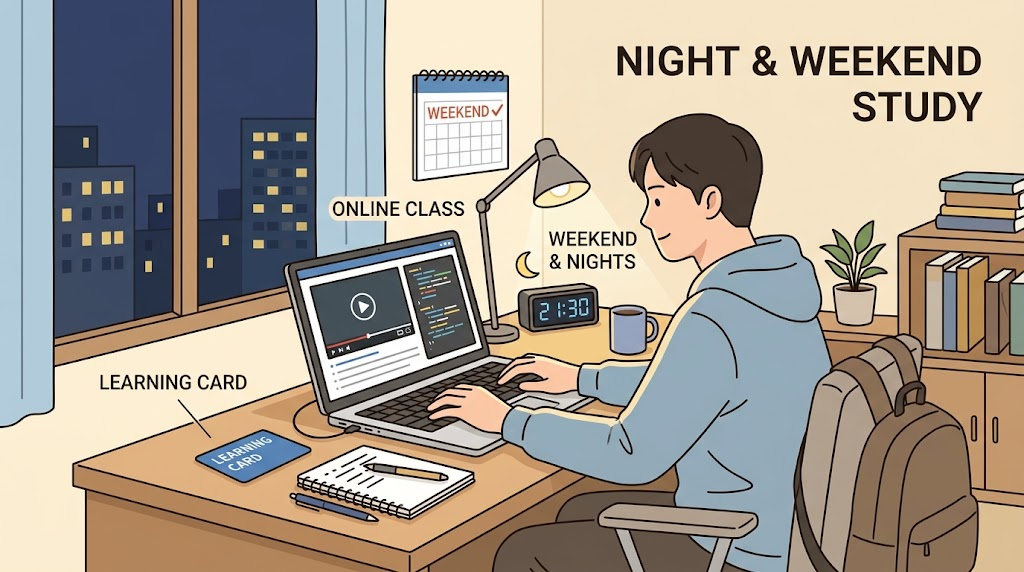
Core Attendance Management Strategies for Busy Office Workers to Complete Courses
When an office worker begins a government-funded training course, the biggest hidden obstacle is not the study difficulty, but rather ‘attendance management.’ Because the government-funded program supports training fees with tax dollars, the Ministry of Employment and Labor’s attendance standards are enforced very strictly.
Here are practical attendance management tips that office workers—who face numerous unexpected variables such as overtime, team dinners, and weekend plans—must follow to safely complete the course without dropping out (failing to complete).
- Absolute Red Line: The 80% Attendance Rate Rule
All courses under the Tomorrow Learning Card are recognized as properly completed only when you attend at least 80% of the total scheduled training days (or training hours).
- If the attendance rate falls below 80%, it is processed as ‘incomplete (dropout),’ resulting in penalties such as deduction of the support limit and an increase in out-of-pocket expense rates.
- Calculating Allowed Absence Days Backwards: When the course begins, check the total number of class days on the first day. For example, for a course held twice a week for a total of 20 sessions (40 hours), you must attend at least 16 sessions (80%), meaning the maximum number of legally permissible absences is only 4 sessions. You should write this allowance on your calendar in advance and save it for emergencies.
- Watch Out for the ‘3-Occurrence Accumulation Formula’ for Tardiness, Early Departure, and Going Out
In addition to simple absences, frequent tardiness or early departures often experienced by office workers are also fatal when accumulated.
- 3 Occurrences = 1 Day of Absence: Under Ministry of Employment and Labor regulations, accumulating a total of 3 occurrences combining tardiness, early departure, and going out is treated as 1 day of absence.
- Participation Under 50% of Training Hours: If you cannot attend more than half of the class time by arriving late or leaving early, it is not processed as tardiness or early departure, but the entire day is immediately treated as an absence.
- Even if you are 10 to 20 minutes late due to subway delays on your way from work, you must check in to defend it as 1 occurrence of tardiness.
- Check-in and Check-out Tips Using the Goyong24 Mobile App
Currently, most offline academies verify attendance via QR code scans in the Goyong24 mobile app or Bluetooth Beacons located inside classrooms.
- 2 Mandatory Verifications for Check-in/Check-out: You must record both ‘Check-in’ before class starts and ‘Check-out’ after class ends. You must be careful because forgetting to tag check-out before heading home can result in an absence.
- Troubleshooting Location and Network Errors: If your smartphone’s GPS or Bluetooth is turned off, beacon recognition may fail. Turn on location permissions and Bluetooth before arriving at the academy.
- In Case of Smartphone Battery Depletion/Loss: You must notify the instructor or the academy’s administrative office immediately on the same day and submit a written ‘Attendance Entry Request Form’ to prevent an absence. (Same-day requests are the rule, as retroactive entry regulations are strict.)
- How to Prove ‘Excused Absence (Attendance Credit)’ for Inevitable Overtime, Business Trips, and Family Events
When unavoidable reasons occur rather than simple change of mind or oversleeping, you should take advantage of the ‘Excused Absence’ system, where attendance is credited upon submitting supporting documents.
| Reason Category | Recognition Criteria | Required Supporting Documents to Submit |
|---|---|---|
| Company Business Trips / Dispatches | Travel due to official company business | Business trip order, business trip report, corporate credit card receipt, etc. |
| Illness and Hospitalization | Outpatient treatment or hospitalization due to personal illness | Medical certificate, hospitalization/discharge certificate, prescription, and medical treatment confirmation |
| Personal and Family Events | Marriage, death of direct ascendants/descendants, etc. | Wedding invitation, death certificate, family relations certificate |
| Reserve Forces / Civil Defense | Call-up for national military training | Training call-up notice and certificate of training completion |
Office Worker Pro-Tip: ‘Overtime work’ resulting from corporate duties is often not officially recognized as a statutory excused absence reason. Therefore, during seasons when frequent overtime is expected, choosing an ‘Intensive Saturday Class’ or a ‘Blended Online/Offline (Remote) Course’ with fewer schedule fluctuations rather than a weekday evening class is the best way to fundamentally block the risk of absence.

Penalties for Dropping Out (Non-Completion) and Coping Strategies
When it is judged that fulfilling required attendance days is no longer feasible due to sudden project assignments, frequent overtime, or frequent business trips, many office workers are inevitably forced to discontinue their classes.
However, if you miss attendance or abandon courses without taking proper measures, you will face substantive monetary and administrative penalties under Ministry of Employment and Labor regulations. Here is a breakdown of the specific penalty regulations incurred when dropping out (non-completion) and the coping strategies to legally defend against them.
- 3 Major Penalties Imposed on Dropping Out (Non-Completion)
Because the Tomorrow Learning Card is a program funded by national subsidies, strict sanctions are imposed according to the cumulative number of occurrences if processed as ‘non-completed’ due to an attendance rate under 80% or voluntary ‘drop out’.
| Cumulative Violations | Support Limit Deduction (Direct Monetary Loss) | Increase in Self-Pay Rate for Future Courses | Card Usage Restriction Period |
|---|---|---|---|
| 1st Non-Completion | Immediate deduction of 200,000 KRW from remaining subsidy balance | Self-pay rate for next course increases by 20%p | No separate suspension of use |
| 2nd Non-Completion | Immediate deduction of 500,000 KRW from remaining subsidy balance | Self-pay rate for next course increases by 50%p | No separate suspension of use |
| 3rd or More Non-Completion | Immediate deduction of 1,000,000 KRW from remaining subsidy balance | Enrolled with 100% self-pay (level of government subsidy restriction) | Card issuance and usage suspended for 60 days |
- Support Limit Deduction: Deducted immediately from your held voucher balance of 3,000,000 to 5,000,000 KRW, meaning you must pay that much more of your own money (self-pay) when taking other courses in the future.
- Self-Pay Rate Penalty: When taking another course next time, an additional percentage is added to your existing self-pay copay rate, drastically increasing the course fee burden.
- Under Unavoidable Circumstances: Exemption from Penalties by Substantiating ‘Inevitable Reasons’
If you genuinely cannot continue taking classes due to company circumstances or health issues, do not simply disappear; instead, submit an ‘Application for Recognition of Inevitable Reasons’ and supporting documents to the competent employment center. If the reasons are recognized as legitimate, all penalties regarding limit deductions or self-pay increases can be fully waived.
- Representative Recognized Reasons and Supporting Documents:
- Sudden Personal Illness or Injury: Doctor’s medical certificate stating that continuous medical treatment for 4 weeks or longer is necessary
- Change in Work Location Due to Company Personnel Orders (Regional Transfer, Overseas Dispatch): Personnel appointment order, certificate of employment (indicating the new workplace)
- Inevitable Change in Shift Work Schedule: Confirmation of change in work pattern bearing the company seal
- Natural Disasters or Force Majeure Events: Official documents capable of substantiating the relevant fact
Handling Procedure: As soon as the decision to drop out is finalized, inform the academy’s administrative office immediately, express your intention to substantiate reasons to the officer in charge at the competent Employment Welfare Plus Center via telephone, and submit the documents through the Goyong24 app or fax.
- Golden Cancellation Period Right After Course Starts: Official Processing Deadline for ‘Course Withdrawal’
If you take 1 or 2 classes and feel it is impossible to juggle with your corporate workload or that the lecture level is unsuitable, you must make a decision as early as possible.
- Courses Under 140 Hours: If you process an official ‘Course Withdrawal’ through the academy and the employment center before 1/3 of the total training days has elapsed, there is room to reduce the severity of penalties or receive partial relief when reapplying in the future.
- Cancellation Before Course Commencement: If you directly tap [Cancel Course Application] in the Goyong24 mobile app until the day before the training start date, 100% of the self-pay copayment paid will be fully refunded, and no administrative penalties or limit deductions will occur.
- Practical Course-Taking Tips to Prevent Incompletion in Advance
- Warm Up with Short-Term Courses: Instead of enrolling in 2- to 3-month long-term courses right from the start, first test your physical stamina and post-work patterns with compact weekend short-term courses lasting 2 to 4 weeks (around 20 to 40 hours).
- Real-Time Attendance Rate Calculation: Regularly monitor your current cumulative attendance rate in the Goyong24 app [My Page], and strictly avoid early departures and outings well before dangerously approaching the 80% mark.
Conclusion (Summary and Next Episode Preview)
Continuing your learning by carving out evening or weekend hours after work amidst busy workloads and daily life is by no means an easy task. However, if you establish a realistic plan taking into account physical stamina and commuting routes, the Tomorrow Learning Card serves as your most dependable ally in expanding your career and pursuing career transitions.
Key Summary of the 3 Principles for Office Workers’ Successful Weekend and Night Learning
| Core Principle | Action Strategy | Expected Benefit |
|---|---|---|
| 1. Realistic Route Design | Choose an academy ‘near work’ for weekday nights and ‘near home’ for weekends | Minimize post-work stamina depletion and prevent tardiness/absence |
| 2. Strict Attendance Red Line Management | Strictly observe beacon tags and calculate permissible absence days backwards to achieve an 80% attendance rate | Prevent subsidy deduction penalties worth 200,000 to 1,000,000 KRW |
| 3. Strategy to Minimize Out-of-Pocket Copayments | Utilize internal corporate training expense reimbursements, welfare point deductions, and year-end tax credits | Achieve practically 0 KRW in self-development costs |
The vocational skills development training subsidies provided annually by the government are a legitimate right that employed workers can enjoy. Rather than putting it off due to vague apprehension, we recommend starting lightly with compact 2- to 4-week weekend short-term courses or blended online/offline training.
[Next Episode Preview]
When is the most advantageous timing for office workers to apply for and attend courses with the Tomorrow Learning Card?
In the next post, we will provide a clear comparative analysis of “Timing to Maximize Tomorrow Learning Card Benefits: Before Resignation vs. Immediately After Resignation (Job Seeker Conversion Tips and Linkage to 100% Government Funding).”
Here are the next steps to complete publishing the blog:
Korean version: 한국어로 읽기