Prologue: The Core of Reducing Moving Loads—Old Clothes Sorting and the Benefits of Disposal by the Kilogram (kg)
Many of you have likely had the experience of opening the wardrobe ahead of a move and letting out a sigh right away.
Coats hanging on hangers for years thinking “I’ll wear them someday,” pants left behind because the size no longer fits, and clothes untouched because they went out of style take up a surprisingly enormous volume when gathered together. Since moving estimates are priced based on the volume and tonnage of cargo, cutting down unnecessary clothes in advance is the most certain way to directly save on moving expenses.
Yet how are you emptying out all these clothes? Usually, many people haul them while struggling multiple times to the clothing donation bin in front of the house, or cram them into heavy standard pay-as-you-throw trash bags to toss out. However, by changing the approach just a little, the process of discarding clothes becomes far more convenient, and you can even receive a decent amount of cash in return. This is precisely the method of utilizing ‘door-to-door pickup by weight (kg).’
💡 Comparison: Regular Clothing Donation Bin Drop-off vs. Door-to-Door Pickup by the Kilogram (kg)
| Category | Dropping off at Clothing Donation Bin in Front of House | Door-to-Door Pickup by the Kilogram (kg) |
|---|---|---|
| Effort | Carrying heavy bundles of clothes directly and making multiple trips | Doorstep drop-off in front of the house (contactless) or pickup driver home visit |
| Cost/Revenue | 0 won revenue (simple free disposal) | Weighed and cash deposited directly into account on the same day |
| Additional Items | Small-volume disposal focused on clothing/shoes | Combined pickup possible for used books, frying pans (scrap metal), small appliances, etc. |
| Physical Exertion | High (requires moving through stairs/alleys) | Very low |
💰 A Rewarding Benefit That Earns “Chicken Money” Just by Discarding
The clothing donation bins located along alleys are, in most cases, bins run by private operators rather than being operated by public institutions for welfare purposes. In other words, even if you sweat and carry heavy loads to deposit there, there is no compensation returned to you at all.
On the other hand, when using a used clothing door-to-door pickup service, a professional driver visits directly, measures the weight with a precision scale, and settles the payment on the spot immediately in cash or via bank transfer according to the set unit price per kg.
Usually, when you set aside a day to empty out the closet, it easily exceeds 20–30kg, and when adding shoes, bags, and thin quilted blankets, reaching 40–50kg or more is also common. While cutting the effort of throwing items out by more than half, you can easily pocket enough money for coffee or a whole fried chicken to reward yourself after working hard on moving day.
Then, what are the minimum weight requirements and advance preparation details needed to apply for a door-to-door pickup? Let’s take a detailed look directly below.
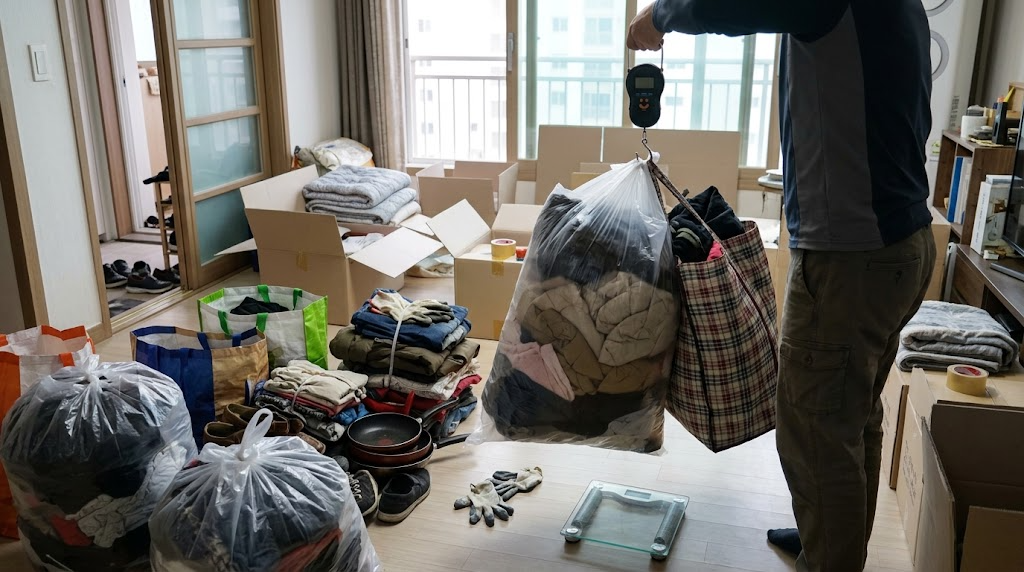
Application Criteria and Basic Requirements for Door-to-Door Used Clothing Pickup
As door-to-door used clothing pickup is a convenient service where a driver visits right up to your front door, each company establishes minimum pickup criteria for smooth route navigation and operation.
Before applying, checking in advance whether the amount of clothing coming from your home meets the criteria and whether the residential environment is suitable for door-to-door pickup can prevent wasted trips or reservation cancellations.
⚖️ 1. Easy Way to Estimate the Minimum Pickup Weight (20kg)
Most used clothing door-to-door pickup companies offer free dispatch and paid purchasing (settlement per kilogram) starting from a minimum of 20kg or more.
If you do not have a scale at home or find it difficult to weigh clothes one by one, you can estimate the approximate weight using the size of plastic wraps or bags frequently used in daily life.
Based on a 100L large standard pay-as-you-throw trash bag: When packed tightly with clothes, it yields around 15–20kg per bag. In other words, about 1.5 to 2 fully packed 100L bags comfortably exceeds the basic 20kg threshold.
Based on a large kimchi-making plastic bag (extra-large): When filled tightly with coats, pants, knits, etc., and tied up, about 10–12kg is measured per bag. A quantity of 2 to 3 large kimchi plastic bags is sufficient to apply for pickup.
Weight Differences by Season:
Thin summer short-sleeve T-shirts or blouses weigh less relative to their volume.
The more jeans, thick winter knits, padded jackets, coats, and jacket types are mixed in, the much faster the weight increases compared to volume.
💡 Tip: If it feels borderline to fill 20kg with clothes alone, you can supplement the weight by gathering shoes, bags, hats, belts, etc., together. (However, there may be ratio restrictions by item category, so clothing must make up the majority.)
📍 2. Checking Dispatch Availability by Region
Door-to-door pickup companies are usually operated under an assigned driver dispatch system based on district (gu) and neighborhood (dong) units.
Metropolitan areas and major metropolitan cities: Services are active to the point where same-day or next-day reservations are available in most areas.
Provincial and outlying areas: Visits may only occur on specific days of the week (e.g., every Tuesday/Thursday), or the minimum threshold weight may be raised to 30kg or more, so it is necessary to first verify the visitable days for your residential area through reservation platforms, cafes, or messenger channels.
🏢 3. Pre-checking Residential Environment (Elevator Availability and Parking)
Since the driver must move carrying large burlap sacks and scales, additional guidelines may apply depending on the housing environment.
Apartments/officetels with an elevator: Both contactless doorstep pickup and in-person pickup proceed smoothly.
Multi-family housing/villas without an elevator (high floors of 3 stories or higher): Depending on company regulations, stair handling fees may be partially deducted, or you may be requested to bring items down in front of the 1st-floor main entrance, so it is best to indicate the housing type in advance upon application.
Single-family detached houses and narrow alleys: In the case of narrow alleys where vehicle entry is difficult, disposal in front of the main gate or at a designated base point accessible by vehicle must be discussed.
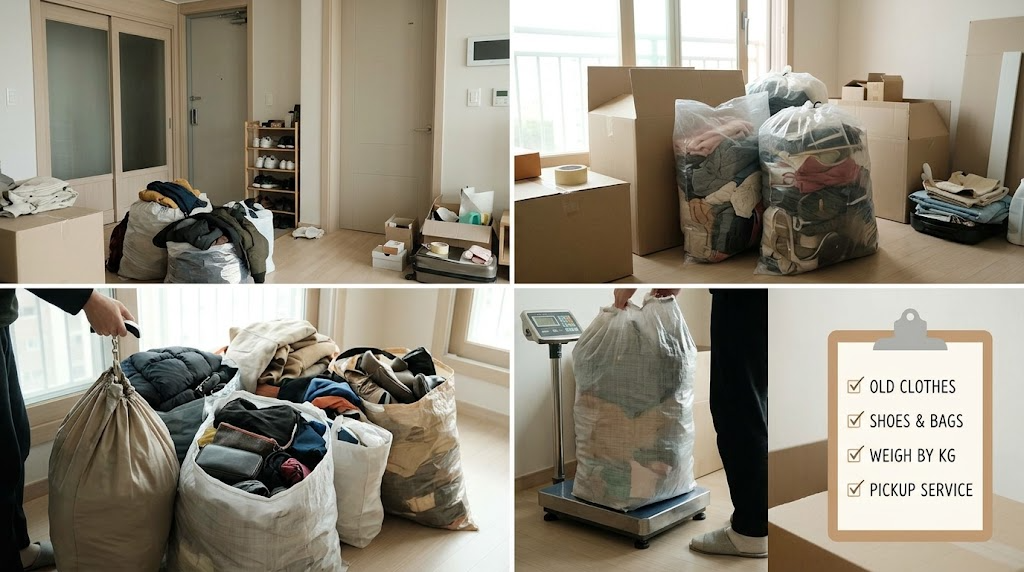
Complete Breakdown of Purchased vs. Non-Collectible Items
The most frequent confusion when applying for used clothing door-to-door pickup is item classification.
When the driver arrives at the site, if many non-collectible items are mixed in, excluding those items may cause the total to fall below the minimum threshold weight (20kg), leading to the cancellation of the pickup itself or awkward situations on site.
The core standard of door-to-door pickup companies is “whether the item is in a condition that another person can wear or use again (resale viability).” You must clearly distinguish between items eligible for paid purchase and items that must be disposed of using the table and detailed categories below.
📋 Collection Item Checklist at a Glance
| Category | Purchasable Items (O) | Non-Collectible Items (X) |
|---|---|---|
| Clothing | All four-season clothing (T-shirts, jeans, coats, padded jackets, suits, knits, dresses, etc.) | Torn clothes, items with severe mold/bad odors, group uniforms/martial arts uniforms, work clothes |
| Fashion Accessories | Standard footwear (sneakers, dress shoes, sandals, boots), bags, hats, belts, mufflers, scarves | Wheeled luggage carriers, fur slippers, three-stripe slippers, mismatched single shoes, roller skates |
| Bedding/Fabric | Thin comforters, quilted blankets, mattress pads, curtains, carpets (small size) | Cotton batting quilts, silk batting quilts, thick down/goose down quilts, pillows, cushions, floor cushions |
| Other Miscellaneous | Small stuffed animals (varies by company), pots/frying pans (scrap metal) | Large stuffed animals (30cm or larger), electric heating blankets, jade heating mats, tents, picnic mats |
⭕ 1. Core Items Eligible for Paid Purchase
- Four-season standard clothing: All items are accepted regardless of men’s, women’s, or children’s wear. Mixing summer clothes and thick winter outerwear together regardless of season is completely fine.
- Footwear: All shoes that can be normally worn are included, such as sneakers, loafers, flats, heels, and boots. (However, both sides must form a complete pair.)
- Bags and accessories: Daily accessories such as backpacks, crossbody bags, handbags, leather bags, tote bags, hats, and leather belts are also added to the weight.
- Thin fabrics: Most items with thin padding, such as spring/autumn single-layer blankets, thin comforters, tablecloths, and curtains, are included as pickup targets.
❌ 2. Strictly Non-Collectible Items (Mandatory Prior Sorting)
- Thick batting blankets/quilts: Traditional quilts containing cotton or silk batting, bulky microfiber/wool blankets, and bed mattress toppers cannot be recycled, so they must be discarded with a bulky waste sticker attached.
- Pillows and cushion batting: Due to hygiene concerns and degraded recyclability, all of these are subject to standard trash (pay-as-you-throw trash bag) disposal.
- Severely damaged clothing: Clothes stained with oil grease or paint, heavily moldy clothes, or garments contaminated with pet waste will be excluded on-site by the driver.
- Wheeled travel carriers: Because they contain internal plastic and metal frames combined together, they are not purchased under the used clothing category.
- Indoor slippers/slides: Simple bathroom rubber slippers or EVA slides cannot be resold and are therefore excluded from pickup.
💡 Pricing and Advance Sorting Precautions
Door-to-door pickup companies generally do not set different unit prices by item; instead, it is customary to put all purchased items into a single burlap sack and calculate them collectively by total weight (kg).
Therefore, if you filter out non-collectible items in advance and pack heavy miscellaneous items like shoes and bags mixed appropriately with clothing, you can reach the total weight much more efficiently.
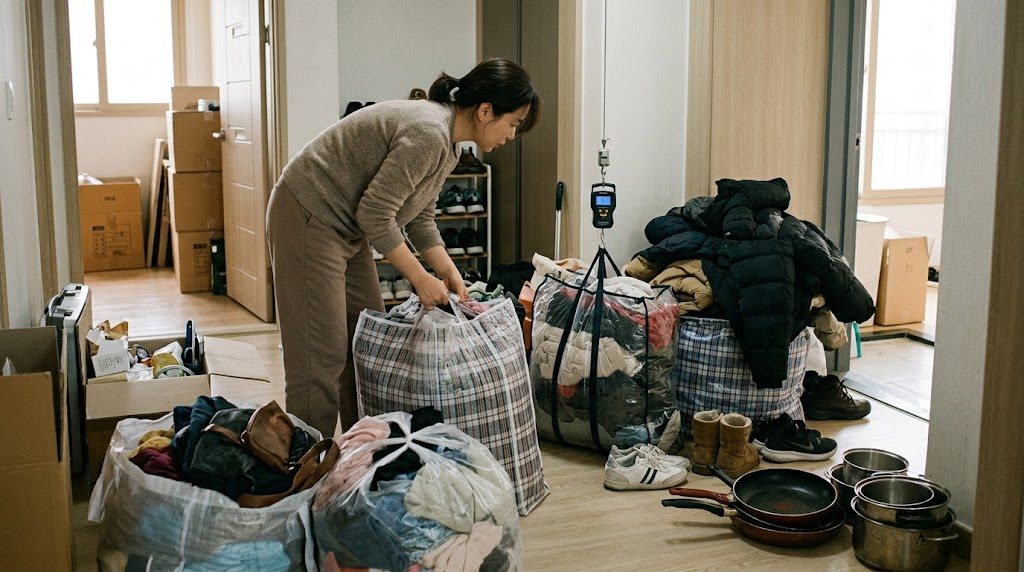
Door-to-Door Used Clothing Pickup Process: From Application to Same-Day Settlement
The entire process of door-to-door used clothing pickup is carried out conveniently via mobile or online. The standard procedure from booking receipt to disposal method selection, on-site weighing, and same-day payment is organized step by step.
1
Online/App Booking Receipt and Pickup Schedule Confirmation
Advance booking recommended at least 2–3 days prior
Submit an application via regional used clothing door-to-door pickup specialty company websites, mobile apps, or Naver Cafe/KakaoTalk channels.
Information to enter: Address, elevator availability, shared front entrance access code, estimated quantity (number of bags or estimated weight), bank account number to receive settlement
Schedule coordination: After applying, you will receive a notification message from the assigned dedicated driver with the scheduled visit date and estimated visit time slot (morning/afternoon). During peak moving seasons (inauspicious-free days, end of the month), schedules may fill up early, so booking in advance is recommended.
2
Selecting the Disposal Method (In-Person vs. Contactless)
Can proceed even in your absence
Choose the convenient form between two pickup methods according to your schedule.
Contactless doorstep disposal (Recommended): A method mainly used when both partners work or while away from home. If you place the packed bags outside your front door by the evening before the reservation or by the designated time on the morning of the day, the driver will visit and collect them.
In-person direct pickup: A method where you stay home according to the driver’s visit time, directly observe the scale weighing process, and communicate.
3
On-Site Scale Weighing and Final Weight Confirmation
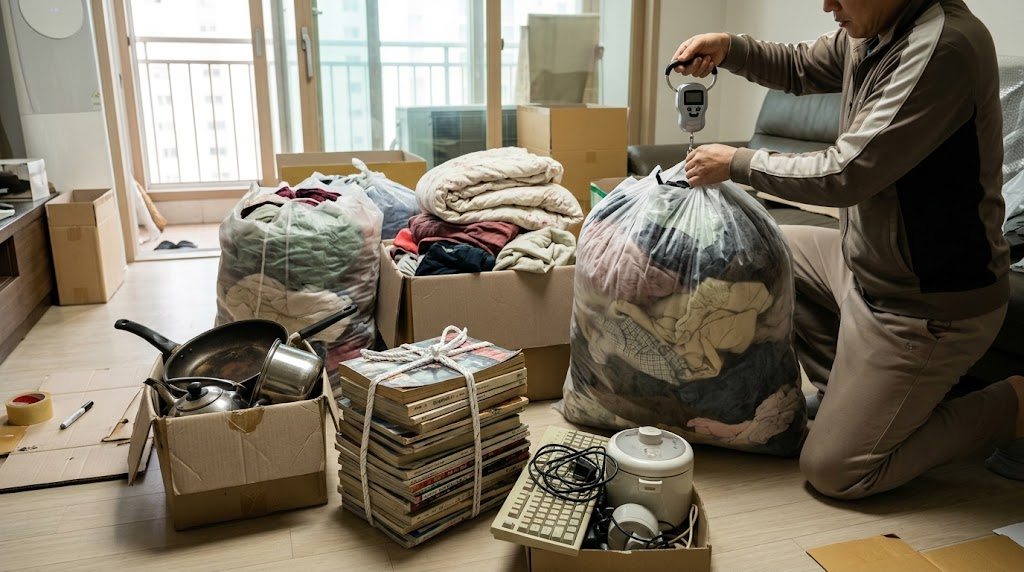
The driver arrives on site equipped with a portable digital scale (needle-type or digital indicator scale) and large burlap sacks.
The discharged clothes, shoes, and miscellaneous goods are placed into the provided burlap sacks and lifted right on-site to measure the weight.
In the case of contactless pickup, the driver takes a photo clearly showing the scale’s graduation readings and sends it via text or messenger.
4
Same-Day Bank Account Deposit and Settlement Statement Confirmation
Settlement immediately upon completion of weighing
The final settlement amount is confirmed by multiplying the measured total weight by the applicable unit price of the day (purchase price per kg).
Settlement method: Deposited immediately on-site to the registered account, or a real-time account transfer confirmation is sent by text. (You can also choose cash receipt during in-person pickup.)
Confirming that the sender name matches the settlement amount (total weight × unit price) concludes the entire pickup process.
💡 Practical Tips for Clean Same-Day Settlement
Labeling bag bundles: When disposing in apartment hallways or in front of multi-family housing doors, place them close to the wall so they do not obstruct neighbors’ passage, and attaching a memo reading “For Used Clothing Pickup” on the outside of the bags can prevent loss or miscollection.
Plastic bag disposal: During pickup, the driver may transfer only the clothes into the burlap sacks and leave the plastic bags behind, so stating in advance in the request field whether the plastic bags can also be collected makes hallway cleanup much easier.
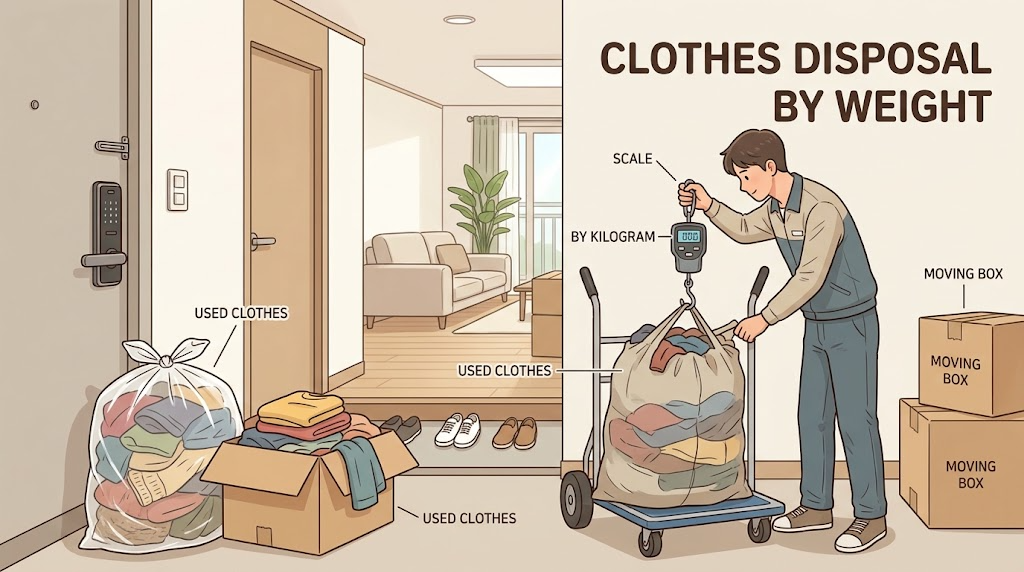
Practical Tips to Add More Weight and Avoid Losses
When using a door-to-door used clothing pickup service, knowing just a few practical tips can easily help you exceed the minimum threshold weight (20kg) and maximize your final settlement amount.
We have compiled practical tips for smartly gathering and disposing of items eligible for paid collection hidden in every corner of your home, rather than just collecting clothes.
📦 1. Actively Utilize Items Eligible for ‘Combined Pickup’
Most used clothing pickup companies purchase a variety of household items with high recycling value in addition to clothing. While meeting the basic used clothing standard (20kg), putting out the items below together can significantly increase the settlement weight.
- Used books and scrap paper (paperbacks, study workbooks, magazines):
- Used books are representative items that carry a substantial amount of weight relative to their volume.
- Tie them in a cross (+) pattern with twine so they do not scatter, or divide them into small boxes for disposal. (However, standalone pickup of used books alone is not permitted; they are generally purchased through combined pickup once the base weight for used clothing is met.)
- Scrap metal (frying pans, pots, kettles):
- Old frying pans with peeling coatings that need to be discarded, stainless steel pots, etc., are classified as non-ferrous/scrap metal and can be purchased by weight.
- Most kitchen utensils with plastic handles are also collected together.
- Small waste home appliances and computer parts:
- Broken laptops, desktop towers, monitors, microwave ovens, rice cookers, wires/cables, etc., can receive free collection or small-sum purchase benefits depending on the item, significantly reducing moving junk disposal costs.
⚖️ 2. Filling the Center of Gravity with Shoes and Bags
- Matching shoe pairs: Shoes missing their mate are treated as non-purchasable, so matching the pairs and tying the shoelaces together or placing each pair in a transparent plastic bag ensures they are fully reflected in the weight without loss.
- Emptying bag interiors: Quite often, receipts, trash, coins, or valuables remain in bag pockets. Before measuring weight, make sure to unzip them to confirm the contents are completely emptied.
🗑️ 3. Strictly Separating and Disposing of Non-Collectible Items in Advance
If the driver sorts out cotton batting quilts, floor cushions, torn clothes, etc., while transferring clothes into burlap sacks on site, they may be left behind as trash right in front of the front door on the spot.
Sorting them in advance and disposing of them according to the regulations below ensures a clean process.
| Separated Item | Recommended Disposal Method | Disposal Cost |
|---|---|---|
| Cotton/silk batting quilts, toppers | Dispose with local municipality bulky waste sticker attached (apply at community service center or mobile app) | Around 2,000–5,000 won depending on specifications |
| Pillows, cushion batting, floor cushions | Place in standard pay-as-you-throw trash bags (50L, 100L) and dispose as general waste | Price of the pay-as-you-throw trash bag |
| Wheeled travel carriers | Dispose with local municipality bulky waste sticker attached | Around 2,000–4,000 won depending on size |
| Heavily soiled clothes, torn clothes | Place in standard pay-as-you-throw trash bags and dispose as general waste | Price of the pay-as-you-throw trash bag |
📱 4. Taking Advantage of Cafe/App Events and Review Cashback
- Additional accumulation through reviews: In the case of used clothing companies affiliated with Naver Mom Cafes, blogs, and regional communities, events offering additional Naver Pay points or cash rewards worth 1,000 to 3,000 won per review are continuously held when you leave verified collection photos and reviews.
- Attendance checks / coupon discounts: Companies running their own dedicated apps often provide first-time user coupons or coupons that increase the unit price by 50 to 100 won per kg, so be sure to check the active promotions before booking.
Epilogue: A Clean Moving Preparation That Reduces Cargo Weight and Fills Your Bank Account
Moving is not merely a physical relocation of where you live, but an opportunity for “space detox,” clearing out unnecessary items that have accumulated in your daily life and starting afresh with a lighter space.
In particular, the longer clothes and daily sundries are left neglected, the more space they occupy, which increases the tonnage of the moving truck and directly leads to higher overall moving estimate costs. Instead of struggling to carry heavy loads up and down stairs to the neighborhood clothing collection bin, actively make use of door-to-door pickup by the kilogram (kg) weighed right at your front door.
You can relieve the wasted effort of sweating, reduce the volume of unnecessary cargo to lower your moving quote, and even secure a solid payment deposited directly into your bank account on the same day.
This weekend, take your time organizing the used clothes sleeping in your wardrobe and prepare for a pleasant new beginning with a lighter heart and a reassuring bank account.
Do you need additional assistance to complete your post?
Generate custom 16:9 AI image generation prompts for the body text
Recommend SEO keywords and tags for top search ranking on Naver
Organize a finalized full draft combining the entire outline and body text into one
Korean version: 한국어로 읽기