Introduction: Monthly Rent Outflows—Are There Specific Subsidies Just for Me?
After finding a room with a fluttering heart dreaming of independence, the monthly rent bill that returns every month is always the biggest burden for early-career newcomers and youth. Everyone has probably sighed at least once, thinking, “If it weren’t for the monthly rent, I could save money much faster…”
Fortunately, the government is rolling out various housing support policies to alleviate the housing cost burden of youth. However, when you actually try to look into the subsidies, the names are similar and there are so many types that it is always confusing. There are representative systems like ‘Housing Benefits’ and ‘Youth Monthly Rent Support’, but did you know that the target audience and conditions for these two are completely different?
Depending on your income level or residential form, you might be selected for certain systems while being excluded from others, so it is essential to carefully examine which subsidy precisely matches your conditions before blindly applying.
In today’s posting, we will clearly and easily point out the distinct differences between Housing Benefits and Youth Monthly Rent Support that many people find most confusing, so do not miss out on the valuable benefits that will act as the guardian of your bank account!

Core Comparison 1: What Is Housing Benefit? (Target, Criteria, Support Benefits)
When talking about youth housing support systems, the representative government welfare system that serves as the most fundamental yet solid pillar is none other than ‘Housing Benefit’.
Though often confused with Youth Monthly Rent Support, Housing Benefit is not just a one-time support but a national basic security project consistently supported for the housing stability of vulnerable-income households. Let’s take a closer look at what specific criteria and benefits exist.
- Housing Benefit Support Target and Income Criteria
Selection Criteria: Households whose recognized income amount of the applicant household is 47% or less of the standard median income are eligible. (Detailed percentages, such as the 2026 standards, may fluctuate every year according to government notices.)
Household Composition Characteristics: Not only households living together with parents, but also youth living separately from parents (unmarried children aged 19 to under 30) are recognized as independent households and frequently receive Housing Benefits separately. (In this case, since the income and property of the original household are often queried together, checking detailed criteria is essential.)
- Key Support Benefits (Based on Rent Allowance)
Actual Rent Support: For lease (monthly rent) households, actual rent is supported in cash every month by comparing the regional standard rent and the monthly rent on the actual lease contract (adding up the amount converted from the deposit to monthly rent).
Differential Payment by Region: Standard amounts supported are set differently depending on the rent level of the residential area, such as Seoul, Gyeonggi-Incheon, and other regional provinces.
- Core Characteristics of Housing Benefits
Stable long-term receipt: As long as income and property criteria continue to be met, it is the most reliable basic welfare network that can steadily reduce the monthly rent burden every month.
In the case of homeowner households: It is linked not only with monthly rent support but also with repair and maintenance benefits that support home repair (minor/maintenance) costs.
💡 Points to Remember When Applying for Housing Benefits
Since income criteria (47% or less of median income) are applied relatively strictly, it is important to understand in advance whether changes in earned income or property will affect eligibility for receipt.
Applications can be made at any time through the jurisdictional resident center (administrative welfare center) or the Bokjiro (bokjiro.go.kr) website.
In the next chapter, we will refreshingly break down the criteria and benefits of ‘Youth Monthly Rent Support’—a representative customized support project targeting the youth demographic—by comparing it with Housing Benefits!
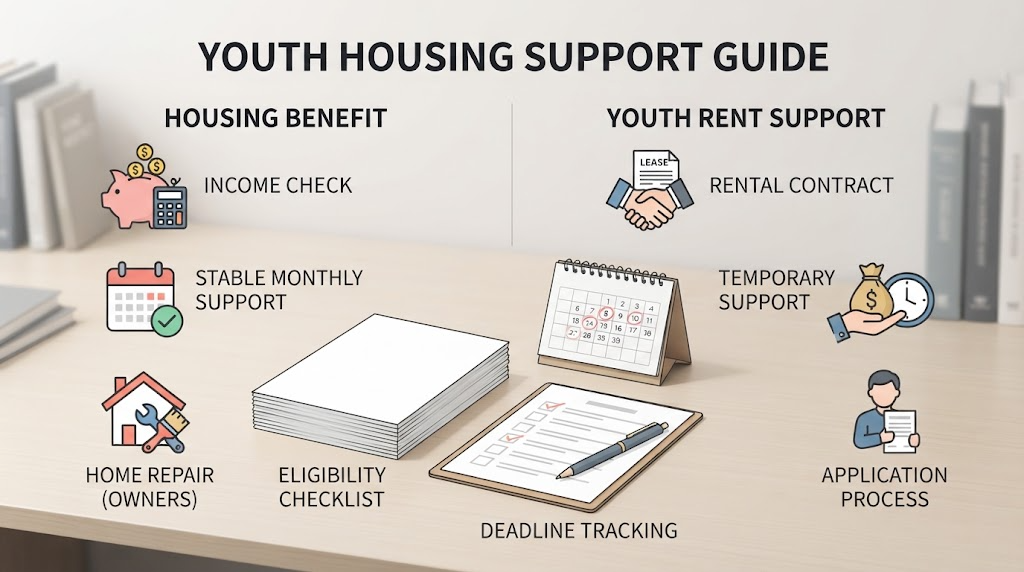
Core Comparison 2: What Is Youth Monthly Rent Support? (Focusing on Temporary Special Support)
While the ‘Housing Benefit’ examined earlier is a system of a basic security nature with relatively strict income criteria, there is a customized project intensively pushed by the government and local governments directly targeting the housing cost burden of the youth demographic. It is none other than the ‘Youth Monthly Rent Support (Youth Monthly Rent Temporary Special Support, etc.)’ system.
Let’s point out the core contents that young office workers or college students who felt the threshold of Housing Benefits to be somewhat high should keep an eye on.
- Youth Monthly Rent Support Target and Income Criteria
Support Target: Homeless youth aged 19 to 34 living separately from parents are the main targets. (There may be slight differences in age criteria or residential requirements by local government.)
Income and Property Criteria: In many cases, income and property criteria of not only the youth’s own household but also the original household including parents are evaluated together. (e.g., Youth household standard median income 60% or less + original household standard median income 100% or less, etc.; checking announcement notices by project round is essential for detailed criteria.)
Lease Deposit and Monthly Rent Conditions: Generally, applications can only be made when residing in housing below a certain lease deposit amount (e.g., 50 million won or less) and a certain monthly rent amount (e.g., 70 million won [Note: 700,000 won] or less). (Even if the monthly rent exceeds 700,000 won, support is sometimes provided if criteria are met by combining it with the deposit converted to monthly rent.)
- Key Support Benefits (Cash Monthly Rent Subsidy)
Up to 200,000 won support per month: You can receive cash support of up to 200,000 won per month within the range of the actual monthly rent paid, for up to 12 months (or the designated period per round).
Substantial reduction in living expenses: Cash support of 200,000 won per month for early-career newcomers or job seekers is immensely practically useful for defending fixed expenses.
- Core Characteristics of Youth Monthly Rent Support
Temporary customized support: Since it strongly has the characteristic of the government intensively injecting budget with a time limit for the housing stability of the youth demographic, not missing the implementation period and application deadline is more important than anything else.
Difference from Housing Benefits: Housing benefit recipients or public rental housing residents are generally excluded from duplicate support in principle.
💡 Pro Tips When Applying for Youth Monthly Rent Support
Even if you are a homeowner or using a jeonse loan (such as Jung-Gi-Cheong), applications are often possible as long as you meet the monthly rent residency requirements and income criteria, but whether there is duplicate receipt of housing benefits must definitely be checked in advance.
Since notices are frequently uploaded through Bokjiro (bokjiro.go.kr) or youth portals by each local government, it is good to set up notifications.
In the next chapter, we will comprehensively summarize by comparing these two systems at a glance to see which subsidy fits you best!

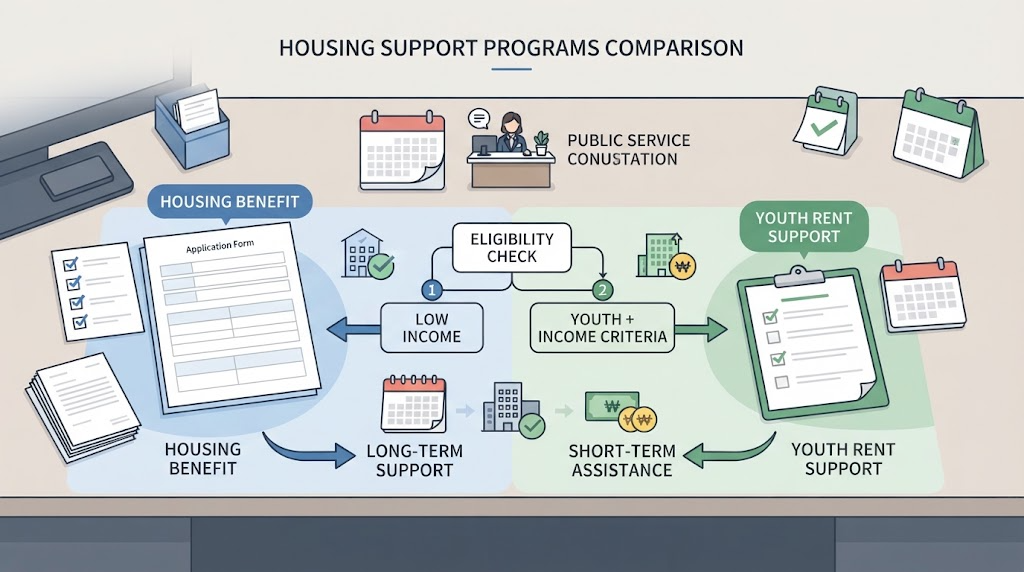
Comparison at a Glance: Summary of Differences Between Housing Benefits vs. Youth Monthly Rent Support
So far, we have examined the concepts and criteria by target for ‘Housing Benefits’ and ‘Youth Monthly Rent Support’ respectively. You must have felt that although the names are similar, there are quite large differences in support grounds, targets, and benefit methods.
We will gather only the core contents and compare them at a glance to see which system you should apply for to be most advantageous!
📊 Housing Benefits vs. Youth Monthly Rent Support Core Comparison Table
| Classification | Housing Benefits | Youth Monthly Rent Support (Temporary Special Support, etc.) |
|---|---|---|
| Support Nature | National basic security welfare system (always open for application) | Government and local government-led youth customized temporary support |
| Age Requirement | No separate age limit (however, separate youth independent household criteria exist) | Homeless youth aged 19 to 34 or younger |
| Income Criterion | Standard median income 47% or less (relatively strict) | Youth household + original household (including parents) income/property criteria applied |
| Support Benefit | Full or partial support of actual rent (standard rent) by region and number of household members | Fixed support of up to 200,000 won per month (up to 12 months, etc.) |
| Payment Method | Regular monthly cash payment (long-term support when recipient eligibility is maintained) | Cash payment for a certain period every month (temporary project) |
🔍 Selection Guide Tailored for Me
- If your income criteria are very low and you need long-term housing stability ➔ Aim for ‘Housing Benefit’ rolling applications
- If your income criteria correspond to the median income level and you are an independent youth ➔ Apply in accordance with the ‘Youth Monthly Rent Support’ announcement period
- Things to note: Since both systems are welfare benefits of similar natures, simultaneous receipt (duplicate benefits) is impossible in principle. You must carefully weigh which system can support you with a larger amount according to your own income and property conditions before choosing.
In the next chapter, we will organize frequently asked questions during the application process and tips for easy inquiry!
Frequently Asked Questions (FAQ) and Essential Checklist Before Applying
As the benefits of Housing Benefits and Youth Monthly Rent Support systems are robust, there are many conditions to weigh when applying. Finally, we organize the questions that many people are most curious about and practical checklists in a Q&A format.
Q1. Can I receive both Housing Benefits and Youth Monthly Rent Support at the same time?
A: Simultaneous receipt (duplicate receipt) is impossible in principle. Because Housing Benefit is also a welfare benefit of a housing assistance nature supported by the state, it cannot be duplicated with government and local government monthly rent support projects of a similar nature. You must compare the support amounts and qualification requirements of the two systems and choose and apply for the one more advantageous to you.
Q2. My address on the resident registration is the same as my parents’. Can I receive Youth Monthly Rent Support?
A: The basic premise of Youth Monthly Rent Support is ‘homeless youth living separately from parents’. Therefore, you must maintain an independent residential form with a separate transfer report (move-in report), and since the income and property criteria of not only the youth’s own household but also the parents (original household) are evaluated together, you must satisfy all these requirements to be selected as the final recipient.
Q3. I am already living after receiving a jeonse loan (such as Jung-Gi-Cheong loan). Can I apply for monthly rent support?
A: Jeonse loans are a system that borrows a deposit, whereas Housing Benefits or Youth Monthly Rent Support are systems that subsidize ‘monthly rent (lease payments)’, so their natures differ. However, applications for monthly rent support itself are frequently possible if you meet the deposit and monthly rent limit criteria of the housing you wish to receive support for (e.g., deposit of 50 million won or less, monthly rent of 700,000 won or less, etc.) and there are no other exclusion grounds. However, since detailed requirements may vary depending on local government guidelines, prior confirmation is essential.
📋 Essential Checklist Before Applying
- Check Lease Agreement: Make sure there is a formal lease agreement signed in your name and that you have received a confirmed date.
- Check Income and Asset Criteria: Gauge in advance whether your recognized income amount meets the median income percentage criteria through the Bokjiro (bokjiro.go.kr) mock calculation service or Myhome portal.
- Check Application Timing and Reception Desk: While housing benefits can be applied for at any time, youth monthly rent support (such as temporary special support) has set project rounds and application periods by local government, so you must be careful not to miss the periods.
In the next section, we will wrap up warmly while summarizing the core contents of this posting!

Conclusion: Relieving the Housing Cost Burden with Housing Support Perfectly Suited to Your Conditions
So far, we have carefully examined the differences between ‘housing benefits’ and ‘youth monthly rent support,’ which are representative housing support systems to ease the monthly rent burden incurred every month.
For early-career workers or independent youths, monthly rent paid every month is one of the biggest factors shaking up account balances. However, if you accurately know and utilize a system that fits your income criteria and living arrangements, you can defend your fixed expenses much more reliably than you think.
The core lies in ‘choosing the system that matches your conditions and applying at the right time.’
If your income criteria are strict but you need stable long-term support, look into housing benefits,
And if you are an independent youth meeting certain age and income requirements, keep your eyes on the youth monthly rent support projects conducted by period!
After carefully weighing the characteristics of the two systems and the criteria prohibiting overlapping benefits, we hope you wisely choose the most advantageous benefit for yourself.
We hope that the contents organized today served as a small help in protecting your housing stability and light wallet. Check your eligibility requirements right now through Bokjiro (bokjiro.go.kr) or your local community center, and prepare hastily so that you don’t regrettably miss out on benefits.
We sincerely cheer on your comfortable nest and solid asset accumulation! Thank you for reading the long post today as well. ✨
💡 Blog Posting Completion Tip: Leaving calls to action for likes (❤️), comments, and adding neighbors at the bottom of the post will be of great use for communication and increasing your blog index!
Korean version: 한국어로 읽기