
Introduction: Is Taking More Supplements Really Better?
As soon as you open your eyes in the morning, do you reach for Vitamin C, probiotics, omega-3s, lutein, and even B-complex vitamins for fatigue recovery? Many of you probably fill a corner of your desk or dining table with colorful supplement bottles and swallow a handful every day. While you start with the diligence and determination to take care of your health, at the end of the month you might check your payment history or notice your supplement bottles emptying and wonder, “Is taking all of these really useful for my body?”
Browsing the internet or social media, you constantly encounter recommendations for new ingredients claiming “This supplement is essential for fatigue” or “You lose out if you don’t take that one.” If you blindly increase your supplements just based on hearing they are good, you will not only quickly empty your wallet but also potentially place unnecessary strain on the liver and kidneys responsible for your body’s metabolism. Sometimes, ingredients even clash with each other to hinder absorption, or excessive intake of certain nutrients can trigger side effects.
True health management does not begin with “eating as much as possible blindly,” but rather with the wisdom to accurately distinguish what your body truly needs from what it does not.
In this article, we will carefully examine the smart know-how to reasonably reduce your monthly supplement expenses and select and consume only the essential, high-value ingredients your body actually requires. Shall we find out together how to protect both your wallet and your health?
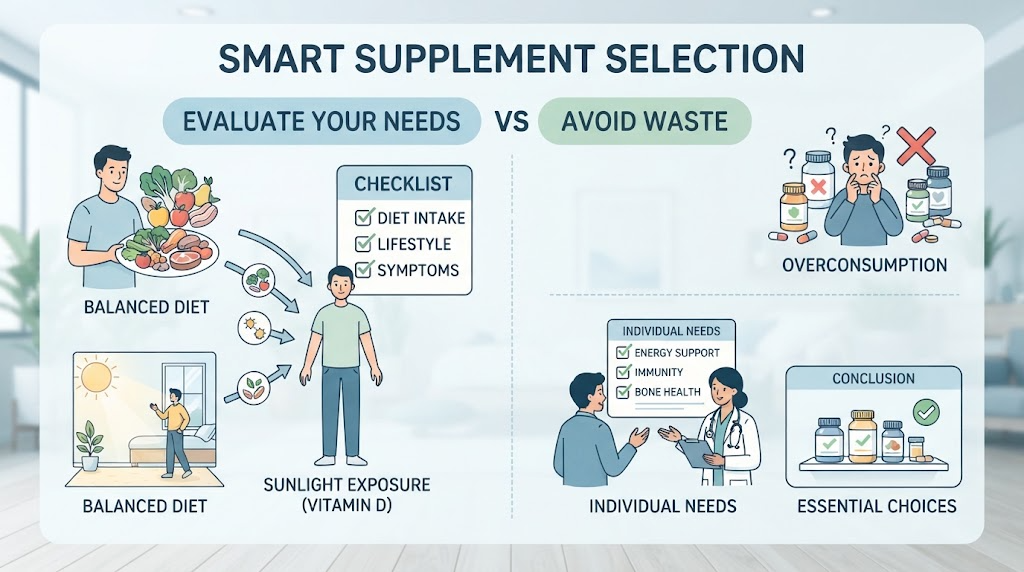
Checking Your Health Status: What to Verify Before Supplement Shopping
Before you fill your supplement shopping cart, tempted by commercials or home shopping claims like “This will completely dissolve fatigue” or “It contains all the nutrition you need,” there is something you must stop and check first: your actual dietary habits and lifestyle patterns.
Before buying popular products blindly, let’s look at why the evaluation stage of objectively figuring out what your body is truly lacking matters so much.
① Take an Objective Look at Your Diet and Lifestyle Patterns
True to the name “supplement,” a supplement is merely an auxiliary means to “supplement” parts lacking in your regular diet and can never replace a perfect meal.
Diet check: You must first reflect on whether you usually scrape by on instant or delivery meals for all three daily meals, or if your intake of vegetables, fruits, and protein is severely lacking.
Living environment check: Check your lifestyle to see if you work indoors all day without ever seeing sunlight, leading to a vitamin D deficiency environment, or if you constantly drink coffee or caffeinated beverages, causing heavy fluid excretion and hindered absorption.
Taking extra nutritional supplements for nutrients you already consume sufficiently in your diet is not only a waste of money but can also lead to excessive intake.
② Following Fads Blindly vs. Distinguishing Ingredients Your Body Truly Needs
Will what works for others work for me?: There is no guarantee that a supplement that worked wonders for someone on social media or a product recommended by an acquaintance will work the same way in your body. It might be a fatigue remedy for someone else, but your body might already have enough of that nutrient.
Identify causes by symptom: If you feel exceptionally tired lately, you must first distinguish whether the cause is simply a vitamin deficiency or rather chronic sleep deprivation, work stress, or a lack of exercise. Getting more sleep or taking light walks could serve as a more reliable miracle cure than supplements costing hundreds of thousands of won.
Utilize health checkup results: The most objective chart of your body’s condition is your recent health checkup report. Referring to cholesterol levels, liver enzymes, fasting blood glucose, and anemia test figures will clearly show you where warning lights are actually flashing in your body.
💡 Tip: Before you start shopping for supplements, briefly jot down the meals you ate, the fatigue you felt, and your sleeping hours in a memo pad for a week. This makes the gaps in your diet visible at a glance and creates a smart criterion for selecting only the supplements you truly need.

How to Choose Necessary Supplements (Essential vs. Optional)
Among the countless supplements on the market, clearly distinguishing between essential supplements that “you must take” and optional supplements that you should choose based on your health condition or purpose can significantly reduce unnecessary spending.
We have organized the smart selection criteria to protect both your wallet and your health.
① Basic Base Supplements: The Minimum 3 You Must Take
Considering the busy dietary habits and environments of modern people, these are 3 representative supplements chosen as a base because they are commonly lacking for the majority.
Multivitamin (Comprehensive Vitamin)
Selection criteria and benefits: It supports basal metabolism when it is difficult to get a well-rounded intake of all micronutrients through diet alone. Buying multiple supplements separately only increases costs and pill counts, so filling the foundation with a single multivitamin of certified, safe ingredients is most advantageous in terms of cost-effectiveness.
Omega-3 (Dietary Lipids Containing EPA and DHA)
Selection criteria and benefits: Essential for office workers who cannot frequently eat blue-backed fish or who need blood circulation improvement and triglyceride level management. It is best to check and choose whether the raw material comes from small fish species with a low risk of rancidity and whether it is in an rTG form (a form with high body absorption rate).
Probiotics (Lactic Acid Bacteria)
Selection criteria and benefits: They support the immunity and bowel movement of modern people whose gut health is prone to breaking down due to irregular meals and stress. You should choose them after verifying the guaranteed bacterial count and whether coating technology is applied so they can survive stomach acid and reach the intestines alive.
② Customized Supplements: ‘Optional’ Ingredients According to Your Symptoms and Purpose
These are optional supplements added only when you have a specific purpose beyond the basic base. Rather than adding them indiscriminately, adding just one at a time according to your body’s signals is the secret to protecting your wallet.
Fatigue Recovery and Stress Relief (Vitamin B Complex, Red Ginseng, etc.)
They help when you suffer from chronic fatigue or lack energy. In particular, water-soluble Vitamin B is excellent for rapidly metabolizing fatigue substances, but you must take it after meals to prevent stomach upset.
Eye Health (Lutein, Zeaxanthin, etc.)
Office workers who look at monitors and smartphones all day seek them to maintain macular pigment density, but if you normally eat enough dark green and yellow vegetables, they are not strictly essential, so take them selectively only when eye fatigue is severe.
Bone Health and Immunity (Vitamin D)
This is the component most easily deficient in office workers whose work is predominantly indoors, leading them to rarely see sunlight. However, since it is often already included in multivitamins, you must check for overlapping content.
💡 Tip: When choosing supplements, the mindset that “more is better” is a taboo. Limiting the number so that it does not exceed ‘2 to 3 basic base supplements + 1 targeted supplement truly needed by your body’ is the smartest principle to prevent wasted expenses and protect liver health.

Smart Purchase and Storage Tips to Save on Supplement Costs
No matter how well you choose the ingredients and variety of your supplements, if your purchasing method gets tangled or improper storage causes them to spoil, it is ultimately no different from throwing precious money in the trash. Let’s learn the smart purchasing and storage know-how that can substantially reduce supplement spending while enjoying 100% of the benefits.
① How to Read the Ingredient Label Carefully: Comparing Content and Cost-Effectiveness
The most reliable way to select high-value products without being dazzled by flashy packaging or advertising copy is to inspect the “Nutrition and Functional Information” label on the back.
Calculate price versus content (cost-effectiveness): Do not just look at the total price. Calculate the daily cost by dividing how much core active ingredient is contained per serving (e.g., pure omega-3 EPA+DHA combined density) by how many total days’ worth it provides.
Filter out unnecessary additives: It is advantageous for your long-term health and expenses to avoid products that excessively contain secondary chemical ingredients (such as colorants and sweeteners) added to make pills hard or add fragrance.
② Pros and Cons of Overseas Direct Purchases vs. Domestic Products and Avoiding Overlapping Intake
Pros and cons of overseas direct purchases: They are cost-effective because you can buy high-content products cheaply in large quantities, but shipping takes a long time and returns are difficult. In addition, you must be cautious because the content may be excessively higher than domestic standards, making it excessive for Korean body types and dietary habits.
Domestically officially distributed products: Safety and traceability are certain and returns are easy, but they can be relatively expensive.
Avoiding overlapping intake (overdose): If you take a multivitamin while separately taking individual Vitamin C or Vitamin D supplements, certain components will far exceed the recommended daily intake. Be sure to compare the ingredient labels of each product to check for overlapping components.
③ Proper Storage and Expiration Date Management to Prevent Supplement Spoilage
If expensive supplements spoil due to moisture or heat, not only does their efficacy decrease, but they can also cause side effects.
Block moisture and light: Many people keep and take supplements on their kitchen dining table or bathroom cabinet, which is the worst storage method. Places with high humidity and severe temperature changes easily oxidize supplements and make them soggy. Store them in a cool, dry place away from direct sunlight (at room temperature).
Check products requiring refrigeration such as probiotics: Products like probiotics (lactic acid bacteria) that require mandatory refrigeration must be placed in the refrigerator following the instructions on the label, and after opening, it is best to consume them as soon as possible (within 3 to 6 months).
💡 Tip: If you buy too many bulk products at once, you often end up not finishing them or throwing them away after the expiration date passes. Starting with small quantities for 1 to 2 months first to check if they suit your body well and if you can take them consistently before using bulk purchases or direct imports is the real tip for protecting your wallet.

Conclusion: A Smart Supplement Routine to Protect Both Your Body and Wallet
So far, we have looked at ways to prevent wasting money caused by indiscriminate supplement consumption and to take what you need smartly by selecting only the components truly required by your body.
Taking supplements, which started for the sake of health, should never turn into a situation where the cart is placed before the horse, making your wallet lighter and putting a strain on your liver. True health management does not lie in swallowing dozens of pills swept away by flashy advertisements or recommendations from others, but in a simple and consistent routine of correcting your dietary habits and filling in the nutrients genuinely lacking in your body.
Starting today, examine step by step the supplement bottles filling your shopping cart and dining table. If you boldly clear out what is unnecessary and leave only the high-value base and customized supplements you truly need, you will be able to feel the change where your wallet becomes robust and your body feels significantly lighter.
We cheer you on to complete a wiser and healthier supplement routine based on the tips you verified today!
💡 If this post was helpful, please share it with your friends who are supplement enthusiasts! We will return with even more useful and substantial health and lifestyle information next time.
Korean version: 한국어로 읽기