Step 1: Check ‘Monetization & Free Giveaways’ Before Discarding
When you start preparing to move, there is a dilemma you face first. That is: “Do I really have to pay to throw away these perfectly usable items?”
Bulky furniture or home appliances can easily cost anywhere from tens of thousands to hundreds of thousands of won just in waste sticker fees. However, if you act just a little earlier, you can reduce disposal costs to 0 won, and even gain decent cash income or year-end tax deduction benefits.
- How to make 200% use of second-hand trading platforms: “You must post them at least 2 weeks before moving”
If you try to get rid of furniture right on moving day, you will run out of time and end up having to pay for waste stickers against your will. If you aim for second-hand transactions, it is safe to take photos and post them on platforms 2–3 weeks before the scheduled moving date.
- Setting essential phrases when writing sales posts
- Large furniture (sofas, dining tables, bookshelves, etc.### Step 1: Check ‘Monetization & Free Giveaways’ Before Discarding
When you start cleaning out the house, it is easy to begin filling trash bags right away, but you should pause and first consider, “Could someone else need this item?” If you throw it away, it incurs waste sticker fees, but simply categorizing items well can earn you decent pocket money or reduce disposal costs to 0 won.
- Sorting items that can be monetized through second-hand sales
Items in good working order or condition can be quickly turned into cash through Karrot, Bunjang, Joonggonara, etc.
- Small appliances & IT devices: Unused air fryers, blenders, tablets, monitors, etc., sell quickly even if priced just 10,000 to 20,000 won lower than market rates.
- Branded clothing & miscellaneous goods: Outerwear, bags, and shoes in good condition can be sold individually or all at once by weight via used clothing collection platforms (e.g., Reloop, etc.).
- Children’s goods & books: Toys with short usage periods, book sets, and childcare supplies are popular staple categories with steady demand in second-hand markets.
💡 Quick Selling Tip:
Clearly photograph the front, sides, model label, and any scratches under natural light, and honestly describe the purchase date and frequency of use to reduce unnecessary negotiation inquiries.
- Ambiguous pricing? Save on disposal costs with ‘Free Giveaways’
For bulky furniture or household items that show signs of use or have low market value to sell, but are too good to throw away, a ‘free giveaway on the condition of self-pickup’ is the wisest choice.
- Large furniture: Bookshelves, chest of drawers, chairs, etc., incur waste sticker costs (several thousand to over 10,000 won) and the hassle of carrying them outside. If you post them for free on the condition of ‘direct visit and pickup (freight truck/self-transport)’, they are often collected on the very same day.
- Tableware & storage items: Undamaged storage bins, baskets, and dish sets are very popular among people living alone or neighbors preparing to move.
- Getting year-end tax deductions through bulk donations
If the quantity is too large for individual sales or giveaways, consider donating to Beautiful Store or Goodwill Store.
- Acceptable donation items: Clean clothing, miscellaneous goods, unopened kitchenware, books, etc.
- Home pickup support: When items reach a certain quantity (usually 3 or more standard postal box size 5 boxes), a driver visits to pick them up right at your doorstep.
- Donation receipt issuance: A tax-deductible receipt is issued for the evaluated value of donated items, returning tax deduction benefits during year-end tax settlement.
| Category | Recommended Items | Pros | Points to Note |
|---|---|---|---|
| Second-hand Sale | Small appliances, electronic devices, branded clothing | Direct cash return | Requires time for chatting and transactions |
| Free Giveaway | Large furniture, interior decor items, tableware | Saves waste sticker costs, fast removal | Must specify ‘self-pickup’ condition |
| Nonprofit Donation | Bulk clothing, books, unused miscellaneous goods | Year-end tax deduction, home pickup available | Stained or damaged items cannot be donated |
Step 2: Make 100% Use of the Free Waste Appliance Collection Service (e-Circulation Governance)
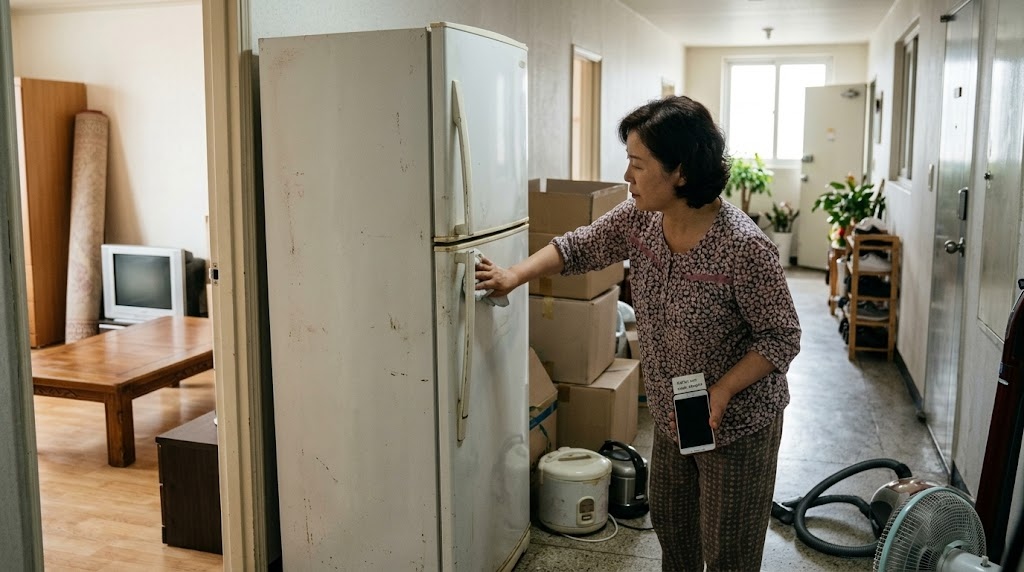
Are you still paying for district office stickers when throwing away bulky refrigerators, washing machines, or old rice cookers and vacuum cleaners?
For home appliances, using the ‘Free Doorstep Collection Service for Waste Appliances (e-Circulation Governance)’, jointly operated by the Ministry of Environment, local governments, and electronics manufacturers, allows drivers to visit your home (or doorstep) directly and collect them for a 0-won fee. Simply understanding the reservation procedure and collection criteria by item can greatly cut down moving costs.
- Single Collection vs. Set Collection: Complete Overview of Item Standards
Free collection services are strictly divided into large home appliances that can be collected individually and small home appliances that must be bundled together based on item size and type.
Items eligible for single collection (driver visits even for just 1 item):
Refrigerators, washing machines, air conditioners (including outdoor units), TVs (displays)
Solar panels, microwave ovens, air purifiers, water purifiers, dishwashers, clothes dryers, massage chairs, etc.
Set collection items (bundle of 5 or more required### Step 2: Make 100% Use of the Free Waste Appliance Collection Service (e-Circulation Governance)
When discarding bulky large appliances or broken small appliances, there is no need to pay sticker fees or struggle to haul them downstairs yourself. By utilizing e-Circulation Governance (Free Doorstep Collection Service for Waste Home Appliances), jointly run by the Ministry of Environment, local governments, and electronics manufacturers, a technician visits directly in front of your home to collect them free of charge.
- Single Collection vs. Bulk Collection Criteria
Before applying for collection, you must check the classification criteria of the appliances you intend to discard to prevent your application from being rejected.
Items eligible for single collection (can be collected with just 1 item)
Large appliances: Refrigerators, washing machines, air conditioners (including outdoor units), TVs (LCD, LED, etc.), dishwashers, electric ovens, vending machines, air purifiers, treadmills, etc.
Set items: Desktop PC sets (main body + monitor), audio sets
Bulk disposal items (must gather 5 or more for collection)
Small appliances: Hair dryers, electric rice cookers, microwave ovens, toasters, irons, vacuum cleaners, electric fans, blenders, standalone monitors/towers, printers, etc.
Tip: If you apply for small appliances together when discarding large appliances, they can be collected simultaneously regardless of the quantity of small appliances (even under 5 items).
- Collection Application Process and Disposal Tips
- Reservation registration: Apply through the official ‘Free Waste Appliance Doorstep Collection’ website (www.15990903.or.kr) or call center (1599-0903).
- Selecting discharge location:
Indoor collection: The technician enters inside the residence to collect items directly (resident presence mandatory).
Discharge outside front door: Non-face-to-face collection method where you place products outside your designated front door the evening before or morning of the reserved date, and the technician sends an SMS notification after collection.
- Scheduling: After the reservation is complete, a KakaoTalk notification containing assigned technician information is sent the day before or the morning of collection, and timing is coordinated.
- Precautions You Must Know Before Using
Must preserve original form: Home appliances with arbitrarily disassembled or damaged parts (refrigerator compressors, motors, etc.) are excluded from collection.
Must be fully dismantled in advance: Air conditioners, wall-mounted TVs, built-in appliances, etc., must be dismantled in advance. (Technicians do not perform dismantling work.)
Non-collectible items: Furniture (wardrobes, beds, desks, etc.), electric heating mats/jade mats, musical instruments, medical devices, massage chairs, etc., must be disposed of separately by purchasing large waste stickers from the local government.
Step 3: Disposal Methods for Large Furniture and Miscellaneous Waste
Large furniture such as bed frames, mattresses, sofas, and wardrobes, as well as miscellaneous items like broken dishes and flowerpots that cannot be sold used or collected for free, must be properly disposed of according to local waste disposal regulations to avoid fines (up to 1,000,000 won).
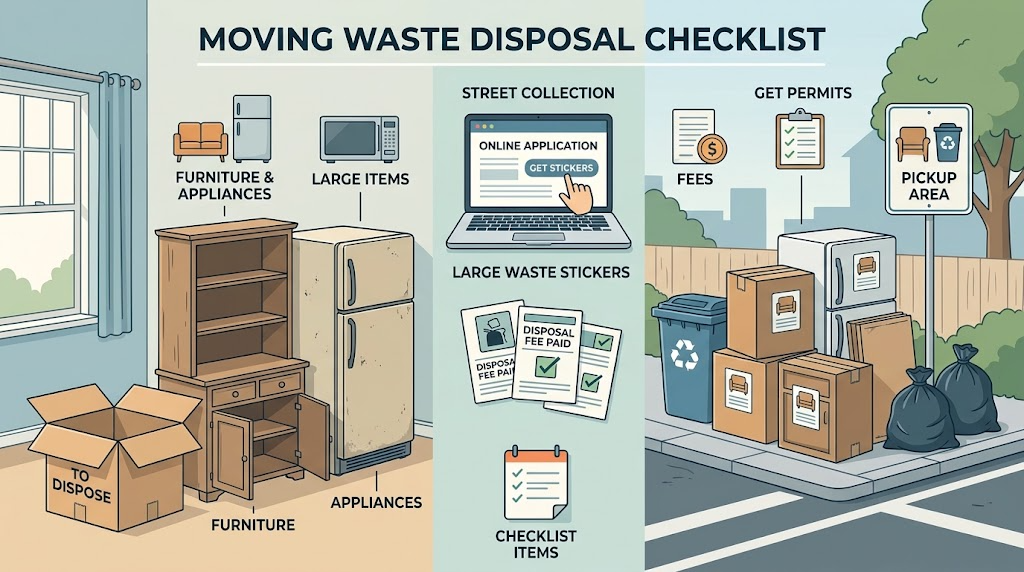
- Local Government Large Waste Sticker Issuance (Online / Offline)
This is the most common method, where you pay a designated fee according to the specifications of the disposal item and discard it.
- Online application (District/City Hall website):
- Access the ‘Large Waste Online Reporting’ section on your local district office website
- Enter discharger info, planned discharge date, disposal items (select size/specifications), and pay
- Print and attach the payment sticker (report certificate), or if you do not have a printer, write [Report Number, Item, Amount, Disposal Date] in large letters on A4 paper with a thick permanent marker and attach it
- Offline application (Community center and designated retailers):
- Visit the local community center or purchase stickers at nearby supermarkets/convenience stores that sell volume-rate garbage bags
- Attach the sticker to the furniture and place it at the designated location
- Using Mobile Waste Disposal Apps (‘Bbaegi’, ‘Yeogiro’, etc.)
This is a mobile simple disposal service recently adopted by many local governments. With just a smartphone, you can process items in 3 minutes without printing stickers.
- Direct disposal:
- When you take and upload photos of the furniture to be discarded in the app, AI or item search automatically calculates the specifications and fees.
- After mobile payment, write the assigned reservation disposal number on blank paper, attach it to the furniture, and place it outside.
- ‘Carry Down’ service (paid agency):
- A paid service that moves heavy mattresses, wardrobes, or large dining tables that are difficult to lift alone from inside the home down to the 1st-floor collection area. Costs vary depending on elevator availability and weight, but it is safer and more convenient than calling a ladder truck or freight vehicle.
- Disposal via ‘Special Sacks (Non-combustible Volume-rate Bags)’ Differing from Regular Trash
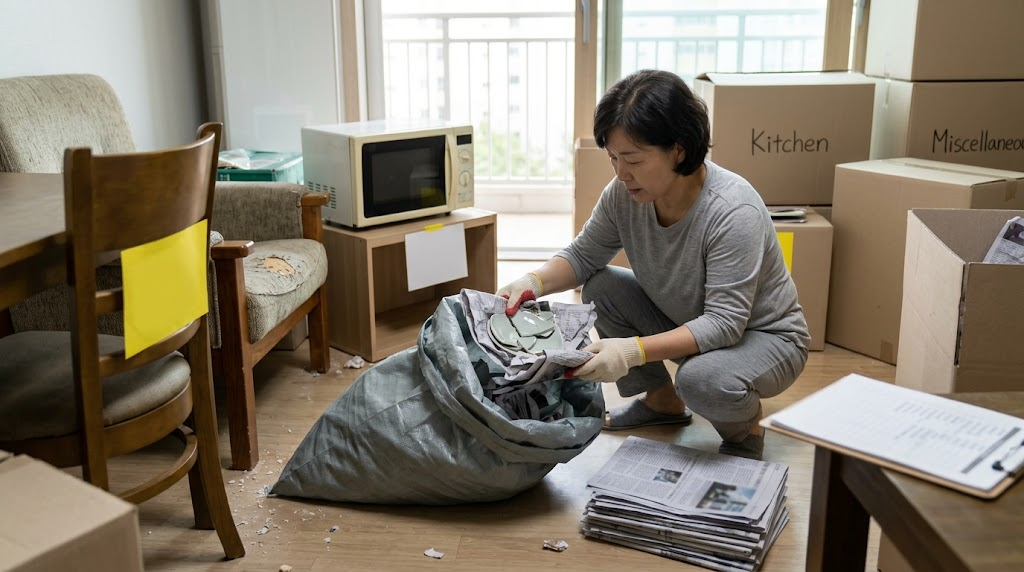
Broken glass, mirrors, ceramic dishes, flowerpots, tiles, etc., which frequently appear during moves, are subject to collection refusal if thrown into regular garbage bags (combustible).
- Non-combustible volume-rate bags (PP woven sacks):
- Dedicated woven sacks designed for non-burnable trash, available for purchase at community service centers, supermarkets, or designated hardware stores. (Sizes such as 20L and 50L vary by municipality)
- Precautions:
- When placing items in sacks, broken glass or sharp fragments should be wrapped in newspaper or cushioning material before putting them in for the safety of collection workers.
- Soil (potting soil), construction debris, etc., often have restrictions under local ordinances regarding permitted amounts in non-combustible sacks, so verification is needed prior to disposal.
| Item Category | Recommended Disposal Method | Key Preparation Details |
|---|---|---|
| Large furniture (sofas, beds, wardrobes) | District office online report / Mobile app | Mark disposal number and discharge on designated date |
| Small-to-medium miscellaneous furniture (chairs, dining tables, mirrors) | Purchase stickers at convenience store/supermarket | Check fees by specification before attaching |
| Non-combustible sundries (ceramics, flowerpots, glass) | Non-combustible volume-rate sacks (PP bags) | Wrap fragments in newspaper and seal sack |
Step 4: [At a Glance] Moving D-30 Waste Disposal Checklist
Trying to organize furniture and home appliances all at once on moving day will lead to Step 4: [At a Glance] Moving D-30 Waste Disposal Checklist
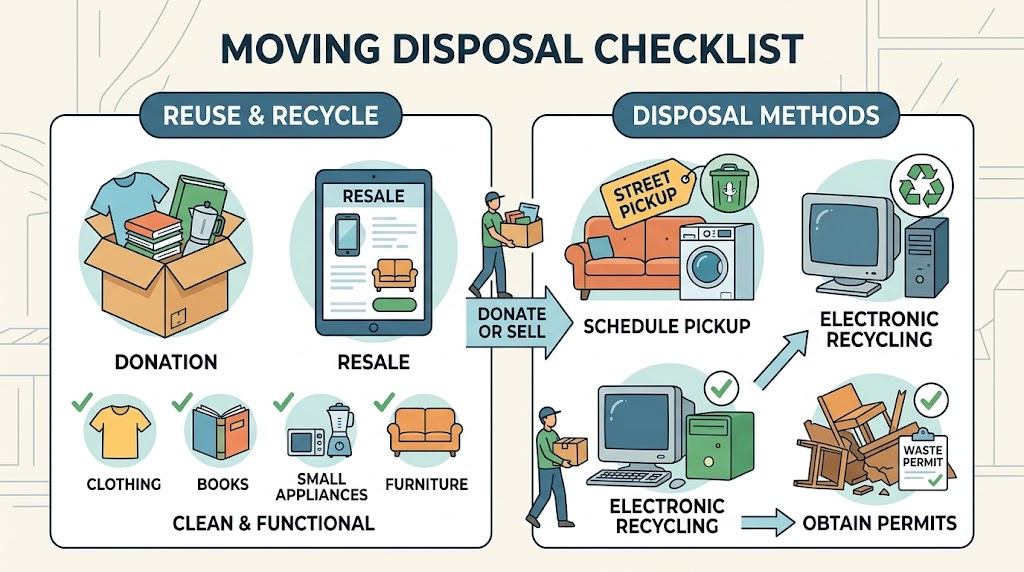
The surest way to reduce luggage on moving day is to sort items to discard and make a disposal plan one month in advance. Prevent confusion on moving day and save costs by checking disposal regulations and processing fees by item ahead of time.
Waste Classification and Disposal Standards by Item
| Category | Target Items | Disposal Method and Key Tips | Cost |
|---|---|---|---|
| Large waste appliances | Refrigerators, washing machines, air conditioners, TVs (single item eligible) | Free doorstep collection on designated date after pre-booking via e-Circulation Governance | Free |
| Small waste appliances | Hair dryers, rice cookers, fans, vacuum cleaners, etc. | Bundled reservation for 5+ items or drop off in dedicated bins at community centers | Free |
| Large domestic waste | Bed mattresses, wardrobes, sofas, desks, mirrors, etc. | Attach marked disposal number after registering via district office website / ‘Bbaegi’ or ‘Yeogiro’ app | Paid (sticker issuance) |
| Non-combustible waste | Broken glass, ceramics, flowerpots, tiles, bricks, etc. | Disposal in regular trash bags prohibited; purchase and dispose in special specification sacks (PP woven sacks) from supermarkets/community centers | Paid (dedicated sack purchase) |
| Clothing and scrap metal | Old clothes, blankets (excluding cotton quilts), curtains, scrap metals | Deposit in clothing collection boxes if in good condition, or use doorstep clothing buying services (settled by weight) | Free or receive payout |
D-30 Step-by-Step Action Checklist
- D-30: Thorough cleaning of all areas and item sorting
- Open corners, verandas, and pantry storage cabinets to list items unused for over 1 year
- Sort items to discard into 4 groups: [Appliances / Large furniture / Non-combustible sundries / Recyclable clothing]
- D-20: Apply for free collection and organize second-hand sales
- List items in good condition on second-hand trade platforms or donate to organizations issuing donation receipts (Beautiful Store, etc.)
- Complete doorstep reservations 3–5 days prior to moving via the free waste appliance doorstep collection site (e-Circulation Governance)
- D-7: Procure large waste stickers and special sacks
- Measure large furniture dimensions (width/height) and pay for waste stickers on the municipality website or dedicated collection app
- Purchase 1–2 non-combustible volume-rate sacks (PP bags) in advance for potting soil or broken tableware
- D-Day: Transfer to designated disposal location
- Move items to designated disposal zones (complex clean house, etc.) that do not interfere with the moving company’s ladder truck route
- Securely attach waste sticker numbers with packing tape to avoid rain damage or loss, then photograph and save the disposal number