
Basics of Searching for Government-Funded Training: Using HRD-Net Wisely
Once you make up your mind to develop your competencies through government funding and receive your Tomorrow Learning Card, the next step is finding the course that fits you best. However, when you access the vocational training portal HRD-Net, numerous training institutions and thousands of courses pour out, making it easy to feel at a loss about where to begin.
To properly learn skills in your desired field and minimize out-of-pocket expenses, you must move beyond simply entering basic keywords in the search bar. Here are 3 key utilization tips for selecting high-quality lectures without wasting time.
- Filtering ‘Training Institution Evaluation Grade’ and ‘Employment Rate’ First
HRD-Net’s detailed search provides numerous filters. At this time, the indicators you should check first are the institution’s evaluation grade (Best Training Institution) and the post-completion employment rate.
- Checking the Evaluation Grade: The Ministry of Employment and Labor and the Korea Skills Quality Authority comprehensively evaluate facilities, instructors, and training performance every year to grant 1-year to 5-year certifications. Prioritizing Best Training Institutions (such as BMT) that have obtained certification for at least 3 years can significantly reduce the risk of inadequate educational infrastructure or curriculum.
- Comparing the Average Employment Rate: Check whether the employment rate of the relevant course is meaningfully higher than the nationwide average employment rate for the same occupation. The employment rate based on employment insurance enrollment indicated next to the figure reflects the institution’s substantive follow-up management capability.
- Calculating Actual Payment Amounts in Advance with ‘View Out-of-Pocket Expenses’
Even for the same course, the self-pay ratio (0% to 45% or more) varies entirely depending on the participant’s situation (general job seeker, National Employment Support Program Type I or II, earned income tax credit recipient, etc.) and the employment rate by occupation.
- Click the [View Out-of-Pocket Expenses] button at the top of the course details page.
- Selecting your support target type allows you to immediately simulate costs down to the single won, showing whether it is completely free (K-Digital Training, National Strategic Industry Occupations, etc.) or incurs some out-of-pocket expenses.
- Checking your budget in advance helps prevent dropping out right before course registration due to unexpected expenditures.
- Cross-Verifying Actual Trainees’ ‘Satisfaction and Course Reviews’
Far more objective data than promotional detail pages written by the institutions themselves are the job satisfaction scores and honest written reviews of past graduates.
- Read carefully the official HRD-Net course reviews registered along with the star rating below the course name. HRD-Net reviews can only be written by actual trainees who met an attendance rate of 80% or more and completed the course, ensuring high reliability.
- Practical shortcomings—such as the instructor’s feedback speed during practice sessions, difficulty adjustment for non-majors, lecture room PC specifications, and equipment management status—are revealed without omission in the review section.
| Category | General Search | Smart HRD-Net Utilization |
|---|---|---|
| Selection Criteria | Focused on close distance from home | Focused on Best Training Institutions with 3–5 year certification |
| Cost Identification | Checking only total training cost | Checking actual out-of-pocket expenses by personal type via ‘View Out-of-Pocket Expenses’ |
| Lecture Verification | Referring to academy promotional blog posts | Checking actual course reviews from verified graduates and employment insurance employment rates |
After actively utilizing HRD-Net’s filter functions to narrow down at least 2 to 3 candidate options, verify detailed curriculum schedules and textbook provision through phone or in-person consultations to choose a government-funded course with no regrets.

3 Key Indicators to Filter Out Courses Without Failure
There are quite a few cases where people enroll solely based on flashy promotional phrases and the latest technology trends, only to drop out halfway due to sub-par class content or poor management. In government-funded programs, dropping out due to insufficient attendance results in penalties (deduction of support limits, temporary restrictions on card usage, etc.), making the initial choice more important than anything else.
Before applying for enrollment, here are 3 key indicators you must cross-verify on the training course details page.
① Employment Rate and Completion Rate: Substantive Data Analysis Behind the Numbers
Do not simply trust promotional banners claiming things like “80% Employment Rate Achieved.” You need to scrutinize the detailed conditions based on official figures compiled in the HRD-Net system.
- Gap Compared to the National Average for the Same Occupation: Check whether the course’s employment rate is at least 10–15%p higher than the nationwide average employment rate for the same occupation set by the Ministry of Employment and Labor.
- Completion Rate and Employment Rate with Employment Insurance Enrollment:
- Check whether a completion rate of 85% or higher is maintained relative to enrolled trainees. A low completion rate signals that many people dropped out due to failed curriculum difficulty adjustments or poor instructor management.
- Determine whether the employment rate calculation criteria are centered on workers with employment insurance (regular/contract workers covered by the four major insurances) rather than short-term part-time or special employment, allowing you to gauge the true rate of major-aligned employment.
② Review Analysis: ‘Specific Review’ Keywords to Check Beyond Ratings
A rating itself, such as 4.8 out of 5 stars, is not very significant. You should read the recurring keywords in written reviews left by actual graduates who achieved an attendance rate of 80% or higher.
- Practical Feedback, Code Reviews, and Assignment Checks: Look for comments like “The instructor answered questions thoroughly until the end” or “Feedback on code and project outputs was meticulous.” Theory-oriented, one-way lectures are no different from self-study.
- Receptivity to Non-Majors and Beginners: If there are many reviews stating “The pace was too fast for complete beginners to keep up,” entering without prior knowledge can be risky.
- Equipment and Administrative Support: Check whether there are specific comments regarding lecture room PC specifications, dual monitor availability, certification acquisition grants, or the counselor’s active commitment to job placement.
③ Instructor Career History and Curriculum: Industry Trend Alignment and Practical Project Ratio
The ultimate goal of government-funded training is to create a ‘portfolio that can be used immediately in the workplace’ beyond simply acquiring certifications.
- Instructor’s Recent Practical Experience: Verify whether the instructor teaches exclusively or has experience performing practical projects in the field within the last 3–5 years. In fast-evolving fields like IT, design, and digital marketing, courses by instructors who have lost touch with the field easily remain tied to outdated tools.
- Project (Practical Training) Time Proportion: It is advisable to avoid courses where simple tool usage (theory/functions) lectures exceed 60% of total training hours. At least 40% or more of total class hours must be allocated to personal portfolio creation or team projects to produce deliverables ready for submission in document screenings.
- Industry-Academia Partnerships and Corporate Project Participation: Courses that provide mentoring based on practical assignments or enterprise datasets from actual companies (e.g., K-Digital Training) make it easier to complete a resume tailored to interviewers’ standards.
| Key Verification Indicator | Items to Check | Passing Standard (Safety Line) |
|---|---|---|
| Employment/Completion Rate | Certified employment insurance employment rate, dropout ratio | +10%p or more above national average, 85% or higher completion rate |
| Review Keywords | Instructor feedback speed, response to practical questions, equipment environment | Mentions of close feedback, smooth progress adaptation for non-majors |
| Curriculum Composition | Project and practice ratio, tool versions used | Practical tasks covering 40% or more of total hours, latest tools reflected |
By narrowing down 2 to 3 courses that meet these 3 indicators, you can filter out substandard education that is government-funded in name only and find high-quality training programs directly connected to an actual career transition.
Please select what you would like to do next:

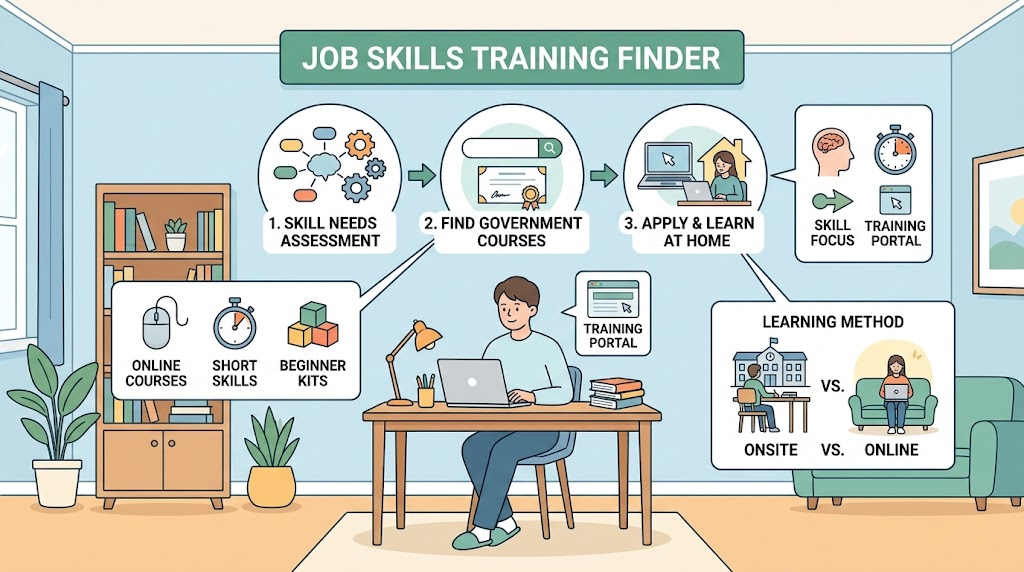
Choosing a Customized Government-Funded Training Track by Job Role and Situation
Government-funded education is not applied in the same manner for everyone. The track you need to choose differs entirely depending on whether you are currently a full-time job seeker, an incumbent aiming for career advancement or job skill upgrades while working, or a non-major entering a completely new field.
Selecting a course that does not align with your available time and target level makes handling the schedule itself overwhelming, increasing the risk of dropping out. Here is a summary of the most appropriate government-funded training types for each situation.
① Job Seekers & All-in Career Changers: Immersive Bootcamp Track (K-Digital Training & National Strategic Industry Occupations)
If you are a job seeker who can dedicate yourself to studying full-time 5 days a week without immediate commuting constraints, choosing an intensive, immersive course that elevates your skills to practical levels in a short period is most advantageous.
- K-Digital Training (KDT): In addition to IT development, big data, cloud, and AI, this has recently expanded to digital marketing and product management/product ownership (PM/PO) fields. Centered on corporate-led project practice, it offers 100% free support along with monthly training allowances (up to several hundred thousand won) to help you study while easing living expense burdens.
- National Strategic Industry Occupations (National Strategic Training): Focuses on cultivating core industrial fields facing workforce shortages at the national level, such as mechanical design, smart factories, tax accounting, traditional manufacturing, and convergence technologies. It is suitable for simultaneously acquiring certifications and field-ready skills through 3–6 months of intensive group education.
② Working Professionals & Incumbents: Weekend/Evening Short-Term Competency Enhancement Track (Job Performance Improvement Course)
For working professionals who split time after work or during weekends to boost practical productivity or prepare for a job change behind the scenes, a flexible curriculum that can be completed is essential.
- Weekday Evening and Saturday Intensive Classes: These are short-term 1–2 month courses arranged around 6–12 hours per week. Taking classes focused on single skills that can be applied to tomorrow’s work right away—such as Python business automation, SQL data extraction, no-code tool utilization, and business English/accounting practice—is effective.
- Remote (Online) Government-Funded Courses: If attending an academy at fixed times is difficult, you can utilize HRD-Net’s internet remote training courses. Completing lectures flexibly during commute hours or weekends and finishing via assignment submissions helps minimize accumulated work fatigue.
③ Non-Majors & Beginners: Step-by-Step Introductory Track with Solid Basics (K-Digital Basic Competency Training)
Jumping straight into a 6-month bootcamp when encountering coding, design, or data analysis for the first time makes it easy to fall behind and lose interest. Non-majors should first go through a brief aptitude exploration process.
- K-Digital Basic Competency Training (K-Digital Credit): A course where an additional 500,000 won in credit is provided separately from the existing Tomorrow Learning Card support limit.
- 100% Online Self-Directed Learning: Trainees can lightly practice web development basics, app development previews, and data visualization fundamentals along with 1:1 tutor feedback over a short period of roughly 4–8 weeks.
- Aptitude Self-Verification: Completing this course (with a 10% self-pay refund upon graduation) and transitioning to a long-term full-time bootcamp only after deciding it fits your aptitude is the safest route.
| Type | Recommended Government-Funded Track | Suitable Target | Training Format and Duration |
|---|---|---|---|
| Job Seeking / Full-Time Career Change | K-Digital Training (KDT), National Strategic Training | Job seekers and resignees capable of full-time study | Full-time, 5 days a week on weekdays (3–6 months) |
| Incumbent Skill-Up | Worker Job Performance Improvement Course, Remote Training | Currently employed workers, part-time job seekers | Weekday evenings / Weekend classes / Online (1–2 months) |
| Non-Major Introduction | K-Digital Basic Competency Training (Credit) | Beginners with no foundation in programming or data | 100% online practical course (4–8 weeks) |
Deciding on a track after objectively assessing your current available time and prerequisite knowledge levels is crucial to staying engaged without burning out and translating the training into tangible resume credentials.
Please select what you would like to do next:

Checklist of ‘Training Institution Pre-Consultation’ Questions You Must Ask Before Enrolling
If you have shortlisted several appealing courses on HRD-Net, you must undergo a phone or in-person pre-consultation with the academy (training institution) before finalizing your application with a single click.
This is the only opportunity to uncover the reality of the educational environment, the instructor’s teaching approach, and the actual employment support concealed behind smooth promotional copy on detail pages. Here is a checklist of 4 essential questions you should be sure to ask the counseling desk or assigned mentor.
① Checking Portfolio Quality and Production Methods
The core deliverable of government-funded education is not a certificate of completion, but a ‘portfolio.’ You need to verify during the consultation phase whether results that work in the entry-level hiring market are produced.
- “May I see the actual portfolios of recent graduates from the previous cohort?”
- Check the average-level deliverables in addition to the few outstanding pieces of work.
- Examine whether all trainees produce identical results using cookie-cutter templates, or if distinct, individualized problem-solving processes are included.
- “How is the balance divided between team projects and individual projects?”
- If conducted solely through team projects, work may be delayed by free-riders, or there may be parts you did not handle directly, making them difficult to defend in interviews. Ensure that at least 1 individual project output is secured.
② Inspecting the Dedicated Employment Support System and Corporate Linkage Status
Many academies tout ‘100% Employment Linkage,’ but the actual depth of support provided varies widely across institutions.
- “Is a dedicated career counselor assigned after completion to provide 1:1 resume and interview clinics?”
- Check whether support simply consists of sharing job opening links in group chat rooms, or if a dedicated counselor conducts tailored resume proofreading and mock interviews.
- “What is the partner company pool and the actual proportion of linked employment?”
- Ask whether the list of companies with industry-academia MOU partnerships leads to tangible hiring, and what scale of enterprises (startups, mid-sized companies, agencies, etc.) previous cohort graduates entered.
③ Checking Lecture Room Infrastructure and Practice Equipment Environment
For courses in development, video editing, 3D graphics, and big data analysis, hardware performance is directly linked to learning efficiency.
- “How are the lecture room PC specifications and monitor setup configured?”
- Confirm that the CPU, RAM, and graphics card specifications are sufficient to handle heavy tools (PyCharm, Premiere Pro, Blender, etc.) without difficulty.
- Checking whether dual monitors are equipped—a key factor in coding and design efficiency—is also an essential check item.
- “Can trainees freely use the lecture rooms or self-study spaces outside of class hours?”
- Inquire whether study rooms remain open on weekday evenings or weekends, and whether software license accounts are supported for long-distance commuters or home practice.
④ Checking Dropout Penalty Regulations and Absence Handling Standards
In government-funded programs, abandoning a course due to personal reasons leads to administrative penalties, including account limit deductions and future card issuance restrictions.
- “What are the attendance recognition criteria and the documentation procedures for official absences (reserve forces training, sick leave, job interviews, etc.)?”
- Familiarize yourself in advance with detailed rules on accumulating late arrivals and early departures to meet completion criteria (typically 80% or higher attendance per unit period).
- “How is it handled if one finishes early due to personal circumstances or successful employment (early job placement)?”
- Verify regulations to ensure that successfully landing a job mid-course is recognized as early completion, allowing support benefits to remain without penalty so you can balance job hunting with peace of mind.
| Verification Area | Essential Question | Key Checkpoints |
|---|---|---|
| Portfolio | “May I see the average portfolio of the previous cohort?” | Cookie-cutter templates vs. proportion of individual assignments |
| Employment Support | “Are 1:1 resume proofreading and mock interviews provided regularly?” | Simple announcement sharing vs. dedicated counselor close care |
| Equipment/Facilities | “What are the PC specifications and after-class study room opening hours?” | Dual monitors, high-spec task execution, self-study environment |
| Attendance/Rules | “What are the recognition standards for early employment and absence policies?” | Preventing dropout penalties, recognition of employment absence letters |
Institutions that answer these questions with confidence, presenting clear and specific data during consultations, are far more likely to provide systematic trainee management and deliver superior employment outcomes.
Please choose the next step to wrap up the entire post neatly:
Korean version: 한국어로 읽기