Moving Out and Cleaning Up a Studio Apartment Alone: Where Does It Start Getting Stuck?
This body text resonates with studio apartment dwellers and single-person households, highlighting the practical challenges and importance of schedule management when moving out.
- Moving Out and Cleaning Up a Studio Apartment Alone: Where Does It Start Getting Stuck?
When move-out day approaches to leave the studio apartment you’ve grown fond of, the excitement is fleeting, and you quickly run into practical obstacles.
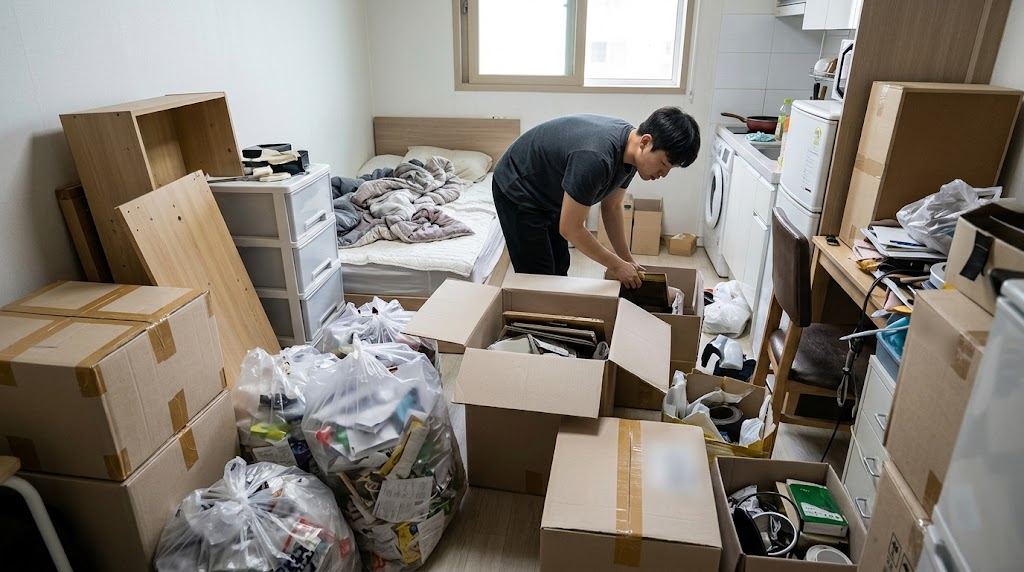
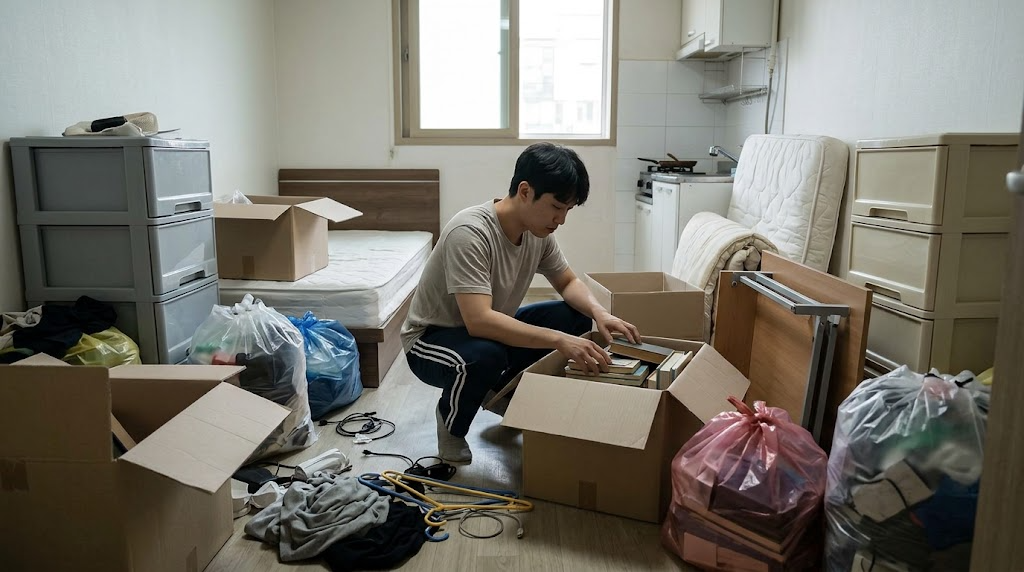
It usually looks like a cozy studio apartment of roughly 6 to 7 pyeong, but once you start packing and sorting what to throw away, an overwhelming volume of trash and miscellaneous items begins pouring out—enough to make you wonder, “Where on earth was all this stuff hiding in such a cramped room?”
Especially for single-person households who must handle the move-out cleanup entirely on their own with no one to ask for help, it is all too common to feel overwhelmed days in advance, procrastinate without touching anything, and end up pulling an all-nighter right before move-out day.
① Mattresses, Drawers, Sofas… The Hurdle of Bulky Luggage Difficult to Lift Alone
The moment panic sets in most when organizing a studio apartment alone is when confronting “heavy and bulky large furniture.”
Mattresses without handles: Soft and slippery, it is difficult for an adult to balance and lift one alone.
Flat-pack storage units and desks: Though they seem light at a glance, coated particle board (MDF) carries substantial weight, making merely dragging them out the front door a major hurdle.
2-person sofas or solid wood chairs: Getting caught in narrow studio hallways or angled entryways, you easily end up scratching the wallpaper while struggling alone.
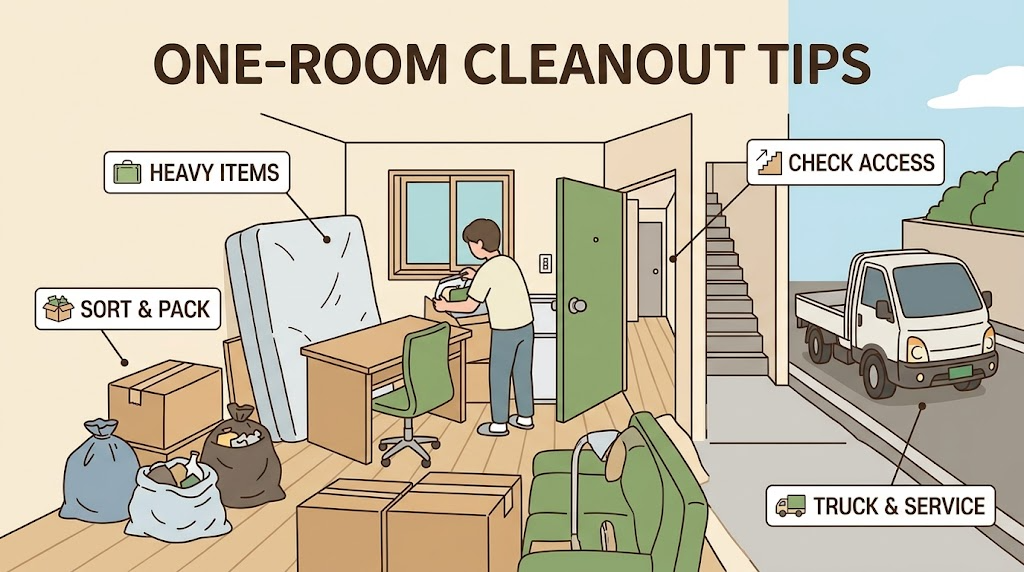
In particular, if you live on the 2nd or 3rd floor of an older villa without an elevator, carrying heavy furniture down the stairs to the designated ground-floor disposal area can be a challenge bordering on physically impossible.
② The Core of Deposit Refunds: The ‘Duty to Restore to Original Condition’ and Waste Disposal Deadlines
The most dangerous misconception when clearing out a studio apartment is the thought: *”If I just move my belongings out on moving day and leave the rest behind, the landlord will take care of the settlement.”*
Upon termination of a lease agreement, the tenant has a ‘duty to restore to original condition,’ requiring them to return the property to its original state. What happens if you leave furniture or miscellaneous items behind in the room upon check-out?
- Deposit cannot be settled on the same day: If residual waste remains in the room, the landlord will not pass the room condition inspection (move-out inspection), which may delay the same-day return of your deposit.
- Excessive deduction for labor costs: If the landlord directly hires a private cleaning and hauling company, disputes frequently arise from unilaterally deducting collection costs that are 2 to 3 times more expensive than if the tenant handled it themselves.
- Delays in municipal collection schedules: Even if you purchase bulky waste stickers, municipal collection crews only visit on designated days of the week. Miscalculating dates can result in furniture sitting neglected for several days even after you move out, leading to neighbor complaints.
💡 Key Checkpoint
“The deadline for move-out cleanup is not the ‘morning of move-out day,’ but the ‘evening before move-out day.'”
To ensure that all you need to take on the morning of moving day is your suitcase and personal luggage, disposing of bulky furniture and cleaning up remaining trash must be finished at least 24 hours prior to checkout so you can cleanly hand over the keys without deposit disputes.
Sorting Items to Discard: Money-Making Items vs. Money-Costing Waste
This body text is written to help solo dwellers prevent unnecessary spending before moving out and quickly and efficiently sort items to be discarded.
- Sorting Items to Discard: Money-Making Items vs. Money-Costing Waste
When starting move-out cleanup, simply unfolding volume-rate garbage bags without a plan takes a long time and only increases disposal costs.
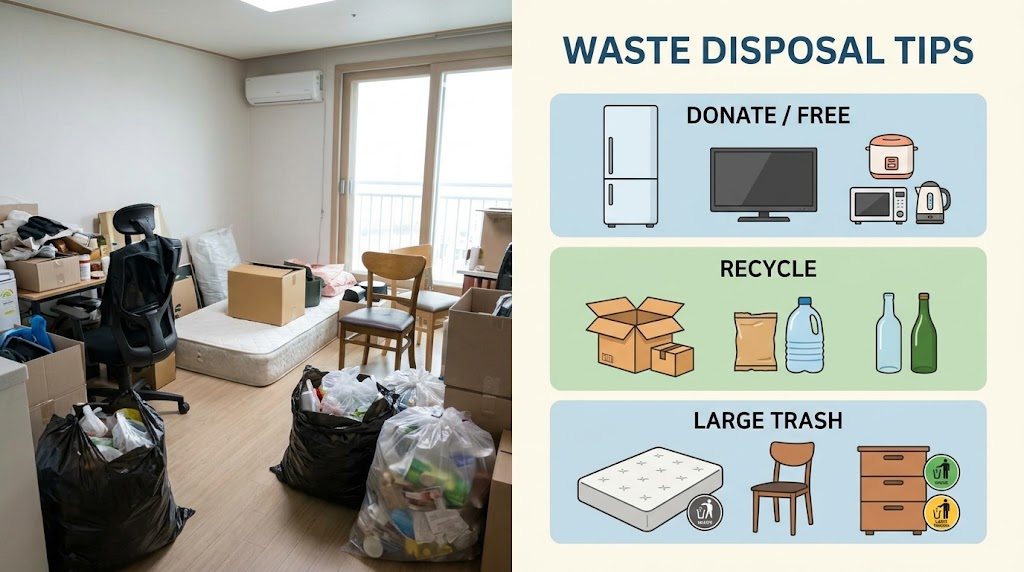
The very first thing you need to do is clearly sort everything in the room into three categories: [① belongings that can be sold for money], [② belongings collected for free], and [③ waste that requires paying a fee to discard].
① Secondhand Sales and Free Giveaways: Sticking to the Danggeun Market Golden Time
For small appliances or furniture in good condition used in a studio apartment, you can use secondhand trading platforms (such as Danggeun Market) to save disposal costs and even make some modest moving cash.
- Items eligible for sale: Single-person microwaves, electric kettles, power strips, stand lamps in good condition, full-length mirrors, clothes drying racks
- Pricing tip: Rather than aiming to sell at a high price, the key to quick transactions is listing items 20–30% below market price with the ‘goal of saving waste sticker fees (5,000 to 10,000 KRW).’
- Deadlines:
- 7 days before moving: Upload paid sale listings
- 3 days before moving: Immediately switch unsold items to ‘free giveaways’ (on the condition of direct pick-up)
- 2 days before moving: For items where even giveaway attempts fail, finalize them as targets for waste sticker disposal without hesitation
② Free Collection Service: Never Pay to Discard Waste Home Appliances
For home appliances such as refrigerators, washing machines, and microwaves, there is an official national service that visits inside your home to collect them for free without purchasing local government waste stickers.
- e-Circulation Governance (Free On-Site Pick-up Service for Waste Home Appliances)
- How to apply: Online search (Waste Home Appliances Free On-site Pick-up) or apply via representative phone (1599-0903)
- Collection criteria:
- Single item eligible for collection: Large home appliances such as refrigerators, washing machines, air conditioners, TVs, and microwaves (free visit even with just 1 unit)
- Set collection items: Small appliances such as electric fans, hair dryers, rice cookers, and vacuum cleaners are eligible for free on-site collection only when gathering 5 or more units
- Precautions: If reservation volume spikes, a collection technician is assigned 3–5 days after the application date, so you must complete advance reservations at least 5 days prior to moving.
③ Money-Costing Waste: 3-Step Separate Disposal Method
Pure waste left after giveaways and free collection must be strictly separated by material type to prevent fines or additional collection fees.
| Category | Applicable Items | Disposal Method |
|---|---|---|
| General Waste | Contaminated plastic wrap/bags, cotton pillows, slippers, worn-out towels, receipts, small amounts of broken ceramics | Discard in standard volume-rate garbage bags |
| Recyclables | Clear PET bottles, cans, glass bottles, clean plastic, flattened delivery boxes | Tie and discard by item in transparent plastic bags |
| Bulky Waste | Mattresses, bed frames, drawer chests, chairs, clothes racks, large rugs/carpets | Discard after attaching local government stickers or registering via mobile apps (such as ‘Bbaegi’) |
| Non-combustible Waste | Large amounts of broken glass, tiles, flower pots, soil | Purchase special-standard sacks (non-combustible volume-rate bags) at hardware stores or community service centers and discard |
💡 Classification Key Summary
“Reserve free collection for home appliances, give away knick-knacks on Danggeun, and use stickers only for remaining large furniture!”
By following just this principle, you can significantly reduce waste disposal costs that typically run around 50,000–100,000 KRW for a 6–7 pyeong studio apartment down to the 10,000–20,000 KRW range.
Choose what to cover next:
Realistic Tips for Disposing of Bulky Waste Alone
This content contains practical know-how and tool utilization tips so that single-person household dwellers can dispose of heavy loads down to the 1st floor without getting injured.
- Realistic Tips for Disposing of Bulky Waste Alone
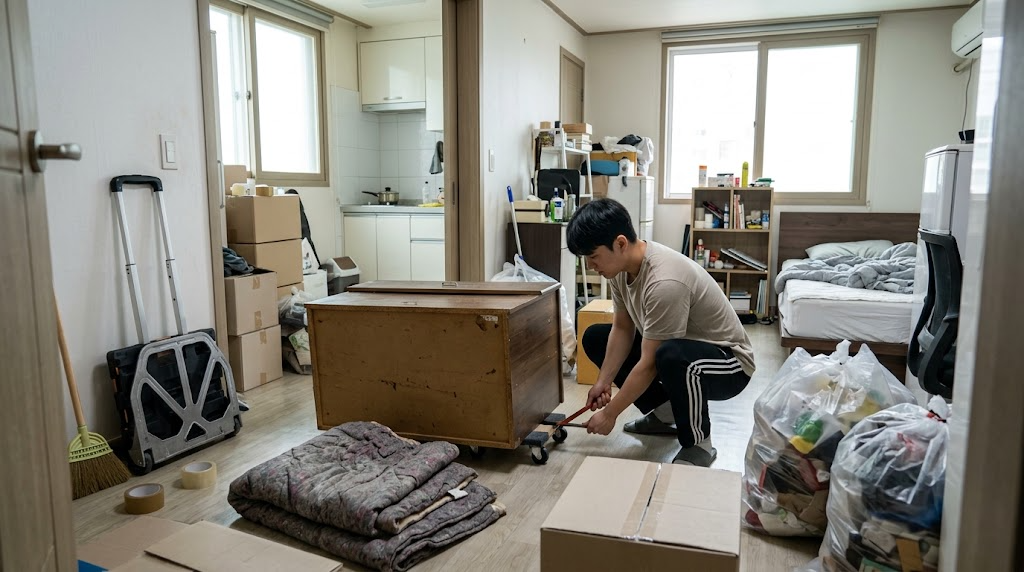
Even for single-person dwellers who do not have a large build or strong muscular strength, knowing the right tools and tips allows anyone to effortlessly move a queen mattress or a 3-drawer chest down to the 1st-floor disposal area alone.
Instead of trying to lift blindly with sheer force, try applying the following 3 practical tips.
① Reducing Volume with Screwdrivers and Wrenches (Furniture Disassembly Know-How)
Fully assembled furniture is dangerous to handle alone because its bulky volume easily catches on stairs or doorframe edges. Loosening just a few screws to break it down into flat boards lowers the center of gravity, making it easy to move even by oneself.
Bed frame: Remove the mattress, loosen the corner bolts/nuts of the frame with a hex wrench or cordless drill, and stack and tie the boards together.
Drawer chest: Take out all the drawer compartments and carry the main body and drawers separately. Just removing all drawers reduces the weight of the main body by more than half.
Dining table and desk: Turning the tabletop upside down and unscrewing the leg joints to separate them prevents scratching the wallpaper when passing through narrow room doors or stairs.
Hangers and metal shelving: Release the fixing levers, disassemble pipe by pipe, and tape them together to carry down all at once.
② The Big 3 Essential Disposal Equipment for Single-Person Households
Using the lever principle and wheels when carrying heavy furniture down stairs or moving through hallways alone can reduce physical exertion by more than 80%.
Furniture Moving Wheels (Moving Wheels / Furniture Lifter):
A small wheel set that can be purchased for 5,000 to 10,000 KRW at Daiso or online shopping malls.
Slightly lifting the corners of a chest of drawers with the lifter and placing the 4 wheels underneath allows even an adult woman alone to push it to the elevator with just finger strength.
Foldable Hand Truck (Cart / Dolly):
Essential for transporting disassembled panels, heavy drawers, or burlap sacks to the 1st-floor collection area.
Using a urethane-wheel cart with low wheel noise helps reduce noise complaints in hallways.
Discarded Duvets/Blankets (The Dragging Technique):
Placing a thick discarded blanket or duvet under a mattress or sofa and pulling one end of the blanket allows smooth, gliding movement all the way to the end of the hallway without scratching the floor.
③ Local Government Stickers vs. Mobile Disposal Apps (‘Bbaegi’, ‘Yeogiro’) Usage Guide
Before taking furniture down to the 1st floor, completing the local government reporting process first avoids being mistaken for illegal dumping.
Traditional Convenience Store / Community Service Center Stickers:
Check the item specifications, purchase the sticker, and attach it to an easily visible spot on the furniture. (Waterproofing with clear tape is recommended in case of rain)
Mobile Bulky Waste Collection Apps (‘Bbaegi’, ‘Yeogiro’):
Without needing to search district office websites or visit a community center, taking a photo of the furniture via the smartphone app lets AI automatically recognize specifications, completing payment in just 1 minute.
Simply write the [Reservation Number] generated after payment largely on an A4 sheet or cardboard scrap with a permanent marker and tape it to the furniture.
Tip: If you are in an environment where you cannot carry items down to the 1st floor alone (3rd–4th floor without an elevator), you can request the in-app paid add-on service ‘Carry Down Service’ to get a mover’s help bringing items from inside the home down to the 1st floor.
💡 Safety Rules for Secure Disposal
“When going down stairs, the furniture must always be lower than you.”
Going down stairs with furniture behind your back can lead to a severe accident where you get crushed if the furniture slips. Always support the furniture from below and descend slowly, step by step.
Guide to Using Private Studio Waste Collection Services
This is a practical guide to using ‘private waste collection services’ when the volume of items is too large or when living in a high-floor villa without an elevator makes it impossible to dispose of everything by yourself.
- Guide to Using Private Studio Waste Collection Services
If you have a lot of bulky furniture or cannot fathom carrying items down alone before move-out day, calling a private waste collection company is the surest and fastest solution.
However, inquiring without prior knowledge makes it easy to be charged extra fees up to double the initial consultation quote, with companies claiming “there are more items than expected upon arrival” or “labor costs are higher due to stairs.” Here is a guide on how to hire an agency at a reasonable rate without getting ripped off.
① Basic Unit Rate Standards for Studio Waste Collection (Half Truck vs. Full Truck)
Quotes from private collection companies are generally based on the loading capacity of a 1-ton truck.
| Load Standard | Estimated Loaded Items | Average Market Price (Metropolitan Area Standard) |
|---|---|---|
| 1-Ton Truck Half Load (1/2) | 1 mattress, 1 small drawer chest, around 4–5 sacks of miscellaneous volume-rate items | Approx. 150,000–250,000 KRW |
| 1-Ton Truck Full Load (Full) | Bed set, wardrobe, desk, chair, refrigerator, and all remaining domestic waste | Approx. 350,000–500,000 KRW |
- Items Included in the Rate: Base freight cost, disposal facility dump fee, base collection labor (based on 1 driver)
- Caution: The above amounts are general standards and may vary depending on elevator availability or waste characteristics (proportion of mixed waste).
② 3 Defensive Lines to Prevent On-Site Extra Charge Bombs
You must preemptively block the 3 most common reasons that online quotes differ from on-site payment amounts.
- Clearly State Elevator Availability and Stair Floor Count
- For villas on the 2nd floor or higher without an elevator, a ladder truck must be called or the technician must carry items down the stairs manually, incurring stair labor fees of about 30,000 to 50,000 KRW per floor.
- Informing access conditions during the quote stage—such as “It is the 3rd floor of a villa without an elevator, and the distance from the parking area to the entrance is about 10m”—prevents on-site surcharge disputes.
- Whether Truck Parking Space Is Secured
- If narrow alleys prevent a 1-ton truck from pulling up right in front of the building, moving distances increase and additional labor costs may be charged.
- It is recommended to clear a parking space for one truck in the building parking lot or entrance on moving day.
- Packing Condition of Miscellaneous Items
- Aside from furniture, if small waste, clothing, or food ingredients are scattered on the floor, technicians must pack them on-site, adding ‘organizing labor fees.’
- Simply packing small items tightly into 100L trash bags or woven sacks and tying them up can save 50,000 to 100,000 KRW or more on the quote.
③ Tips for Inducing Reverse Bidding with Photo-Based ‘Fixed Quotes’
Explaining vaguely over the phone causes companies to quote the highest amount to hedge against risks. Be sure to take photos and request quotes from at least 3 places simultaneously, such as Soomgo, Danggeun Market Business Profiles, and local waste companies.
- Photo Taking Tips:
- Take wide-angle photos from 2–3 perspectives so the entire room can be seen at a glance.
- Leave doors open to capture items that are only visible when opened, such as inside drawers, lower sink cabinets, and balcony corners.
- Standard Quote Request Message:
“This is based on collecting all furniture and packaged sacks shown in the attached photos.
It is the 2nd floor of a villa without an elevator, and a 1-ton truck can be parked in front of the entrance.
Please provide a final fixed quote (all-in-one) with no additional fees for hauling away items exactly as pictured with no extra belongings added on-site.”
Specifying this when receiving quotes induces natural price competition among companies, allowing you to select the most affordable option with the best reviews.
④ How to Use ‘Contactless On-Site Collection’ Tailored to Move-Out Schedules
If you cannot be present on-site on the day due to work commutes or moving schedules to another region, you can request contactless collection.
- Share a temporary door lock passcode, or organize belongings in a designated spot by the 1st-floor entrance or inside the room in advance and hand over the keys contactlessly.
- After receiving before/after on-site photos and truck loading completion photos via messenger, settle the final payment by bank transfer to cleanly pass the move-out inspection without directly confronting heavy items yourself.
Select what to cover next:
3-Day Complete Timeline for Studio Apartment Move-Out Cleanup Without Issues on Moving Day
This is the content of the ‘3-Day Complete Timeline for Studio Apartment Move-Out Cleanup’ tailored chronologically to prevent panic on moving day and wrap up moving out step by step as planned.
- 3-Day Complete Timeline for Studio Apartment Move-Out Cleanup Without Issues on Moving Day
If you postpone move-out cleaning and pull an all-nighter the day before moving, your energy will be depleted, and local government collection registration or booking private companies becomes impossible, easily causing disruptions to your deposit settlement.
Here is a practical timeline to finish step by step starting exactly 3 days prior, so you can leave with only ‘personal luggage to take to the new home’ on the day of moving.
[D-3] Book Free Collection & Complete Bulky Waste Registration
Three days before moving is the golden time to finish ‘external reservations and applications’ rather than moving items physically.
- Apply for Free On-Site Pick-up Service for Waste Home Appliances (e-Circulation Governance):
- Complete booking the on-site collection schedule for large appliances to send for free, such as refrigerators and washing machines, for the morning of moving day (or the day before).
- Bulky Waste Disposal Registration:
- Prepay for bulky furniture to discard, such as mattresses and drawer chests, via mobile apps (‘Bbaegi’ or ‘Yeogiro’) or local government websites, and receive disposal reservation numbers.
- Convert Unsold Danggeun Market Items to ‘Free Giveaways’:
- For secondhand items posted a few days ago that haven’t sold yet, boldly switch them to “free giveaway for whoever can pick up today” to increase disposal chances.
- Purchase Essential Consumables:
- Prepare 2–3 100L volume-rate garbage bags, 1 non-combustible waste sack, packing tape, thick gloves, and permanent marker pens in advance.
[D-2] Emptying the Fridge, Compressing Miscellaneous Items & Disassembling Furniture
Two days before moving, you must significantly reduce small residual items in the room to secure space.
- Food Items & Refrigerator Cleanup:
- Empty all remaining food from the freezer and fridge compartments and discard as food waste.
- Turn off the refrigerator power in advance and leave the door open to melt interior ice, then wipe it down with a dry towel. (Prevents water leakage during transit)
- Compressing & Packing Clothes and Bedding:
- Pack clothes and old bedding to discard into 100L volume-rate bags, stomp firmly to remove air, and seal securely with tape.
- Disassembling Flat-Pack Furniture & Separating Drawers:
- Disassemble desk surfaces and legs, as well as flat-pack bed frames, using a screwdriver and line them up neatly against the wall.
- Completely empty the contents of drawer chests and remove the drawer compartments from the main frame in advance.
[D-1] 1st Round Disposal of Residual Waste & Final Packing of Belongings to Take
By the night before moving, all waste in the room must be gone or organized in a state ready to be taken down to the 1st floor.
- Full Disposal of Household Waste:
- Dispose of packed general volume-rate garbage bags and recyclables at the building’s designated recycling area in advance.
- Move Bulky Furniture to the 1st Floor (or Secure Private Hauling Routes):
- If disposing directly, use moving wheels or a hand cart late in the evening to bring furniture down to the 1st-floor collection site and attach reservation number sheets.
- If hiring a private collection company, clear the entryway generously so that no small clutter obstructs the front door and hallway pathways.
- Final Packing of Items to Move:
- Pack only the belongings to take to the new home (clothing, valuables, laptop, etc.) neatly into suitcases and moving boxes, and gather them next to the front door.
[D-DAY] Final Collection Confirmation, Residual Cleaning, and Move-Out Inspection
On moving day, focus solely on inspection and administrative settlement.
- Carry Out Free Appliance Collection and Private Truck Hauling:
- Check that technicians arrive at the scheduled time to haul away the remaining bulky items.
- Restoration of Studio Default Options and Floor Cleaning:
- Verify that standard options (studio built-in air conditioner remote control, induction cooktop, shoe cabinet shelves, door lock keycard, etc.) are in their proper places.
- Lightly sweep and damp-mop the cleared floor, sink, and bathroom with a broom and mop.
- Utility Bill Settlement and Landlord (Manager) Move-Out Inspection:
- Take photos of the electricity (KEPCO 123), gas, and water meter numbers to pay off usage amounts up to that day immediately.
- Undergo final verification of room condition (wallpaper damage, remaining trash) together with the landlord, receive the full security deposit back into your bank account, and hand over the door lock passcode.
💡 3-Day Completion Checklist Summary
| Category | Key Tasks to Execute | Core Objective |
|---|---|---|
| D-3 | Book free appliance pick-up, register waste stickers/app, purchase waste sacks | Secure external collection schedules in advance |
| D-2 | Empty refrigerator, disassemble furniture, compress clothing/bedding in volume-rate bags | Reduce indoor waste volume by 1/2 |
| D-1 | 1st round disposal of living waste, finish packing items to take | Eliminate all miscellaneous residual items in the room |
| D-DAY | Complete furniture collection, settle utilities, move-out inspection and deposit refund | Retrieve deposit on the same day without disputes |
Try the following next steps to complete your posting:
Korean version: 한국어로 읽기