Introduction: The Betrayal of Mindlessly Over-Consuming Supplements Thinking “It Must Be Good for the Body”
When fatigue sets in, we pop vitamin C; in the name of boosting immunity, we add high-dose vitamin D injections or supplements; and as we layer on various oil-form fat-soluble supplements for eye health and antioxidant effects, our desks quickly fill up with supplement bottles. We take them generously with the pure mindset that “since it’s a good ingredient, the more I eat, the more beneficial it will be for my body.”
However, in the world of supplements, the golden rule is not “the more, the merrier,” but rather “too much is as bad as too little.” When the nutrients we mindlessly overconsume exceed the limits our bodies can handle, the shield meant to protect our health can instead boomerang and attack our bodies.
Unlike water-soluble vitamins, let’s examine thoroughly from now on the hidden pitfalls of “fat-soluble vitamins,” which can accumulate steadily in our bodies and harbor terrifying toxicity, as well as the risks of intake limits that we have casually overlooked.
- The Fatal Misconception That “If You Eat Too Much, It Will Naturally Excrete”
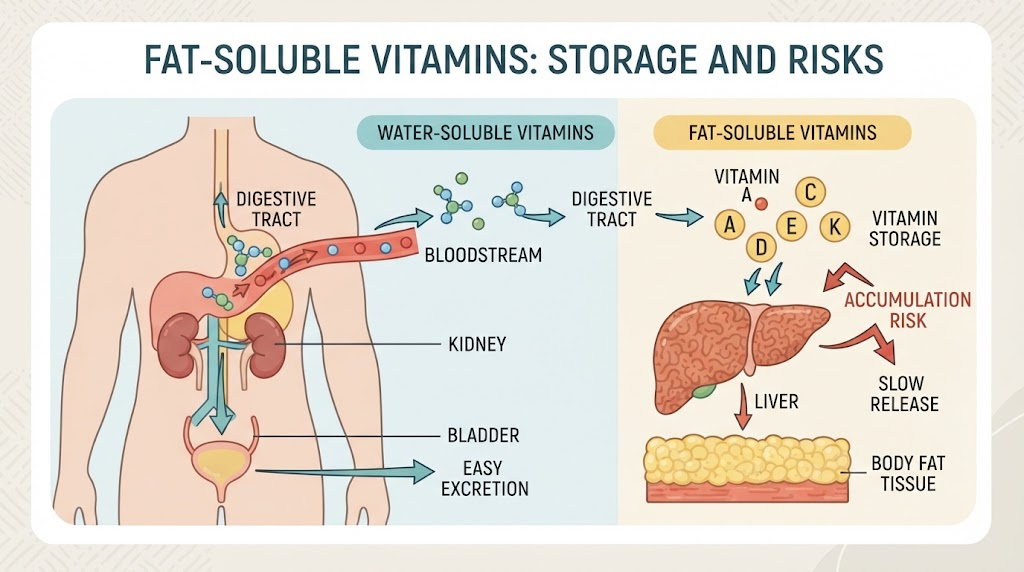
Water-soluble vitamins like vitamin C or the B-complex are water-soluble, so the excess amount remaining after fulfilling the body’s needs is easily eliminated from the body through urine, carrying a relatively low risk of overdose.
Growing accustomed to this experience, it becomes easy to develop a vague belief that regardless of the type of supplement, the more you take, the better.
However, fat-soluble vitamins, which are stored in adipose tissue or the liver, have a completely different nature. They cannot easily escape out of the body and instead accumulate intact within the system, reaching toxic levels over time and triggering various side effects.
- The “Dangerous Limit” Unwittingly Filled Through Duplicate Intake
The most common mistake modern people make when choosing supplements is “duplicate intake of ingredients.”
Even though the morning multivitamin already contains vitamins A and D, people end up overlapping and taking individual fatigue relievers, bone health supplements, or commercially available nutrition-fortified foods and protein shakes.
Although they appear to be different products on the surface, when summing up the total daily intake, it is surprisingly common for it to far exceed the daily upper intake limit recommended by the Ministry of Food and Drug Safety.
- Do Not Trust Your Body’s Metabolic Capacity: The Necessity of Setting Safe Limits
If the investment started for health instead overloads the kidneys or liver and results in unexplained abnormal symptoms like headaches, chronic fatigue, or skin trouble, the cart has been put before the horse.
The wisdom of carefully inspecting the ingredient list on the back of the packaging and observing the appropriate intake limits your body can handle is truly the smartest defense line to protect your health.
Now, let’s specifically delve into what makes fat-soluble vitamins decisively different from water-soluble vitamins so that they accumulate so fearsomely inside our bodies, exploring their principles and characteristics by type in the upcoming content.

The Intracellular Accumulation Principle of “Fat-Soluble Vitamins,” Which Is Completely Different from Water-Soluble Vitamins
When choosing supplements, we often look only at the word “vitamin” and think that since it is good for the body, the more, the better. However, vitamins are divided into “water-soluble,” which dissolves in water, and “fat-soluble,” which dissolves in fat, depending on their properties when dissolved in the body, and these two face completely opposite fates within the body.
Let’s clearly examine how the processing methods of water-soluble and fat-soluble vitamins differ inside the body and why only fat-soluble vitamins harbor the “fear of accumulation.”
- Water-Soluble Vitamins: “Clean Excretion After Use and Residue”
Water-soluble vitamins, such as vitamin C or the B-complex, have the property of dissolving well in water.
Consumption and Excretion Mechanism: The surplus amount remaining after being absorbed into our body and used for necessary metabolic processes dissolves in the blood, passes through the kidneys, and is rapidly excreted out of the body through urine.
Relative Safety: Because of this, water-soluble vitamins do not accumulate excessively in the body even if consumed in somewhat larger amounts than the recommended intake, carrying a relatively low risk of toxicity. (Of course, excessive intake can cause gastrointestinal disorders, but accumulated toxicity is almost nonexistent.)
- Fat-Soluble Vitamins: “A Structure That Clings Closely to Adipose Tissue and the Liver and Does Not Escape”
On the other hand, fat-soluble vitamins, represented by vitamins A, D, E, and K, have the property of dissolving in “fat” just as their name implies.
Presence of Storage: Because they mix well with fat, after being absorbed through the digestive tract, they are sequentially adsorbed and stored in the liver or bodily adipose tissue.
Difficulty of Excretion: Unlike water-soluble vitamins, they are not easily washed away through urine and remain intact inside the body’s warehouse; therefore, if intake continuously exceeds the recommended limit, the warehouse overflows, inducing internal toxicity levels (Hypervitaminosis).
- The Vicious Cycle of Everyday Accumulation: “The Amount That Piles Up Without You Knowing”
Fat-soluble vitamins have the advantage that deficiency symptoms appear relatively slowly because they remain in the body’s storage even if you do not take them every day.
However, conversely, this also means that the excessive amount continuously supplied every day through supplements and fortified foods cannot be excreted and keeps accumulating. As time passes, the internal concentration can soar to dangerous levels, serving as a fuse for various side effects.
Now, let’s take a specific look in the upcoming content at what kind of warning signals and side effects representative fat-soluble vitamins (A, D, E, K), which accumulate so fearsomely inside the body, send to our bodies when overconsumed.
Warning Signals and Side Effects Upon Overconsumption of Representative Fat-Soluble Vitamins
Fat-soluble vitamins are essential nutrients necessary for maintaining our body’s physiological functions, but as we examined earlier, they have a fatal characteristic in that the amount remaining after use cannot be excreted outside the body and instead piles up layer by layer in the liver or adipose tissue.
If you continuously overconsume them well beyond the recommended upper intake limit with the complacency that “the more you eat, the healthier you will get,” our bodies begin sending various warning signals and severe side effects. Let’s point out the risks of overconsumption for the four major representative fat-soluble vitamins.
- Overconsumption of Vitamin A: From Chronic Fatigue and Headaches to Impact on the Fetus
Vitamin A, which helps maintain skin health and vision, is one of the ingredients that exhibits toxicity the fastest when excessively accumulated.
Key Warning Signs: Representative symptoms include severe headaches, dizziness, extreme fatigue, vomiting, dry skin and peeling, and hair loss.
Pregnancy Warning: Particularly for women in early pregnancy, excessive intake of vitamin A sharply increases the risk of congenital malformations in the fetus, requiring special caution against taking high-dose single-ingredient products.
- Overconsumption of Vitamin D: Hypercalcemia, Which Destroys the Kidneys While Trying to Protect the Bones
Called the “sunlight vitamin” and established as a national staple supplement for bone health and immunity, vitamin D is also seeing an increase in side effects from overuse amidst recent high-dose trends.
Induction of Hypercalcemia: When vitamin D becomes excessively abundant, calcium is over-absorbed in the intestines, causing “hypercalcemia,” where the concentration of calcium in the blood becomes abnormally high.
Key Warning Signs: Loss of appetite, vomiting, frequent thirst, muscle weakness, kidney stone formation, and fatal side effects where calcium deposits in soft tissues like blood vessels or kidneys, impairing organ function.
- Overconsumption of Vitamins E and K: Impaired Blood Clotting and Increased Bleeding Tendency
Vitamin E, which aids antioxidant activity, and vitamin K, which is involved in blood clotting, also require caution as fat-soluble substances when excessively accumulated.
Vitamin E: Excessive intake can excessively interfere with platelet coagulation function, increasing the bleeding tendency such that bruising easily or bleeding fails to stop readily when a wound occurs.
Vitamin K: Excessive symptoms through a normal diet or supplements are rare, but if a patient taking certain anticoagulants (thrombolytic agents) overconsumes vitamin K, it can completely neutralize the drug’s efficacy and cause serious risks.
Now, let’s look into specific criteria in the upcoming content regarding the tips for checking the safe intake limit tailored precisely to my body in daily life and avoiding duplicate intake to protect the bodies of myself and my family.

Checking the “Safe Intake Limit” Tailored Precisely to My Body and Avoiding Duplicate Intake
Once you learn about the accumulation risks and terrifying side effects of fat-soluble vitamins, a sudden anxiety creeps in: “How much vitamins A and D are contained in the supplements I’m currently taking?”, “Could I perhaps be exceeding the upper limit without realizing it?”
To ensure that the intake meant to protect health does not instead become poison, let’s examine practical guides to check the safe intake limit tailored perfectly to your body and thoroughly block duplicate intake.
- Understanding the Concept of the Ministry of Food and Drug Safety’s “Tolerable Upper Intake Level (UL)”
When choosing supplements, the first indicator we should look at is not the minimum recommended amount, but the ‘Tolerable Upper Intake Level (UL)’.
Meaning of Upper Intake Level: It refers to the maximum limit that a healthy adult can consume during a day without the risk of side effects. From the moment this figure is exceeded, the countdown for internal accumulation toxicity and side effects risks begins.
Examples of Upper Intake Limits for Major Fat-Soluble Vitamins for Korean Adults:
Vitamin A: Maximum 3,000
μg RAE (based on retinol, beware of excessive accumulation)
Vitamin D: Maximum 4,000 IU per day (beware of the recent influx of products with high doses of 5,000 IU or more)
You must carefully check whether the absolute content in mg or IU units, as well as the ‘percentage (%) of the nutrient reference value’ on the back of the supplement packaging, exceeds the upper intake limit.
- Uncovering the Trap of “Duplicate Intake” Where Loopholes Form Without You Knowing
If we look closely at the supplements and foods we consume throughout the day, it is quite common for the exact same ingredients to flow in redundantly through multiple paths.
Multivitamin + Individual Single-Ingredient Supplement: For example, the morning multivitamin already contains 1,000 IU of vitamin D, but people additionally take a 2,000 IU single vitamin D product or high-dose injections for bone health.
Commercially Available Fortified Foods and Protein Shakes: Recently, vitamins A or D are frequently added for nutritional fortification purposes in milk, cereals, protein supplements, health drinks, and more.
When summing up all these routes, it easily surpasses the upper intake limit of 4,000 IU without realizing it, making a ‘supplement diet’—where you gather the ingredient labels of all products you are taking and calculate the total sum—absolutely necessary.
- Summary of Smart Product Selection to Maintain Safe Intake Limits
Do Not Mindlessly Chase Single High-Dose Products: A product with an unconditionally high number is not necessarily good. Considering your dietary habits and the contents of your multivitamin, choose products with appropriate content that safely fill only what is lacking.
Habit of Cross-Checking Ingredient Labels: Before adding a new supplement to your shopping cart, simply cross-checking whether ingredients overlap with other products you are currently taking can completely block the risk of fat-soluble vitamin accumulation.
Now, let’s do a final check in the upcoming content on what specific tips can be practiced in daily life to safely consume fat-soluble vitamins for a lifetime without side effects.

Smart Practical Tips for Safely Consuming Fat-Soluble Vitamins Without Side Effects
Once you have learned about the risk that fat-soluble vitamins can accumulate in the body and induce toxicity, it is time to stop feeling fearful and instead take hold of practical safety tips to cleverly adjust them to fit your body.
Let’s point out three practical guides to completely block the side effects of fat-soluble vitamins within your daily supplement routine and safely reap only the health benefits.
- Choosing an “Appropriate Content” Balanced Better Than a “High-Dose Single-Ingredient Product”
Among the supplements distributed on the market, quite a few high-dose products lean toward a “mega-dose” profile, far exceeding the daily recommended intake by several to dozens of times.
Setting a Benchmark: In the case of vitamin D, for general maintenance purposes, choosing a product with an appropriate content in the range of 1,000 IU to 2,000 IU is the safest way not to exceed the upper intake limit (4,000 IU).
It is wise to discard the bias that higher numbers unconditionally yield better effects, and instead select stable products that harmonize with the nutrients you obtain from your daily diet.
- Utilizing Periodic Cessation of Intake (Holiday Period) and Blood Tests
Because fat-soluble vitamins do not dissolve in water and wash away, if you have been steadily consuming them for a long time, it is necessary to check how much has accumulated in the body’s storage.
Having a Holiday Period: For example, if you have taken them consistently for about 3 to 6 months, taking a short “holiday” period of temporarily pausing intake for 1 to 2 weeks to give your body some breathing room to consume the residual components on its own is also a good method.
Linking with Regular Checkups: When receiving a regular health checkup once a year, checking the blood vitamin D concentration and other figures numerically allows you to grasp most objectively whether “too much is as bad as too little” is occurring in your body.
- Matching the Timing of Intake with a Fatty Diet
Fat-soluble vitamins (A, D, E, and K) are absorbed best when they come in together with “fat,” exactly as their name implies.
Rather than popping them raw on an empty stomach or in the morning, taking them right after lunch or dinner containing moderate healthy fats (olive oil, nuts, avocados, fish, etc.) is the safest timing to enhance internal utilization and reduce gastrointestinal irritation.
Based on the accumulation principles of fat-soluble vitamins and the correct limit-setting principles we have examined so far, how about calmly inspecting your supplement storage box and ingredient labels starting today? A smart health routine that lets go of greed and aligns with your body’s metabolic capacity is precisely the most certain key to protecting both your wallet and your health simultaneously.

Conclusion: Too Much Is as Bad as Too Little (過猶不及), Setting Wise Supplement Intake Limits to Protect Your Body
From opening our eyes in the morning to falling asleep at night, we take truly numerous pills to protect our health. The supplement routine started with the single belief that “it must be good for the body” eventually lightens our wallets and sometimes places an invisible burden on our body’s liver and kidneys.
Especially after facing the risks of internal accumulation and the pitfalls of indiscriminate duplicate intake of “fat-soluble vitamins,” which operate under completely different rules from water-soluble ones, we realize that a cautious change in our attitude toward supplements is necessary.
Ultimately, the core of wise supplement consumption and intake for health does not lie in “how much you take,” but rather in “how safely and balanced you fill within the limits your body can handle.” Through this time today, why not calmly check your supplement storage box and ingredient labels once more?
Setting safe intake limits that let go of greed and match your body’s metabolic rhythm—that is the most certain and smart health investment that safeguards both your wallet and your health.
Korean version: 한국어로 읽기