
Why a Pre-check of Income and Assets is Essential Before Applying for Youth Housing Support
When taking on various housing support projects from the government and local autonomous governments, such as the Special Youth Monthly Rent Support, the Beontimmok Jeonse Fund Loan, and Youth Purchase Rental Housing, many young people check only their age and homelessness requirements and submit their applications right away. However, after several weeks of screening, the result that comes back is quite often a “disqualified (eliminated)” notice. The main reason for this is exceeding the income and asset limits.
The reasons why a pre-check of income and assets is essential in youth housing support projects are as follows.
The trap of complex income calculation methods: The monthly salary or annual income you think of and the “standard median income” calculated in government subsidy screening are calculated differently. Since business income, income-converted property values, and other factors are reflected in a complex manner in addition to earned income, a large discrepancy can occur between your expectations and the actual screening results.
Original household (parents) income and asset combination criteria: In particular, some projects like the Special Youth Monthly Rent Support screen not only the independent youth household but also the income and property of the “original household,” including parents. Even if your own income meets the criteria, you are often eliminated because of your parents’ home ownership status or asset size, making a preliminary check absolutely necessary.
Prevention of wasted time and application rejections: Even if you submit complete documents, if you exceed the income and asset criteria, you will automatically be eliminated during the screening process, which can cause you to waste several months or miss the timing for other advantageous support projects.
Therefore, prior to full-scale document submission or application, checking in advance whether your income and assets safely fall within the support criteria using the Bokjiro mock calculator or the Housing and Urban Fund asset screening criteria is the first step toward a successful application.
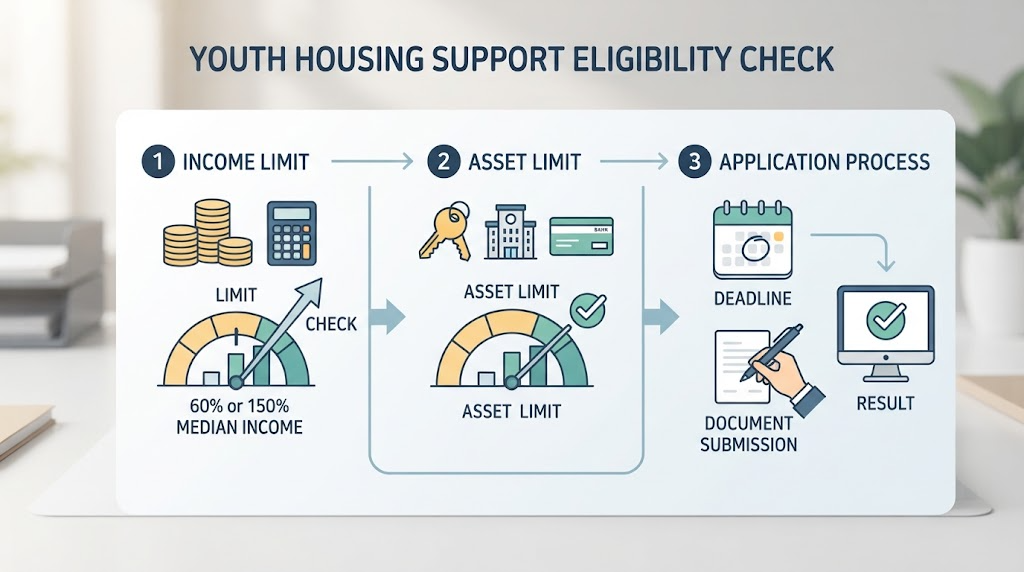
Core of Income Criteria Calculation: Standard Median Income and Household Member Scope
The strictest yardstick determining the application eligibility for youth housing support projects (Special Youth Monthly Rent Support, Happy Housing, Youth Jeonse Lease, etc.) is definitely the “income criteria.” To accurately understand numbers like “60% or less of standard median income” or “150% or less” written in public notices, you must understand the standard median income, which is the standard by which the government calculates income, and how the household member scope is set.
The core structure of income criteria calculation is as follows.
Concept of Standard Median Income: The income of the household located exactly in the middle when all households in South Korea are lined up in order of income is called the “median income,” which is announced annually by the Minister of Health and Welfare. For example, for 100% of the standard median income, there is a unique amount determined by the number of household members, such as a 1-person household or 2-person household (based on monthly income amount), and ratios such as 60% and 150% are calculated based on this.
Setting Household Member Scope (Independent Youth Household vs. Original Household):
Independent Youth Household: If a person is 30 years of age or older, or is not a minor and is recognized as maintaining a certain level of income or higher (50% or more of standard median income, etc.) and living apart from parents, only the youth themselves and their spouse are calculated as household members.
Original Household (Including Parents) Criteria: For college students, low-income youth, or a significant number of unmarried youth under 30 years of age, screening is conducted by combining not only the youth themselves but also the income of the original household including lineal ascendants (parents) residing together on the resident registration. In this case, if the parents’ income or property exceeds the criteria, the youth may be excluded from support targets no matter how small their own income is.
Combination Method by Income Type: Not only simple salary (earned income) but also business income (freelancer, 3.3% income, etc.), property income (rental income, interest income, etc.), and transfer income (public pensions, etc.) are all combined. Since it is calculated based on National Tax Service taxation information and total health insurance premium remuneration, you must keep in mind that a difference may occur from the actual amount received deposited into your bank account every month.

Asset Criteria Calculation and Reflection Criteria by Property Item
Even if you pass the income criteria in youth housing support projects, there are very many cases where you are eliminated at the final hurdle, the “asset and property criteria.” To ensure that the housing stability of the youth demographic practically goes to classes vulnerable in housing costs, the government and local governments strictly screen so that the total asset value held by you or your original household does not exceed a certain amount (e.g., Special Youth Monthly Rent Support total assets of 122 million won or less, etc.).
The core contents of the asset reflection criteria by property item are as follows.
General Property (Land, Buildings, Housing, etc.):
Real estate such as land, buildings, and housing is calculated based on the standard market value (based on officially announced land price and officially announced housing price).
If there is housing or land in your or your original household’s name, it is directly added to the property value regardless of actual residency, which becomes a major cause of elimination due to housing owned by parents.
Automobile Price Criteria:
In housing support projects, vehicle values are strictly reflected to block the ownership of expensive vehicles.
Generally, if you own an automobile exceeding the standard vehicle value determined by the Minister of Health and Welfare (e.g., less than 37 million won, etc.), you are immediately excluded from support targets no matter how small your income or other assets are. You must be careful because even business vehicles or commercial vehicles are included in the vehicle value without exception.
Reflection of Financial Assets and Debts:
Net assets are calculated by subtracting debts such as loans from the total sum of various financial assets such as deposits, installment savings, stock certificates, bonds, investments, and insurance.
However, since all financial institution accounts and balances are integrated and queried through the National Tax Service and Ministry of Health and Welfare’s Bokji-eum system during financial asset inquiries, accurate reporting without omission is necessary.
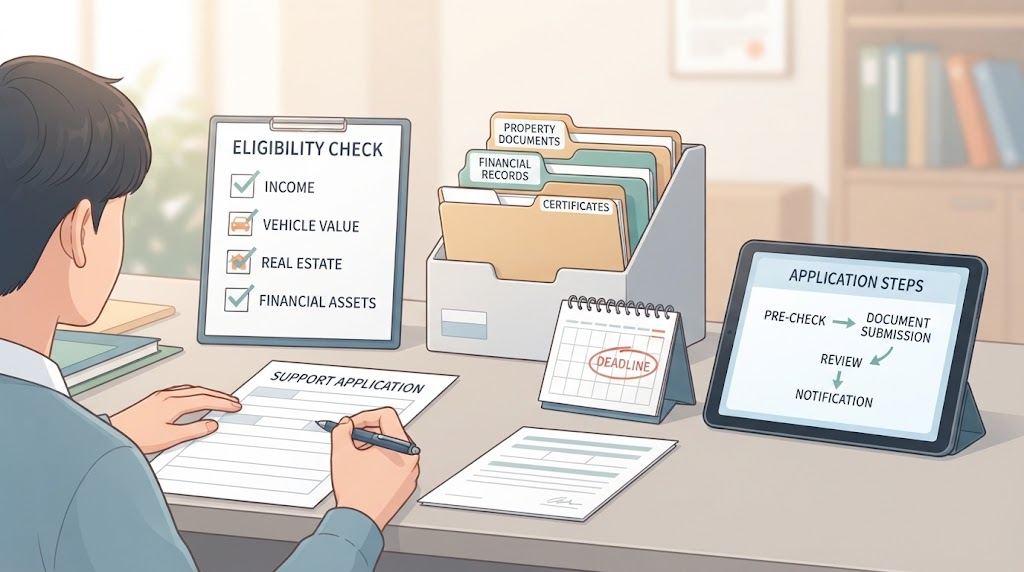
Comparison of Income and Asset Criteria by Major Youth Housing Support Project
Representative youth housing support projects implemented by the government and local governments have subtle differences in the criteria for screening income and assets depending on the form of support (cash support, rental housing, jeonse loans, etc.). You must accurately compare what yardsticks the project you intend to apply for uses to screen in order to reduce useless effort.
The core comparison details of income and asset criteria by major youth housing support project are as follows.
Special Youth Monthly Rent Support (Central Government Cash Support):
Income Criteria: Must simultaneously satisfy 60% or less of standard median income for the independent youth household and 100% or less of standard median income for the original household (including parents).
Asset Criteria: Must satisfy both the criteria of total assets of 122 million won or less for the independent youth household and total assets of 470 million won or less for the original household. Since it is easy to be excluded from selection if the parents’ asset size is not small, a preliminary check is essential.
Beontimmok Jeonse Fund Loan (Housing and Urban Fund Low-Interest Loan):
Income Criteria: Can apply if the combined annual income of the loan applicant and spouse is 50 million won or less (provided, however, that newlyweds or public institution employees relocating to innovative cities are raised to 60 million won to 70 million won or less).
Asset Criteria: Must satisfy the asset criteria determined by the Housing and Urban Fund (e.g., asset criteria adding to the previous year’s income criteria, around the mid-300 million won level or lower), and undergo strict asset screening along with the homeless householder requirement before loan execution.
Youth Purchase Rental Housing and Happy Housing (Public Rental Housing):
Income Criteria: It is basic that the household income of the homeless youth themselves (or college students/job seekers) is 100% or less of the standard median income, and depending on the rank, only the personal income criteria is reflected or parents’ income is partially reflected.
Asset Criteria: Depending on the Happy Housing or purchase rental type, in the case of the Happy Housing youth tier, automobile value criteria (e.g., 37 million won or less) and total asset criteria (e.g., mid-200 million won or less) are applied, blocking youth holding expensive assets from entering public rental housing.

Conclusion: Successful Application Through Accurate Eligibility Check via Pre-checks
So far, we have carefully examined why a pre-check of income and assets is essential when applying for youth housing support projects, what the calculation structure of standard median income and household member scope is, and the reflection criteria by property item and differences by major project.
For youth housing support funds, receipt is not finalized simply by meeting age or residency requirements. It is frequently the case that painstakingly prepared applications come to naught solely because of a single invisible income-converted amount, parents’ assets, or the value of a vehicle owned. Therefore, thoroughly performing mock calculations in advance and checking whether criteria are exceeded before fully preparing and submitting documents is the greatest shortcut to saving time and effort.
Based on what we’ve organized today, actively utilize the Bokjiro mock calculation service, the My Home Portal, and the Housing and Urban Fund asset screening criteria. By accurately grasping the eligibility requirements of your own name and the original household and preparing flawlessly, we sincerely cheer for you to successfully secure precious housing support benefits without missing them!
Korean version: 한국어로 읽기