
Carefully Checking Target Eligibility Conditions by Type of Youth Housing Support Benefits
Due to soaring jeonse and monthly rent prices and the aftermath of interest rate hikes, the housing cost burden on young people taking their first steps into society is heavier than ever. Monthly rent and maintenance fees account for a large portion of fixed expenses, and housing instability is often a major cause that goes beyond simple economic problems to shake academic studies, employment, and the stability of daily life.
The government and local autonomous entities operate various policies and financial support systems to help these young people achieve housing stability. However, because the systems are diverse and complexly intertwined, there are not a few cases where people miss out on benefits due to doubts such as “Will I really be eligible?” or a lack of information.
In this article, we will thoroughly examine the types of major housing support benefits and target eligibility conditions that young people must check, and find out how to wisely find and utilize the most advantageous system for oneself. To avoid suffering disadvantages by missing the application period or misunderstanding eligibility requirements, check out the housing support benefits right now that suit you.
Major Central Government Youth Housing Support Benefits and Eligibility Conditions
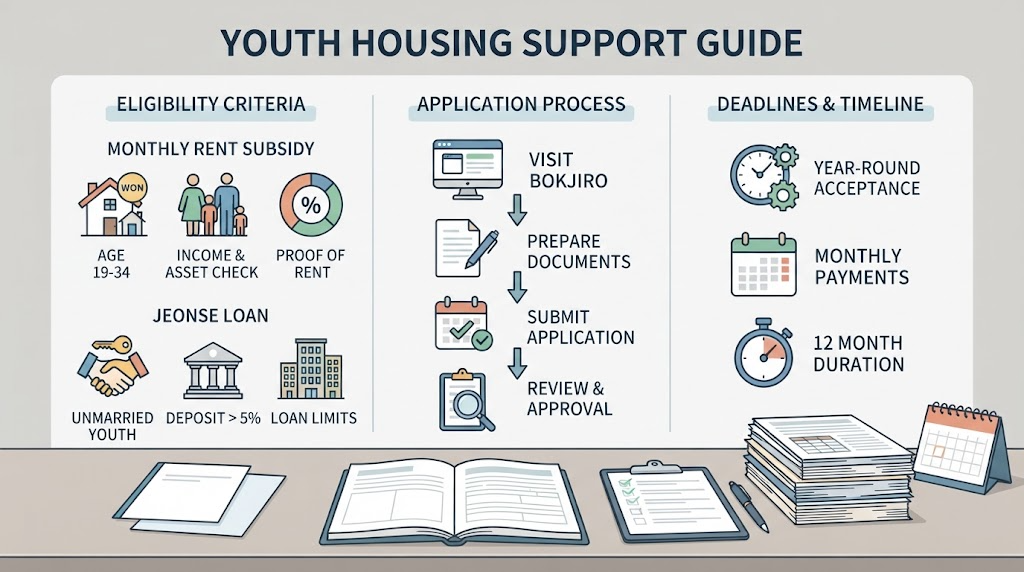
To ease the housing cost burden of young people and support asset formation, the central government is implementing various housing support projects. We have organized the main contents and eligibility conditions of representative central government benefits: the Special Youth Monthly Rent Support, the Beontimok Jeonse Fund Loan, and the Youth Housing Dream Subscription Savings Account.
① Special Youth Monthly Rent Support
This is a project that provides cash support for monthly rent for a certain period to stabilize the housing of low-income youth with heavy economic burdens.
Target Eligibility: Homeless youth living separately from their parents (Ages 19 to 34 or younger)
Income and Property Criteria:
Youth household: 60% or less of median income, property of 122 million won or less
Original household (including parents): 100% or less of median income, property of 470 million won or less
Support Amount: Up to 200,000 won per month for up to 12 months (per installment) (within the limit of actual monthly rent paid)
Application Method: Visit the Bokjiro (bokjiro.go.kr) website or the jurisdiction community center to apply
② Beontimok Jeonse Fund Loan
This is a financial product that lends jeonse funds under cheaper conditions than commercial bank interest rates to homeless youth who have difficulty preparing jeonse deposits.
Target Eligibility: Homeless youth who have signed a jeonse contract for a rental deposit housing unit and paid 5% or more of the rental deposit (Ages 19 to 34 or younger)
Income Criteria: Annual income of 50 million won or less (75 million won or less combined in the case of newlyweds)
Asset Criteria: Meeting the Housing and Urban Fund asset criteria (applying the standard amount announced every year)
Loan Limit and Interest Rate:
Loan Limit: Up to 200 million won in the metropolitan area (up to 160 million won in local regions) (compatible housing price and deposit limit verification required)
Loan Interest Rate: Around 2.1% ~ 2.9% per annum (applied differentially according to income bracket and deposit scale, preferential interest rates separate)
Application Method: Visit the Fund e-Ddeun website or trustee banks (Woori, KB, Shinhan, NH, IBK, etc.) to apply
③ Youth Housing Dream Subscription Savings Account
This is a dedicated subscription savings account that substantially expands the benefits of the existing youth-preferred housing subscription comprehensive savings to simultaneously help youth purchase their own homes and build assets.
Target Eligibility: Homeless individuals aged 19 to 34 or younger (annual income of 50 million won or less, military service period recognition possible)
Subscription Requirements: Earned income earners, business income earners, and other income earners can all subscribe (those serving in military service are also permitted to subscribe)
Major Benefits:
Interest Rate Preference: Annual interest rate of up to 4.5% applied to the payment amount (including preferential interest rates)
Income Deduction Benefit: 40% income deduction on annual payments (up to 3 million won) and interest income tax exemption benefit (when requirements are met)
Housing Connectivity: Upon winning a subscription, grants eligibility to use the ‘Youth Housing Dream Loan’ linked at a low interest rate
Application Method: Visit Housing and Urban Fund handling banks (designated banks nationwide) or non-face-to-face subscription via each bank’s smartphone app

Customized Youth Housing Support Projects by Local Government
In addition to central government support, each local government is operating various support projects tailored to the characteristics and actual housing conditions of youth residing in the region. From the metropolitan area to major metropolitan cities, let’s look at what customized housing welfare benefits are available by region.
① Seoul Metropolitan Government
Seoul Youth Monthly Rent Support: Supports up to 200,000 won per month for up to 10 months targeting homeless youth (ages 19 to 39) residing in Seoul. It applies relatively broad income criteria of 150% or less of the standard median income and focuses on reducing the perceived housing cost burden for the youth demographic.
Station Area Youth Housing (Youth Safety Housing): Public and private rental housing supplied at lower-than-market rents in station areas with convenient public transportation access, helping to stabilize the housing of homeless youth and newlyweds.
② Gyeonggi Province
Gyeonggi-do Youth Basic Income and Housing Welfare Linkage: Gyeonggi Province organically links regional youth housing support with policies that help build the foundation for youth self-reliance.
Youth Jeonse and Monthly Rent Deposit Interest Support: Targeting homeless youth households within Gyeonggi Province, projects are actively operated by each city and county to alleviate the burden of housing costs during high-interest periods by supporting a portion of jeonse and monthly rent loan interest.
③ Incheon Metropolitan City
Incheon-style Youth Monthly Rent Support: To supplement the blind spots of central government support, Incheon City is deploying regional-customized projects that support monthly rent and rental costs for youth residing in Incheon.
Dream City and Youth Purchased Rental Housing: Provides expanded public rental supplies and preferential residency eligibility benefits for housing-vulnerable youth.
④ Busan Metropolitan City
Busan Youth Monthly Rent Support Project: Supports a certain amount of monthly rent every month targeting single-household homeless youth aged 18 to 34 or younger residing in Busan to help them settle in the region.
Youth Rental Deposit Interest Support (such as Meomul Happy Housing): Provides package-type welfare combining loan recommendations and interest support for youth experiencing difficulties in preparing jeonse deposits.
⑤ Daegu Metropolitan City
Daegu Youth Monthly Rent Support: Implements a cash support project targeting homeless youth (ages 19 to 39) households with addresses in Daegu to alleviate the burden of monthly rent.
Youth Housing Stability Deposit Support: Supports policies from various angles for the convenience of paying deposits and monthly rent to lower the initial entry barrier for housing-vulnerable youth.
Frequent Mistakes and Precautions When Applying for Youth Housing Support
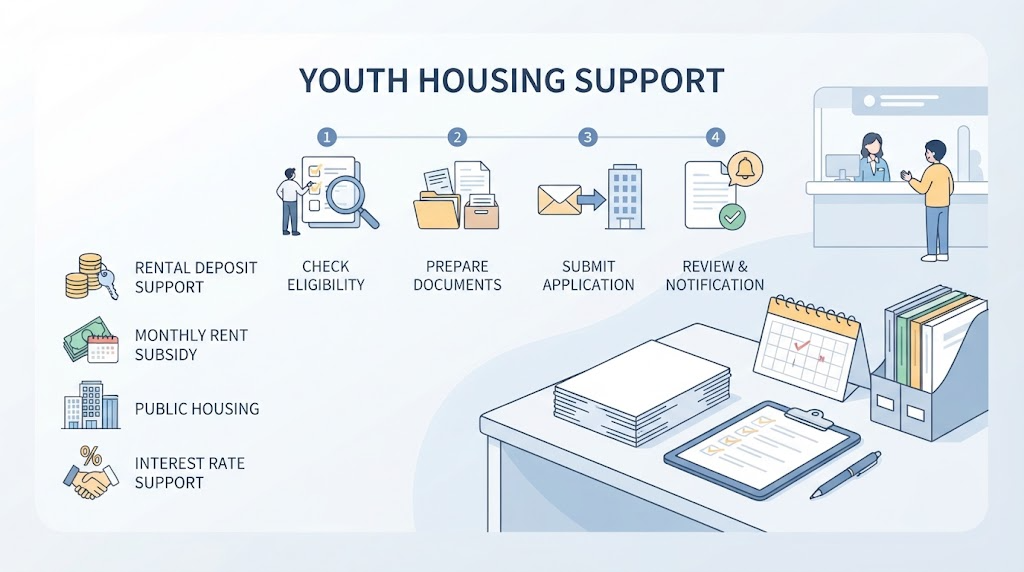
Youth housing support benefits are a precious opportunity to ease the burden of housing costs, but situations often occur where applicants fail because they miss detailed requirements or improperly prepare documents when actually applying. We have organized representative mistakes and precautions that must be checked to fully receive benefits.
① Misunderstanding Income and Asset Calculation Criteria
Check Household Member Scope: Programs such as Special Youth Monthly Rent Support often screen together the income and assets of not only the applicant themselves but also the original household (including parents). Cases frequently occur where people apply blindly thinking only their own income meets the criteria, only to be disqualified because they exceed their parents’ income and asset criteria.
Housing Ownership Status: If any household member on the resident registration owns a house, they may be excluded from the homeless requirement, so you must accurately check the housing ownership and homeless period of all household members before applying.
② Overlooking Duplicate Support Restriction Regulations
Similar housing support projects between local governments and the central government (e.g., government youth monthly rent support and local government’s own monthly rent support) often have restricted duplicate benefits.
If you are already receiving other housing-related cash support or housing benefits, you must check in advance through the competent agency or Bokjiro to see if duplication with the newly applied project is permitted.
③ Failure to Meet Application Timing and Lease Agreement Requirements
Support Age Restrictions: Age criteria such as ages 19 to 34 (or 39) are applied differently depending on the project, and requirements must be met as of the application date. Carefully check whether you exceed the eligible age after your birthday passes.
Lease Agreement and Move-in Report: Deposit and monthly rent limits (e.g., based on converted deposit) for target housing units are often set. In addition, since a normal lease agreement with a completed move-in report and a fixed date is mandatory, you must check whether the contract contents and actual place of residence match.
④ Omission of Mandatory Submission Documents and Exceeding Deadlines
If required documents such as income verification documents, lease agreements, and bankbook copies are omitted, screening may be delayed or rejected.
Since there are many projects that close early when budgets are exhausted or have strictly set reception periods, you must thoroughly comply with the submission document list and deadlines designated in the announcement.

Conclusion: Finding the Right Benefits for Me and Reducing Housing Cost Burdens
So far, we have carefully examined the various youth housing support benefits, target eligibility conditions, and mistakes to watch out for when applying from both the central government and local autonomous governments.
Amid soaring housing costs and prices, a stable housing space during youth goes beyond a simple residence to become a solid stepping stone for preparing for the future. However, no matter how good a system is, you cannot enjoy the benefits unless you look for them and apply yourself.
Based on what we’ve organized today, check out which support project best fits your current situation (income, age, residence, etc.). If you actively utilize Bokjiro (bokjiro.go.kr), the Housing and Urban Fund, and the website of the city, county, or district office in your area of residence, you will be able to find valuable opportunities to reduce housing costs that you might have been missing.
We sincerely cheer for your stable housing and bright tomorrow!
Korean version: 한국어로 읽기