
Introduction: Is the National Health Screening Alone Not Enough? The Need for Additional Tests
The national health screening that comes around every year or once every two years. Seeing the notice letter sent to the mailbox, we tend to visit a designated hospital with a light heart, thinking, “It’s already time to get my screening this year.”
After measuring blood pressure, drawing blood, and taking a chest X-ray, a sense of relief somehow washes over us, as if we have solidly taken care of our health this year as well. If the basic figures come out as ‘normal’, it’s easy to feel reassured and think, “I’m still healthy.”
However, it is worth thinking about carefully. Can we really perfectly detect all diseases and risk signals inside our bodies with only the basic health screenings provided by the state?
- Clear Limitations of National Health Screenings
National health screenings have the character of ‘basic and universal screening tests’ targeting the majority of citizens of the Republic of Korea. In other words, they are designed centering on the minimum essential screening items commonly applied to all citizens (blood pressure, blood sugar, cholesterol, basic cancer screenings, etc.).
Of course, they are of great help in early detection of major diseases, but in the following cases, there may be some areas left to be desired:
Limitations in detecting early-stage cancers or minute lesions: It is difficult to completely filter out minute abnormalities hidden deep inside major organs such as the brain, heart, and lungs using only basic stomach and colon endoscopies, stool tests, and abdominal ultrasounds.
Lack of reflection of personalized risk factors: The scope of basic screenings is somewhat limited to cover all of an individual’s special health risks, such as family history, everyday lifestyle habits, occupational characteristics, and vulnerable diseases by age group.
- Why ‘My Body-Tailored’ Additional Tests Are Needed
This is precisely why, with recent growing interest in health, an increasing number of people are not satisfied with basic national screenings and are choosing to receive additional optional tests (non-covered tests) tailored to their own health status or family history.
For instance, if there is a family history of cerebrovascular disease, one might add a brain MRI; if there is a smoking history or concerns about the respiratory system, a low-dose chest CT; or if frequent heartburn is experienced, a sedated stomach and colon endoscopy. Even if it requires investing a bit more cost and time, it is a wise choice to proactively block major diseases that may arise in the future and achieve true ‘early prevention’.
Then, what kind of additional tests actually exist beyond the state-supported items, and roughly how much do they cost? In the next part, we will review typical types of additional optional tests and their detailed contents.
Representative Additional Optional Test Types Beyond National Support
This is a Naver blog post draft on representative additional optional test types beyond national support. We have neatly organized major non-covered optional test items by category so that readers can easily understand them.
Although basic disease screening is possible even within the basic framework of national health screenings, many people want more precise tests depending on their health status or anxiety factors. Let’s look at the types of representative additional optional tests (non-covered tests) that can be chosen at hospitals by category.
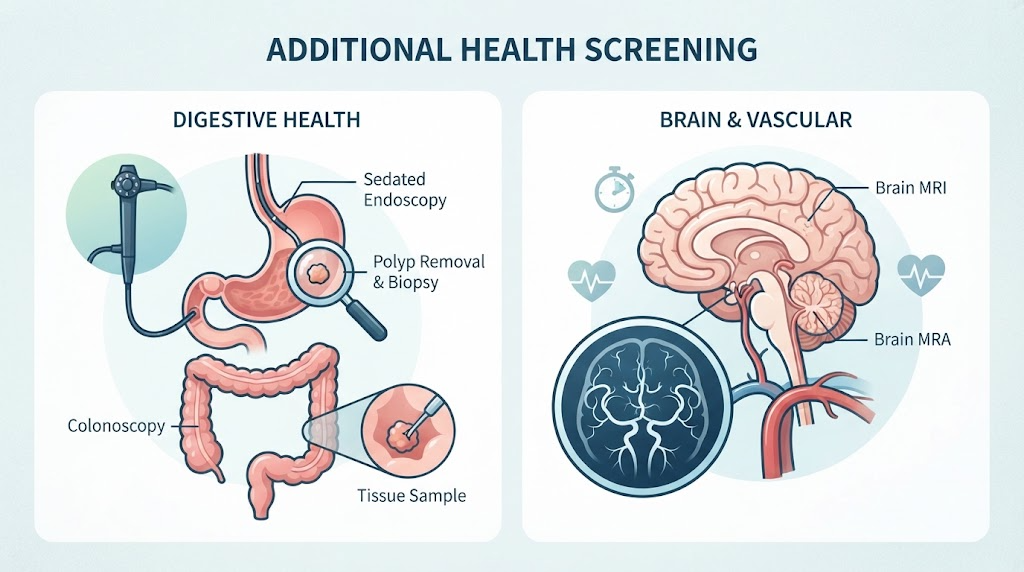
- Precision Digestive Tests: Sedated Endoscopy and Polypectomy
Even in national health screenings, upper gastrointestinal series or basic upper endoscopy are supported, but these are representative tests chosen by paying additional costs to increase comfort and precision.
Addition of sedated upper and lower endoscopies: Using a sleeping inducer instead of non-sedation to reduce pain and burden, the doctor directly observes the mucosal state of the entire esophagus, stomach, duodenum, and large intestine through a monitor in detail.
Polypectomy and biopsy: If a polyp (adenoma) that can develop into cancer is discovered during a colonoscopy, it is immediately removed or a biopsy is performed, incurring additional costs accordingly.
- Diagnostic Imaging Tests: Precision Scans of the Brain, Lungs, and Heart
These are high-cost equipment tests to early detect microscopic lesions in major organs that are difficult to grasp with only simple chest X-rays or basic questionnaires of national screenings.
Brain MRI and MRA: Precisely diagnoses the risk of cerebrovascular diseases that strike silently, such as stroke (paralysis), cerebral infarction, and cerebral aneurysm.
Low-dose chest CT: Excellent for catching microscopic nodules or early lung lesions much more clearly than standard chest radiography if there is a smoking history or a family history of lung cancer.
Echocardiogram and carotid ultrasound: Checks the structure and function of the heart and valve abnormalities, or checks the degree of arteriosclerosis and blood flow status of the carotid arteries leading to the brain.
- Other Specialized and Detailed Blood Tests
These are blood and functional medicine tests additionally combined to evaluate the systemic health status from various angles.
Tumor marker blood tests: Tests that conveniently screen for specific cancer-related levels such as liver cancer, pancreatic cancer, colorectal cancer, prostate cancer, and ovarian cancer through blood collection.
Hormone and chronic fatigue tests: Finds the cause of unexplained fatigue through detailed thyroid function tests, adrenal hormone (stress) tests, vitamin D, and various mineral level tests.
Allergy (IAST) and arteriosclerosis tests: Basic detailed tests that find allergy-causing substances such as atopic dermatitis or rhinitis, or measure blood vessel elasticity.
These various additional tests allow you to pick and combine only the necessary items according to your age, family history, and everyday lifestyle habits. Then, when receiving these tests by hospital size, about how much will the approximate cost be? We will compare them in the next part.

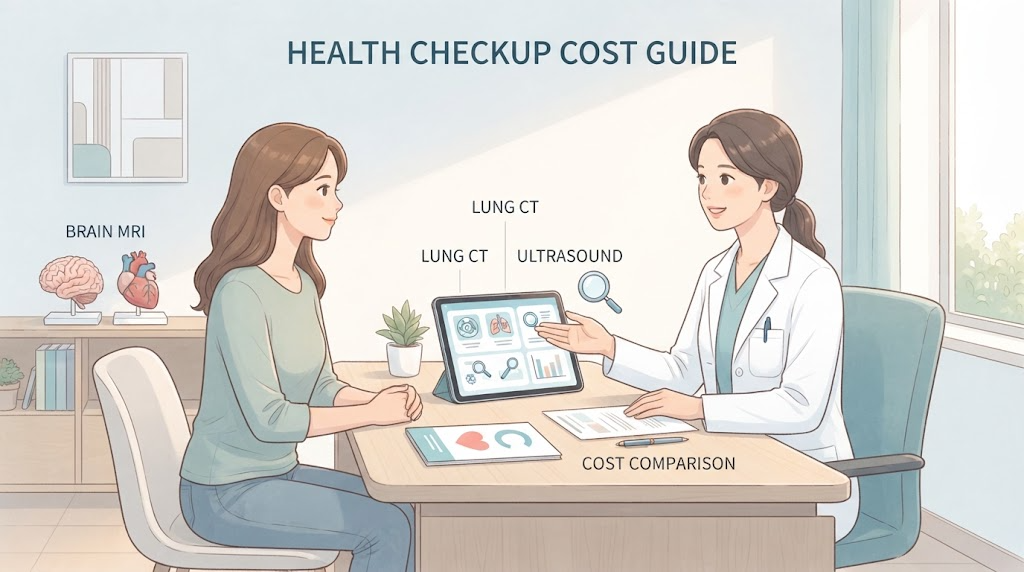
Approximate Market Price Comparison of Additional Test Costs by Hospital Size and Item
This is a Naver blog post draft on the approximate market price comparison of additional test costs by hospital size and item. We have neatly organized the characteristics by size and approximate price ranges of major additional test items so that readers can refer to them when choosing a screening institution.
If you have decided to additionally receive non-covered (optional) tests aside from national health screenings, the realistic concern you encounter first is, “Just how much will it cost?”
Since non-covered tests are not covered by health insurance, price differences vary quite significantly depending on the hospital size, equipment level, and region. Grasping approximate market prices and characteristics by hospital size in advance can be of great use in establishing a budget.
- Comparison of Additional Test Costs and Characteristics by Hospital Size
General local internal medicine clinic / Designated health screening clinic
Characteristics: Accessibility is good, and you can receive necessary basic blood tests, ultrasounds, and stomach/colon endoscopies at relatively low costs.
Approximate costs: Sedated upper endoscopy (around 50,000 to 100,000 won range), sedated colonoscopy (around 100,000 to 150,000 won range). However, since many places do not possess high-cost equipment (MRI, CT, etc.), you may have to go to a connected facility for precision imaging tests.
Mid-to-large general hospitals and specialized health checkup centers
Characteristics: While reservations are easier compared to university hospital levels, advanced equipment (MRI, CT, ultrasound, etc.) and various specialized programs are well equipped, making them the most preferred.
Approximate costs: When adding optional items (brain MRI, lung CT, etc.) to a basic comprehensive checkup package, prices are widely formed from around 300,000 won to over 1 million won depending on the package composition.
University hospitals and tertiary general hospitals
Characteristics: They boast the nation’s top-level medical staff and precision reading systems, but costs are the most expensive, and reservation waiting periods can take several months or longer.
Approximate costs: For precision comprehensive checkup programs, it ranges from hundreds of thousands of won to expensively taking 2 million to 3 million won or more.
- Approximate Individual Item Market Prices for Major Additional Tests (For Reference)
These are approximate non-covered medical fee market prices that can be referenced when adding or comparing specific items individually rather than as a comprehensive checkup package. (※ There may be differences depending on the hospital.)
Brain MRI / MRA: Around 300,000 to 700,000 won per area
Low-dose chest CT: Around 100,000 to 200,000 won range
Carotid ultrasound or echocardiogram: Around 100,000 to 250,000 won range
Sedated upper and lower endoscopies (polypectomy costs separate): Around 150,000 to 250,000 won range
Tumor marker blood tests (5-6 major cancer level types): Around 50,000 to 150,000 won range
- Pro Tips for Rationally Comparing Hospital Prices: Utilizing ‘Non-Covered Medical Expense Information’
Since test costs vary from hospital to hospital, there is no need to blindly go to an expensive place.
If you use the ‘Non-Covered Medical Expense Information’ service provided on the Health Insurance Review and Assessment Service website or smartphone app (Health Info), you can transparently compare the actual prices of MRIs, ultrasounds, endoscopies, etc., by hospital in the area where you live. If you figure out the market prices in advance before visiting, you can plan your screening at a much more reasonable price, right?
Then, what are the tips for picking only the tests that are truly necessary for me out of so many tests to reduce unnecessary spending? We will continue with smart selection tips in the next part.
Tips for Selecting Additional Tests to Reduce Unnecessary Spending and Secure Practical Value
This is a Naver blog post draft on tips for selecting additional tests to reduce unnecessary spending and secure practical value. We have organized a practical guide that allows you to reliably take care of your health while spending your budget rationally.
While it is certain that non-covered additional tests besides national health screenings are of great help to health management, if you greedily add this and that, screening costs easily swell from hundreds of thousands of won to millions of won before you know it.
Rather than hastily choosing a full-package checkup thinking “the more expensive it is, the better it must be,” we need the wisdom to frugally pick out only the items essential to our bodies. We share 3 great tips for selecting additional tests to reduce unnecessary spending and securely take care of practical value.
- First Identify Family History and Your Body’s ‘Vulnerable Departments’
The criteria that must be considered first when choosing additional tests are family history and your everyday lifestyle habits and symptoms.
Reflecting family history: If there are immediate family members who have suffered from a stroke or cardiovascular disease, brain MRI or echocardiograms can be prioritized, and if there is a family history of stomach cancer or colorectal cancer, thoroughly taking care of sedated upper and lower endoscopies is correct.
Reflecting lifestyle habits and symptoms: Intensely defending the ‘weak links of my body’ by choosing an endoscopy if you frequently experience heartburn or indigestion, or a low-dose chest CT if you are a smoker, is the most cost-effective choice.
- Consider Essential Checkpoints by Age Group
As we age, the speed at which aging progresses in our bodies and the vulnerable disease groups change.
20s–30s: Since the risk of major diseases is relatively low, it is good to faithfully receive basic national screenings while complementing them at a level that lightly checks chronic fatigue, hormonal changes, and stomach health.
40s and older: Since this is a period when cancer incidence rates and chronic disease risks rapidly increase, you should actively combine stomach and colon endoscopies, carotid ultrasounds, and major cancer tumor marker blood tests to start regular screening.
- Checking Indemnity Health Insurance (Actual Expense Insurance) Applicability and Utilizing Screening-Linked Discounts
Checking indemnity insurance application criteria: Non-covered tests received for the sole purpose of a general health checkup are difficult to claim under indemnity medical insurance. However, additional tests or polypectomies performed because specific symptoms were discovered through a doctor’s examination during the screening process are frequently eligible for indemnity claims. Checking in advance with the hospital’s administration office or insurance representative before the screening can greatly reduce your financial burden.
Utilizing package events and partnership benefits: If you make reservations during the off-season (first half of the year) avoiding the year-end (November–December), or utilize seasonal promotions conducted at health screening centers, card company partnership benefits, etc., you can proceed at much more reasonable costs even for the exact same test items.
While investments to protect health should not be spared, smart and practical choices tailored precisely to your own body are much wiser than blindly expensive tests. We hope you save on costs and solidly take care of your health through thorough prior preparation!

Conclusion: Protect Your Body Condition, Which Is More Important Than Cost, with Smart Choices
This is a Naver blog post draft on Conclusion: Protect Your Body Condition, Which Is More Important Than Cost, with Smart Choices. It has been written to warmly and persuasively conclude the post to elicit readers’ practical actions.
So far, we have explored together from the basic scope and limitations of national health screenings, representative types of additional optional tests (non-covered), approximate cost market prices by hospital size, to smart tips for reducing unnecessary spending and securing practical value.
Whenever the health screening season that returns annually or periodically arrives, it is the honest feeling of all of us to hesitate, thinking, “Wouldn’t the additional test costs be a waste?”, “Could this possibly be unnecessary over-treatment?”
However, investment in health is not just simple expenditure, but the most certain prevention and insurance to protect the happy future of yourself and your family.
Worried about family history or vulnerable parts of your body? Rather than blindly chasing expensive full packages, smartly pick out the test items essential for you.
Is the cost burdensome? Compare non-covered medical expense information in advance and establish a rational plan utilizing first-half reservations or partnership benefits.
Small interest and smart choices gather to prevent major diseases down the road and protect a solid daily life. On this occasion, how about checking your health schedule that you’ve been putting off and planning a customized screening tailored precisely to your body?
We hope the content prepared today has been a warm guide to your wise and healthy life. Thank you for reading. If you have any questions, please feel free to leave a comment anytime!
Korean version: 한국어로 읽기