
Can I Receive It? K-Digital Training / Tomorrow Learning Card Eligibility Conditions
Job preparation, career changes, self-## Can I Receive It? Tomorrow Learning Card Eligibility Conditions
When preparing for self-development, a job change, or a second chapter in life after retirement, the very first benefit people look for is the Tomorrow Learning Card. Since this system provides training expenses from a base of 3 million KRW up to a maximum of 5 million KRW per person, many wonder, “Can office workers apply?” or “Can college students and freelancers apply too?”
To state the conclusion first: if you are a South Korean citizen, you are eligible for issuance in most cases regardless of your employment status. The door is widely open not only to the unemployed, but also to currently employed workers, self-employed individuals, and workers in special types of employment.
Basic Target Group: Who is eligible?
- Job seekers (unemployed): Youth preparing for employment, women with career breaks, individuals seeking re-employment
- Employed (office workers): Small and medium-sized enterprise (SME) and large corporation workers, fixed-term and short-term workers
- Workers in special types of employment and freelancers: Delivery riders, after-school study materials teachers, insurance agents, freelance developers/designers, etc.
- Self-employed: Sole proprietors who meet specific income standards
- Students: University (and graduate) students whose remaining duration of study until graduation is 2 years or less
In the past, the cards for the unemployed and the employed were separated, making the process cumbersome when changing jobs or leaving employment. Currently, they are integrated into one, allowing you to use the card within its validity period (5 years) even if your economic activity status changes.
Issuance Eligibility & Exclusion Criteria at a Glance
Although it is a program for the entire public, clear exclusion criteria based on income or status exist because state funds are invested. Before applying, check whether any of the items below apply to you.
| Category | Eligible Criteria | Excluded from Support (Issuance Not Allowed) |
|---|---|---|
| Public/Special Status | General public (anyone) | Public servants, private school teachers/staff, military personnel (excluding some mandatory service personnel) |
| Students | University (and graduate) students with 2 years or less remaining until graduation | University (and graduate) students with more than 2 years remaining until graduation, students on leave of absence (excluding certain exceptions) |
| Large Corporation Employees | Aged 45 or older, or with an average monthly wage under 3 million KRW | Employees of large enterprises aged under 45 with an average monthly wage of 3 million KRW or more |
| Special Employment / Freelancers | Average monthly income of less than 3 million KRW over the past 3 months | Workers in special types of employment with an average monthly income of 3 million KRW or more over the past 3 months |
| Self-employed | Annual sales of less than 150 million KRW | Annual sales of 150 million KRW or more (separate income criteria apply to real estate rental businesses) |
| Age | Under 75 years old | Aged 75 or older |
3 Core Checkpoints Frequently Confused
- From which school year can university students apply?
For a 4-year university, you can apply starting from the end of the 2nd semester of the 2nd year (or upon advancing to the 3rd year). For a 3-year college, you can apply from the 2nd semester of the 1st year; for a 2-year junior college, you become eligible right after admission.
- Are employees of large corporations preparing for a job change excluded?
Even if you work at a large corporation, you can apply regardless of your monthly income if you are 45 years of age or older. If you are under 45, you are still eligible if your average monthly salary over the past 3 months is less than 3 million KRW before tax.
- How do I apply?
You can easily apply online after verifying your identity on the Employment24 (formerly HRD-Net) website or mobile app. Watching a training guidance video of about 30 minutes is mandatory during application, so it is recommended to complete it in advance.
Shall we also look into the Tomorrow Learning Card online application procedure and tips for issuance?
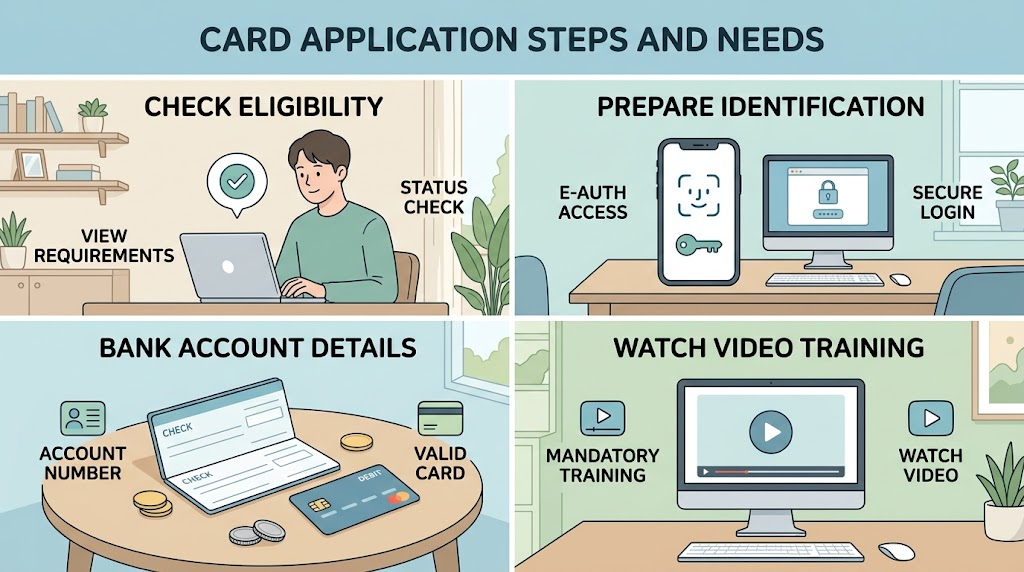
3 Essential Preparations Before Applying
To reduce the hassle of having to restart from the beginning due to session expiration or missing documents during the Tomorrow Learning Card application on Employment24 (online), it is best to prepare the following 3 items in advance.
- Identity Verification Method (Joint/Financial Certificate or Simple Authentication)
Most online application systems such as Gov24, Bokjiro, and financial institutions require login and electronic signature as mandatory steps.
Check the validity period of your certificate saved on your PC or your private simple authentication registered on your smartphone (KakaoTalk, Naver, PASS, etc.) in advance.
- Deposit/Withdrawal Bank Account Number in Your Name (For receiving refunds/subsidies)
This is used for subsidy deposits, refund processing, or identity verification 1-KRW transfer authentication.
Seizure-protected exclusive accounts (such as Happiness Keeper Accounts) or certain installment savings/housing subscription accounts may be restricted from registration, so prepare a standard bank account that allows free deposits and withdrawals.
- Supporting Document PDF File or Clear Photo (Issued within 1 month)
Depending on the business or service type, submission of documents such as a resident registration certificate, proof of income amount certificate, or health insurance qualification acquisition/loss confirmation certificate is required.
When taking mobile photos, use a scanning app to avoid light reflection or cropped corners, or download the original PDF files or files from the Gov24 electronic document wallet to upload immediately.

Tomorrow Learning Card Application Steps Finished in a Few Clicks (Step-by-Step Guide)
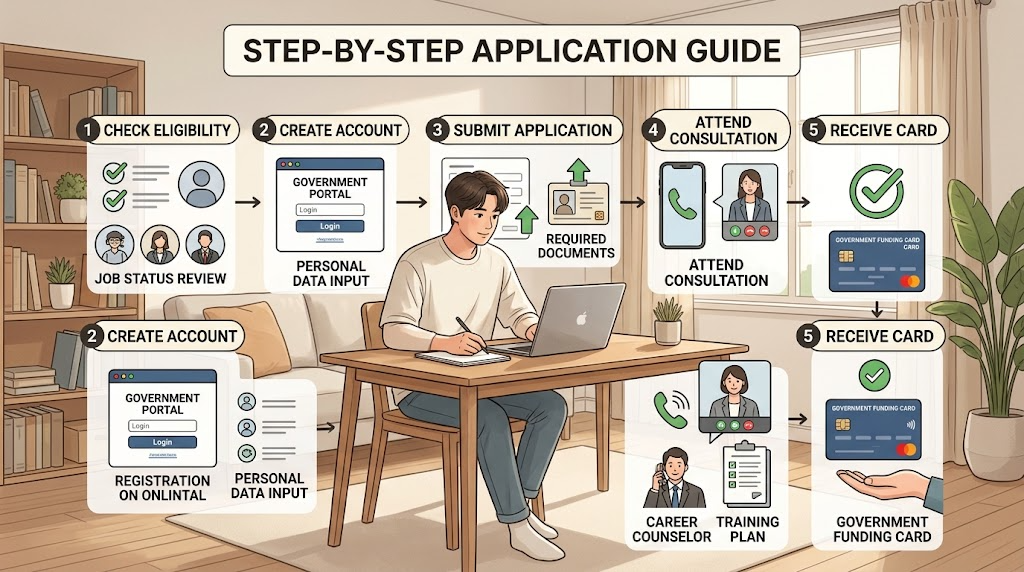
Once all your preparations are ready, it is time to apply directly online. Through Employment24 (work24.go.kr), the integrated employment service portal, you can easily submit an application on PC or mobile in about 10 to 15 minutes without visiting an employment center.
To avoid pausing or getting lost while filling out the application form, here are the 5 steps aligned with the actual screen sequence.
1
Access Employment24 and Log In via Identity Verification
Joint/Financial certificate or Simple Authentication is mandatory
After accessing the Employment24 website, proceed to log in at the top right.
Menu navigation path: In the top menu, click Vocational Competency Development > Tomorrow Learning Card > Issuance Application in order.
If you are not yet a member, you can easily complete integrated membership registration and real-name authentication through Simple Authentication (KakaoTalk, Naver, PASS, etc.) under your own name.
2
Watch Tomorrow Learning Card Guidance Video
Cannot proceed to the next step if not completed (takes about 10–15 minutes)
This is a statutory preliminary education that must be completed before card issuance.
It covers the basic purpose of the system, support limits (3 million to 5 million KRW), validity period (5 years), attendance standards, and precautions to prevent fraudulent receipt.
Fast-forwarding or skipping the video is restricted, so you must watch it until the end and click the confirmation button to complete the requirement.
3
Check Worknet Job Search Registration
Applies only to applicants under the Job Seeker (Unemployed) category
If you are applying as an unemployed job seeker without a current job, your Job Search Application (Worknet Job Search Registration) within Employment24 must be valid in advance.
If you are not registered for a job search or if the validity period has expired, you must register a basic resume and self-introduction and complete the ‘Job Search Application’ first before the issuance review will proceed.
Employed workers and self-employed individuals skip this step and move directly to the next step.
4
Fill Out Application Form and Select Affiliated Card Issuer
Check card requires verifying connected account balance
Enter your basic personal details and eligible group category, then specify the financial institution to issue the card and the delivery method.
Card issuer: Choose between Shinhan Card or NH NongHyup Card
Card type: Choose between Check Card or Credit Card (If selecting Check Card, linking to your own account at the corresponding bank is mandatory)
Delivery method: Choose between postal delivery (home or workplace) or direct branch visit pickup at the bank
Document attachment: Attach supporting documents by file (PDF/image) according to your target group, such as enrollment/expected graduation certificate for university students, value-added tax taxable base certificate for self-employed individuals, etc.
5
Final Submission and Awaiting Review by Competent Employment Center
Review period usually takes 3 to 7 business days
After reviewing the entered application details for the last time, click Submit Application to forward it to your competent employment center.
If supplementary documents are required during the review, the person in charge at the employment center will guide you via SMS or phone call.
Upon receiving the approval text message, the card creation and delivery process begins at your selected card company, and online registration is also possible through mobile apps before receiving the physical card.
💡 Editor’s Practical Tip
Even before the card issuance approval is complete, search for the course schedule and out-of-pocket costs of the courses you want to take on the Employment24 training course search screen and add them to your shopping cart in advance. You can register for the course immediately upon receiving the card to avoid missing out on popular courses reaching capacity.
Useful Tips for Finding Desired State-Funded Training Courses After Receiving the Card
Once you hold the card in your hand, it is time to make good use of your limit (3 million to 5 million KRW). On Employment24, tens of thousands of training courses are registered, ranging from IT coding to barista, baking and pastry arts, accounting/taxation, video editing, and furniture making.
Here are 3 practical search tips for selecting prime courses that save on your out-of-pocket expenses and directly connect to actual employment and skill enhancement among countless lectures.
- Check for the ‘Excellent Training Institution (3–5 Year Certification Assessment)’ Mark First
The Ministry of Employment and Labor and the Korea Skills Quality Authority rigorously evaluate training institutions nationwide every year and grant certification ratings.
- By checking the ‘Excellent Training Institution’ option in the search filter, you can filter for only verified academies that have achieved certification for at least 3 to 5 years.
- Because facility and equipment standards, instructor expertise, and student management systems are stable, you can significantly reduce the risk of instructors changing mid-course or lecture flows being disrupted by equipment malfunctions.
- Calculating Actual Out-of-Pocket Expenses: Support Rates by Occupation & How to Use K-Digital Training (KDT)
While some Tomorrow Learning Card courses are completely free, many courses require an out-of-pocket payment of 15% to 55%. The structure is designed so that occupations with higher employment rates receive higher government support rates, reducing your personal burden.
| Category | Main Features & Support Benefits | Out-of-Pocket Cost Example |
|---|---|---|
| General Occupational Training Courses | OA, design, foreign languages, cooking, beauty, etc. | Self-pay about 15% to 55% of course fees |
| K-Digital Training (KDT) | Advanced new tech courses such as AI, Big Data, Cloud, Full-stack development, etc. | Fully funded (0 KRW out-of-pocket) + monthly training incentive allowance paid |
| National Strategic Industry Occupations (Guk-gi) | Root industries, machinery, welding, electricity, and other national strategic industries | Fully funded (0 KRW out-of-pocket) + meals/transportation subsidy provided |
💡 Tip for Learning with 0 KRW Out-of-Pocket Expenses
If you want to transition or find employment in emerging industries such as IT development, data analysis, or smart factories, search for K-Digital Training (KDT) or National Strategic Industry courses. You can take them entirely free of charge once without deducting from your limit, and you can even receive a monthly training allowance (training incentive) if you meet the attendance rate.
- Filter by ‘Employment Rate’ and ‘Actual Graduate Satisfaction Reviews’ in the Details Window
There are two key indicators you must check on the details page that appears when you click a course name.
- Employment rate (compared to occupation average): It is safe to choose courses where the employment rate is 10 to 20%p higher than the national average employment rate for the same occupation.
- Course reviews (graduate reviews): Read carefully through the official ratings and reviews that only students who completed the training can write. They contain practical feedback on the instructor’s teaching ability, condition of practical equipment, difficulty adjustment of the curriculum, etc., eliminating the risk of failure.
⚠️ Beware of Penalties for Absences!
State-funded courses require an attendance rate of 80% or higher per unit period to be processed as completed. Dropping out due to insufficient attendance results in penalties such as deduction from your subsidy limit and restrictions on applying for subsequent courses, so decide on course enrollment by realistically considering your commuting and study schedule.

Frequently Asked Questions (FAQ) & Precautions
Here are the most frequently asked questions by blog readers while applying for the Tomorrow Learning Card and taking training courses, along with essential precautions that are easy to overlook.
Q1. How long does it take to receive the card after applying?
Issuance approval: The employment center review usually takes about 3 to 7 business days.
Physical card receipt: Postal delivery takes an additional 3 to 5 business days after approval.
Tip for fast receipt: If you select ‘Bank Visit Pickup’ as the card delivery method when applying, you can visit the designated bank branch (Shinhan or NH NongHyup) in person with your ID card and receive it immediately on the same day after the employment center issuance confirmation letter is approved.
Q2. Can employees (working professionals) take full-time state-funded courses?
Taking the course itself is not legally prohibited, but you must satisfy the realistic attendance rate (80% or higher). Weekday daytime courses have a high risk of attendance failure due to overlap with working hours, so it is safer for employed workers to choose night classes, weekend classes, or remote (online) training courses.
Q3. If I leave my company during the 5-year validity period of an already issued card, do I need to remake the card?
There is no need to make it again. Cards are integrated and managed without distinction between employed and unemployed, so even if you become unemployed after resignation, you can continue using the existing card within its remaining limit and validity period. However, when participating in long-term job seeker training (Guk-gi, KDT, etc.), you must update your Worknet job search registration status.
Essential Precautions to Know (Penalty Information)
Because the Tomorrow Learning Card is subsidized by national funds, strict attendance management and dropout penalty rules apply.
- Subsidy deduction for attendance rate below 80% and dropout
If you drop out or are expelled without a justifiable reason (excluding provable reasons such as illness, employment, etc.), a certain amount is immediately deducted from your card account limit.
1st dropout: 200,000 KRW deducted from support limit
2nd dropout: 500,000 KRW deducted from support limit
3 or more dropouts: 1,000,000 KRW deducted from support limit
- Limit on the number of courses taken in the same year
Each person can take up to a maximum of 5 courses per year, and courses in the same occupation are limited to 3 times per year.
- Strict Punishment for Fraudulent Attendance
If fraudulent acts such as proxy attendance or fraudulent QR code tagging are detected, card usage will be suspended, all received training expenses will be reclaimed, and an additional sanction surcharge of up to 5 times may be imposed.
To conclude the posting, you can select the next steps:
Write an ending epilogue and engagement/comment prompts
Organize the entire written draft into a final integrated copy
Korean version: 한국어로 읽기