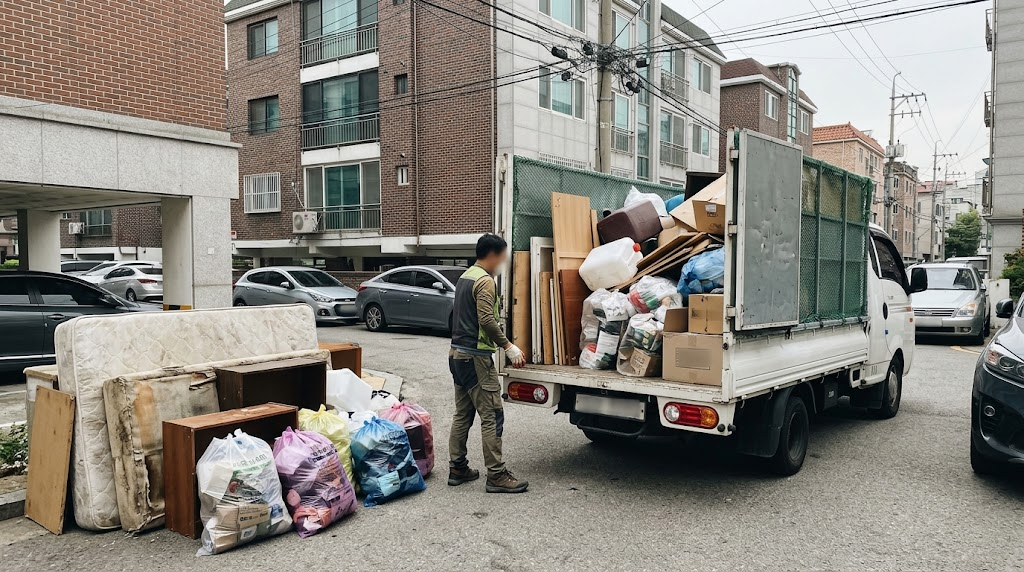
Why Truck Tonnage and Volume Calculations Are Essential for Waste Disposal
This post is written in a friendly yet professional tone (informative + credible) characteristic of Naver Blog.
- Why Truck Tonnage and Volume Calculations Are Essential for Waste Disposal
When looking for waste removal companies ahead of house cleaning, moving, remodeling, or commercial demolition, almost everyone gets caught off guard at least once.
“Company A quoted 350,000 KRW for a 1-ton truck, but Company B asked for 500,000 KRW?”
“They arrived on site and demanded an extra 200,000 KRW, claiming there’s too much stuff?”
The reason waste disposal costs vary widely between companies and disputes often arise on site is precisely because people do not clearly understand the calculation criteria for ‘tonnage (weight)’ and ‘cbm/rube (volume)’.
① Why Do Waste Disposal Costs Vary by Company?
Waste disposal costs are not flatly priced simply as “how much per truck.”
The actual disposal cost is largely determined by combining three components: [Transportation Cost + Treatment Facility Gate Fee (Disposal Fee) + Labor Cost].
Transportation Cost: Basic cost depending on vehicle size (1 ton, 2.5 tons, 5 tons) and travel distance
Treatment Facility Gate Fee: Cost incurred when dumping at the final waste processing site (landfill/incinerator) (usually charged by weight unit)
Labor/Equipment Cost: Service fees based on stair work, presence of an elevator, ladder truck use, etc.
Some companies that advertise cheap estimates often quote only the ‘basic transportation cost’ and then excessively add disposal fees and labor costs on site.
② Tonnage (Weight) vs. Rube (Volume): Understanding the Difference Prevents Being Ripped Off
The two most confusing concepts when calculating waste are ‘weight’ and ‘volume.’
Tonnage (Weight, kg / ton)
Applied to waste that weighs a lot.
Typical items: Incombustible waste such as tiles, bricks, concrete, soil, marble, etc.
Caution: Even if the cargo bed of a 1-ton truck looks less than half full, if the weight already exceeds 1 to 1.5 tons creating an overload risk, an additional vehicle is needed or weight surcharges apply.
Rube (Volume, ㎥)
1m width × 1m length × 1m height is called ‘1 rube (1㎥)’.
Applied to waste that is light in weight but takes up a lot of space.
Typical items: Mattresses, sofas, styrofoam, clothing, cotton duvets, plastic
Caution: Even if the weight is light, if it exceeds the height of the vehicle’s cargo bed rails, more cannot be loaded for safety reasons, requiring an additional vehicle.
💡 Key Takeaway
“Heavy loads go by tonnage (weight), bulky loads go by rube (volume)!”
First figuring out whether your waste consists of ‘heavy stone/concrete materials’ or ‘light but space-consuming furniture/household items’ allows you to select the correct vehicle tonnage and prevent unnecessary on-site extra charges in advance.
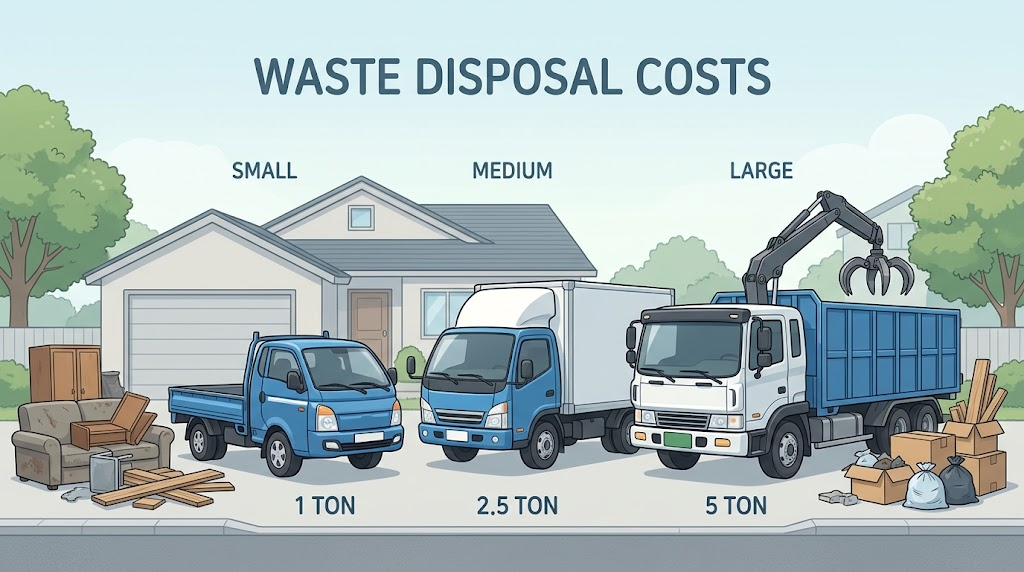
Waste Collection Standards and Unit Price Chart by Truck Tonnage
This content is organized in tables and summary cards so that blog readers can grasp it at a glance.
- Waste Collection Standards and Unit Price Chart by Truck Tonnage
The most commonly used vehicles for waste disposal are 1-ton, 2.5-ton, and 5-ton (grapple truck) trucks.
Knowing in advance which vehicle suits your site and what the approximate market rates are will help you budget accurately.
📊 Average Unit Prices by Truck Tonnage at a Glance
(※ Average market prices based on the Seoul Metropolitan/urban area, purely for vehicle loading. Labor costs and ladder truck fees are separate)
| Classification | Recommended Work Environment | Loading Capacity (Volume Basis) | Average Collection Rate (per Truck) |
|---|---|---|---|
| 1-Ton Truck | Studio/home cleanouts, small-scale interior work | Approx. 2.5 – 3.5 CBM (㎥) | 300,000 – 500,000 KRW |
| 2.5-Ton Truck | 20–30 pyeong-tier moves/remodeling, commercial shop demolition | Approx. 6 – 8 CBM (㎥) | 700,000 – 1,100,000 KRW |
| 5-Ton / Grapple Truck | Complete building demolition, large business sites, factory waste | Approx. 15 – 20 CBM (㎥) | 1,300,000 – 2,000,000 KRW or more |
① 1-Ton Truck (Porter / Bongo): The Most Popular Mobility Powerhouse
- Suitable Work: Studio move-out cleaning, remaining two-room move waste, small-scale bathroom/sink partial interior waste
- Perceived Load Volume:
- Queen-size mattress + 1–2 desks + miscellaneous items (around 15–20 cardboard boxes)
- Vehicles reinforced with a canvas canopy (horu) or side railings can load slightly bulkier items.
- Pricing Tips:
- Around 300,000–400,000 KRW for light wood or general miscellaneous items
- Priced at 400,000–500,000 KRW or more due to excess weight if it is heavy mixed waste such as tiles, broken concrete, or soil.
② 2.5-Ton Truck: The Standard for Full Apartment Remodeling & Store Demolition
- Suitable Work: Full remodeling of 20–30 pyeong-tier apartments (including expansion work), demolition of small-to-medium cafes/restaurants, office reinstatement
- Perceived Load Volume:
- Holds the volume of about 2.5 to 3 1-ton trucks at once.
- Calling one 2.5-ton truck is much cheaper in terms of transportation costs than calling multiple 1-ton trucks.
- Pricing Tips:
- Usually determined at around 800,000–1,000,000 KRW based on mixed waste containing scrap wood, drywall, and furniture.
- Residential areas with narrow alleys where 2.5-ton vehicles cannot enter may require split collections with 1-ton trucks, so checking the access roads in advance is essential.
③ 5-Ton Truck / 5-Ton Grapple Truck: Dedicated to Bulk & Large-Scale Waste
- Suitable Work: Warehouse cleanouts, factory closures, large demolition sites, bulky and heavy scrap metal/timber waste
- Advantages of Grapple Trucks:
- Mechanical grapples (cranes) quickly load heavy waste, logs, steel frames, etc., that are hard for people to lift and load manually, significantly reducing work time and saving labor costs.
- Pricing Tips:
- Grapple trucks include equipment usage fees, making the base rate slightly higher (1,500,000 KRW or more) than standard cargo trucks.
- However, because many workers are not required, it can actually be more advantageous in terms of total cost.
💡 Essential Checklist Before Selecting a Vehicle
“A bigger truck is not always the answer!”
Vehicles of 2.5 tons or larger cannot enter residential villa areas with narrow access roads or underground parking lots. You must inform the company in advance with photos showing whether access to the site is possible to prevent cancellation fees caused by dispatch errors.
Choose what to explore next:
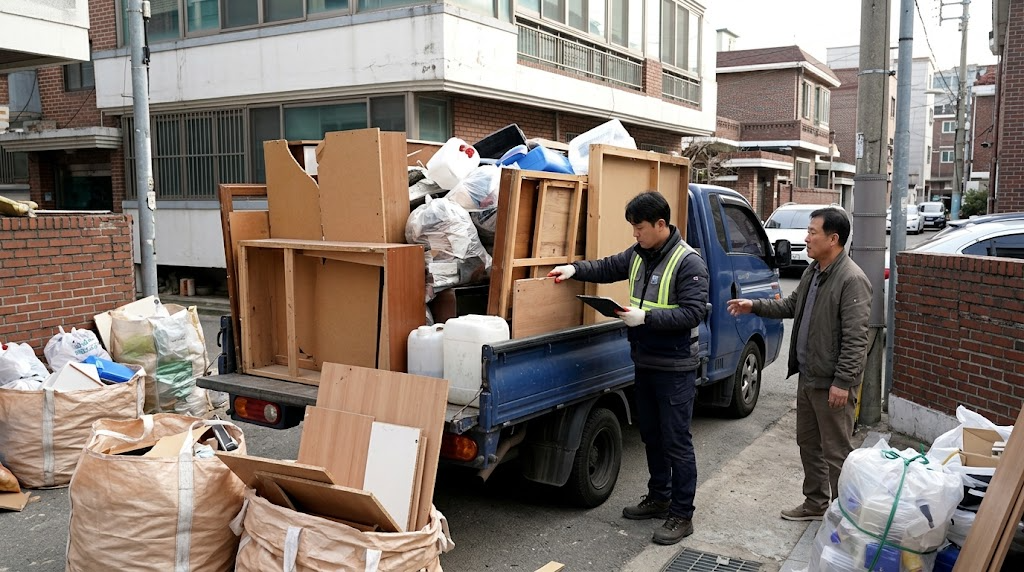
Disposal Unit Price Differences by Waste Type
This post is organized to help blog readers easily understand the cost differences according to waste characteristics and feel the importance of separated disposal.
- Disposal Unit Price Differences by Waste Type
Even for the same 1-ton truck, gate fees at the treatment facility differ by more than double depending on what is loaded in the cargo bed.
This is because disposal facilities apply differentiated processing costs based on recyclability and the difficulty of incineration or landfilling.
📊 Processing Difficulty and Unit Price Comparison by Waste Type
| Waste Type | Representative Items | Unit Price Level | Characteristics and Precautions |
|---|---|---|---|
| Pure Wood | Solid wood, dimensional lumber, plywood, pallets, etc. | Lowest | Can be recycled into sawdust or wood chips after shredding |
| General Mixed Waste | Furniture, plastics, leather, textiles, sundries | Moderate to somewhat high | Most common for home cleanouts and moving; incurs sorting labor costs |
| Incombustible (Stone/Soil/Aggregate) | Concrete, bricks, tiles, marble, sand | Billed by weight | Cannot be incinerated; high disposal cost per ton as it goes straight to landfills |
| Special Waste | Drywall, slate, asbestos, paint cans | Highest / Separate declaration required | Requires designated waste disposal procedures due to hazardous material content |
① Pure Scrap Wood: Good Separation Alone Dramatically Lowers the Cost
- Characteristics: When only wooden materials such as MDF, plywood, treated lumber, and general dimensional lumber are collected separately.
- Cost Advantage: Scrap wood has the lowest gate fee at processing plants because it is recycled into wood chips or fuel for combined heat and power plants after shredding.
- Points to Note: Minor hardware like nails or hinges is permitted, but if plastics, vinyl, glass, etc., get mixed in, it is categorized as ‘mixed waste’ and the unit price jumps sharply.
② General Mixed Waste: The Most Common Type Including Sorting Labor Costs
- Characteristics: Wood, plastic, cotton, clothing, and metal items all mixed together during house moves, home cleanouts, or interior demolition.
- Why the Price Rises: When entering the facility, workers must manually pick through and sort recyclables one by one, so sorting labor costs are directly reflected in the unit price.
- Reduction Tip: Even just roughly separating scrap metal and plastics into separate sacks before loading can lower the processing unit rate.
③ Incombustible Waste (Tiles, Bricks, Concrete): Small in Volume, Heavy in Weight
- Characteristics: Waste concrete, cement chunks, and sanitary ceramics (toilets, sinks) generated from bathroom renovations, floor tile replacements, or wall demolitions.
- Unit Price Feature: Since it does not burn, incineration is impossible, and it must go entirely to the Sudokwon Landfill or private aggregate processing facilities.
- Key Caution: Even if the volume appears to be only 2–3 one-ton sacks, placing it on actual truck scales quickly exceeds 1.5–2 tons. If weight limits are exceeded, additional fees per ton are billed based on the scale weigh ticket.
④ Special Waste (Drywall, Slate): Recklessly Mixing Incurs Fines
- Drywall: In addition to being non-combustible, it generates hydrogen sulfide gas when landfilled, making general incinerators and landfills reluctant to accept it. It must be packed separately in dedicated sacks and sent to dedicated processing plants, which results in higher unit costs.
- Asbestos / Slate: Classified as a Group 1 carcinogen, its collection by general waste companies is strictly illegal. Reporting and disposal can only be carried out through certified asbestos dismantling and removal companies.
💡 Key Tip to Lower Unit Costs
“Mixed together it’s trash; separated it’s a resource (discount).”
Rather than recklessly sweeping all belongings into a single sack, simply sorting and loading them into three categories—[Wood / Stone & Tiles / General Household Goods]—gives the collection driver room to negotiate the total quote down by around 10–20% through separate drop-offs at processing sites.
Choose what to write next:
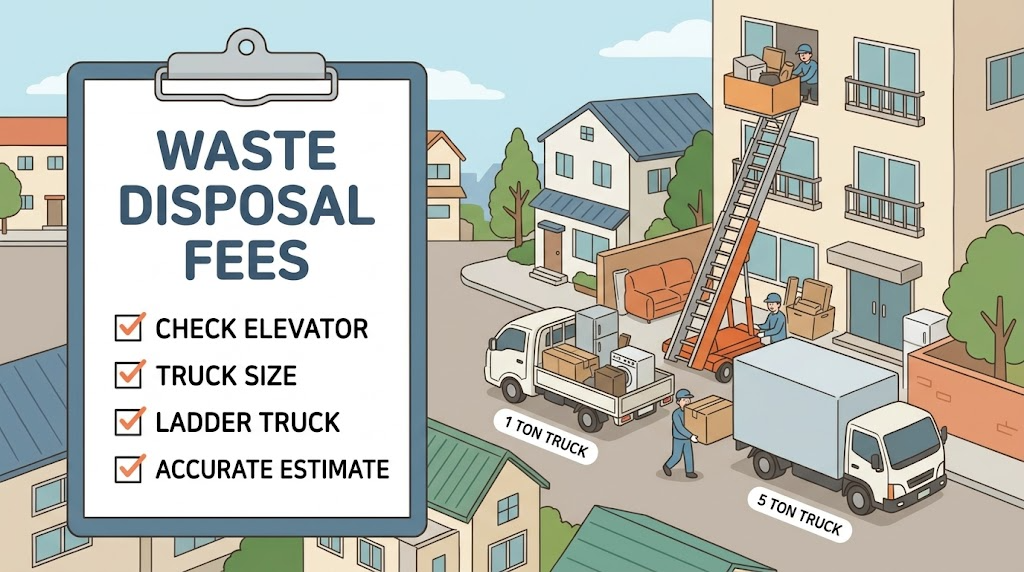
Checklist to Avoid Extra Charges (Rip-offs)
This body text covers practical checkpoints and defense strategies to help blog readers avoid the most common, flustering situations on site.
- Checklist to Avoid Extra Charges (Rip-offs)
It is all too common to call a service after being told over the phone or text, “350,000 KRW for one 1-ton truck,” only to end up red-faced when the driver demands 600,000 or 700,000 KRW once the job is finished on site.
The main reasons companies demand extra charges on site lie in the ‘working environment’ and ‘failure to notify details in advance.’
Checking the following 5 items and getting confirmed answers beforehand when requesting a quote will 100% prevent disputes over on-site surcharges.
📋 Essential Checklist to Prevent On-Site Extra Charges
[ ] 1. Informing Floor Level and Elevator Availability
For 2nd–4th floors in multi-unit villas without an elevator, workers must carry items down the stairs by hand, so ‘stair work fees (around 30,000–50,000 KRW per floor)’ are almost always added.
Even if an elevator is available, the apartment management office’s elevator use fee (usually 30,000–100,000 KRW) is paid by the customer, so you must check this in advance.
[ ] 2. Confirming Ladder Truck Use in Advance
If bulky furniture (wardrobes, sofas, 3-door refrigerators, etc.) cannot fit through the stairs or elevator, a ladder truck will need to be dispatched urgently on site.
On-site emergency dispatch can incur waiting fees in addition to the base cost (over 100,000–150,000 KRW), so if you have large items, firmly clarify before the visit whether disassembly is possible or if a ladder truck is mandatory.
[ ] 3. Vehicle Parking Location and Walking Distance
A ‘horizontal transport fee (walking hauling fee)’ may apply depending on whether the truck can park right in front of the main gate, or if items must be wheeled on handcarts (dollies) for 30–50 meters or more due to narrow alleys.
If parking is tricky along narrow alleys, sharing photos of viable parking spots in advance is the safest approach.
[ ] 4. Number of Workers and Inclusion of Labor Costs
Always check whether the “cost per vehicle” is based on the ‘driver working alone’ or ‘a team of two including a loading helper.’
A classic tactic for driving up extra costs is for the driver to arrive alone and ask the customer to help lift items, or to tack on helper labor costs (100,000–150,000 KRW) on site claiming the load is too heavy.
[ ] 5. Requesting a Scale Weigh Ticket (Weight Certificate)
When there are many heavy items like tiles, bricks, and soil, companies may verbally claim, “The weight is too high, so you must pay 200,000 KRW more.”
When a weight surcharge is demanded, confidently request that an official weigh ticket (Gross Weight – Tare Weight = Net Waste Weight) issued by the processing plant’s weigh station be attached along with the receipt.
💬 Magic Text Message Template to Send to Companies Before Contracting
Do not rely solely on phone conversations; secure written proof by sending a text message using the template below before confirming the dispatch.
[Waste Collection Pre-Confirmation Message]
“Sending full photos of the waste and parking environment.
Collection Location: 0th floor (Elevator Yes/No)
Parking Environment: Direct stopping possible right in front of the building
Waste Type: Furniture and miscellaneous household items (photos attached)
Please confirm whether the final amount includes the vehicle fee + driver loading labor fee + disposal fees based on the photos provided. I would like to proceed on the condition that no separate extra fees will occur, other than for additional work not discussed in advance.”
💡 Key Summary in One Line
“Taking photos as wide as possible, capturing every nook and cranny, is your best defense.”
Downplaying the amount of stuff backfires on site (refusal due to overload or excessive surcharges). Photographing and sending everything, even hidden items, to receive a ‘fixed quote with no extra charges’ is the safest approach.
Tips for Saving 20–30% on Waste Disposal Costs
This content provides practical cost-saving know-how that blog readers can put into action right away after reading.
- Tips for Saving 20–30% on Waste Disposal Costs
Calling a waste collection truck basically costs hundreds of thousands of KRW, but spending just 1–2 hours organizing in advance before the driver arrives can lower the truck tonnage or significantly reduce collection rates by over 20–30%.
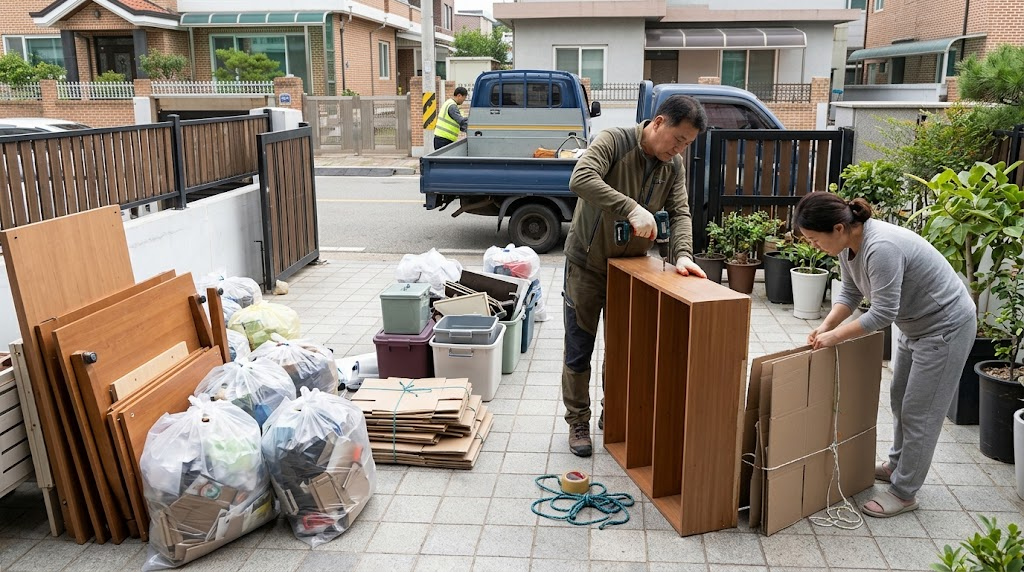
① Reducing Volume (Compression): Disassemble Furniture, Flatten Boxes
Half the cost of truck collection is paying for ‘air.’ Simply reducing volume allows you to handle with a single 1-ton truck a load that would otherwise require calling a 2.5-ton vehicle.
Disassembling Flat-Pack Furniture: Simply removing the screws from drawers, desks, bed frames, etc., with a Phillips screwdriver or cordless drill and stacking them flat cuts the volume to 1/3.
Flattening Cardboard Boxes and Styrofoam: Remove tape from delivery boxes and fold them flat, and break down styrofoam into sacks to minimize empty space.
Compressing Duvets and Clothing: Bulky cotton duvets and old clothes take up far less loading space when packed into 100L trash bags or kimchi plastic bags, pressed firmly, and taped down.
② Utilizing Free Collection Services 100%: Never Pay to Discard Home Appliances
The moment discarded appliances such as refrigerators, washing machines, air conditioners, and TVs are loaded onto a waste truck, they are counted as ‘heavy loads’ and become the cause of extra fees.
e-Circulation Governance (Free On-Site Pick-up Service for Waste Home Appliances):
This is an official free service operated by the state. (Search online or call representative number 1599-0903)
Even for just one single large appliance (refrigerator, washing machine, etc.), a technician will visit inside your home and collect it for free.
Small appliances (fans, rice cookers, vacuums, etc.) become eligible for free collection when grouped into 5 or more.
Gathering Scrap and Non-Ferrous Metals:
Separating pure metals like pots, frying pans, aluminum cans, electrical wires, and steel pipes into sacks and turning them over to a neighborhood scrap yard or giving them to local recyclers greatly cuts down the total waste volume.
③ Parallel Disposal Using Municipality Bulky Waste Stickers: Handling Bulky Single Items
For furniture items that are bulky but only consist of 1–2 pieces—such as a single wardrobe unit or a mattress—it is far more beneficial not to load them on private trucks.
Cost Difference:
Loading a mattress or wardrobe onto a private collection truck accounts for a share of 50,000–100,000 KRW per item due to the volume occupied.
On the other hand, obtaining a municipal bulky waste sticker (via mobile apps like ‘Bbaegi’ or ‘Yeogiro’, or community service centers) and placing it directly at the ground-floor drop-off point allows disposal for around 10,000–15,000 KRW.
How to Utilize: Dispose of light furniture that can be carried down to the first floor on your own with stickers beforehand, and reserve private trucks only for miscellaneous items and mixed junk that are impossible to lift yourself.
④ Taking Photos to Prompt ‘Fixed Quote (All-Inclusive)’ Reverse Bidding
When inquiring for quotes with multiple companies, simply saying “It’s about 2 rooms of stuff” causes companies to quote the highest rate to account for risks.
Accurate Photo Taking Method:
Gather the items to be discarded in one area of the room and take wide shots from 2–3 different angles so the overall layout is visible.
Always open and photograph hidden items that are only visible when doors are opened, such as inside wardrobes or the corners of verandas.
Quote Request Message:
Send the identical photos to at least 3 places, including Soomgo, Kmong, Danggeun Market, and local waste companies.
Specifying, “Please provide a final fixed quote with no extra fees based on loading and disposing of all items shown in the photos,” fosters competition among companies to help you choose the most reasonable rate.
💡 Key Savings Formula
Home appliances are 0 KRW with ‘Free On-Site Pick-up’!
Single furniture pieces cost in the 10,000 KRW tier with ‘Waste Stickers’!
Use private trucks exclusively for ‘one-stop collection of small mixed waste’!
Following just this 3-step separation formula can save at least 100,000 KRW to as much as 300,000 KRW or more on your total waste disposal budget.
Try the following next steps to complete your posting:
Write a concluding paragraph that wraps up the entire blog post
Write a 16:9 AI image generation prompt tailored to this post
Recommend SEO tags and titles optimized for Naver Blog search traffic
Korean version: 한국어로 읽기