Introduction: Why Health Insurance Dependent Status Can Be Ruinous If You Stay Complacent
📋 Introduction: Why Health Insurance Dependent Status Can Be Ruinous If You Stay Complacent
Many of you have likely been registered as dependents under working children or family members and have enjoyed health insurance fee exemption benefits for a long time. There are truly many cases where people comfortably think, “I don’t have separate income, and since I’m retired and just staying put, surely my eligibility won’t change,” only to be flustered by a sudden notice letter from the Corporation arriving one day.
Why is health insurance dependent status not something that “stays maintained on its own if you do nothing,” but rather information that must be thoroughly managed and checked? Let’s examine the reasons.
- Tighter Income and Asset Criteria, Vigilance Is Required
Unlike in the past, the government has been tightening dependent recognition criteria stricter every year to enhance the fairness of the health insurance system.
Financial income that has increased little by little for living expenses after retirement or housing property tax assessment standards that have changed due to rising prices can inadvertently exceed the threshold.
Situations occur where you unknowingly fail to meet eligibility requirements while being complacent, thinking “This much should be fine.”
- The Fatal Blow When Receiving Disqualification Notice Late
Once dependent eligibility is revoked, you are immediately converted to a “local subscriber” and health insurance fees are assessed.
What is even more surprising is that local health insurance fees can be billed all at once retroactively from the date of eligibility loss (the point when income and asset criteria were exceeded).
There are unexpectedly many retirees and freelancers who struggle because it is already too late when they look for measures only after being hit by an unexpected “health insurance fee bomb”.
💡 Tip: Health insurance dependent eligibility is not maintained by your application; it is determined through the Corporation’s regular and ad-hoc income and asset re-evaluations every year.
In the next section, we will examine in detail the core income criteria for dependent disqualification that must be checked based on the latest 2026 standards!

Latest 2026 Standards! Core Income Criteria for Health Insurance Dependent Disqualification
We are writing the main text for the second subheading of the Naver blog post, ‘Latest 2026 Standards! Core Income Criteria for Health Insurance Dependent Disqualification’. We have clearly organized it so that readers can easily understand complex income criteria.
📋 Latest 2026 Standards! Core Income Criteria for Health Insurance Dependent Disqualification
To maintain health insurance dependent eligibility, the item that must be examined first and most strictly is ‘income’. The government reorganizes income criteria every year to enhance fairness.
Let’s carefully examine the core income criteria for dependent disqualification applied as of 2026 by item.
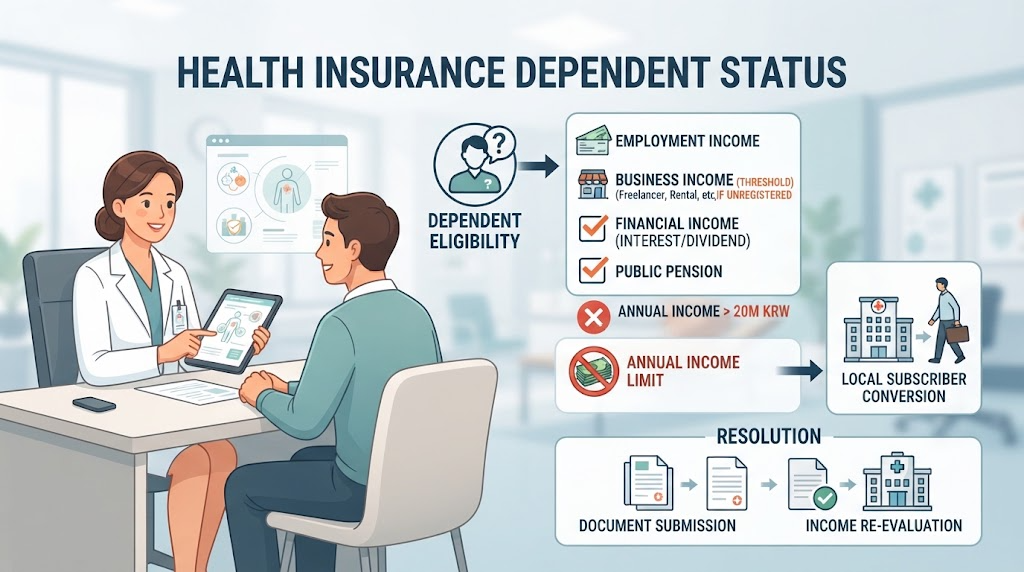
- Annual Combined Income ‘Exceeding 20 Million Won’ (The Most Important Criterion)
The most widely known criterion and core in determining dependent eligibility is whether annual combined income exceeds 20 million won.
‘Income’ referred to here does not mean a single income, but rather refers to the amount combining all comprehensive incomes prescribed under tax law.
The moment combined income exceeds annual 20 million won by even 1 won, dependent eligibility is immediately revoked and converted to a local subscriber, so special caution is required.
- Scope of Income Included in Dependent Income Combination
There are many people who wonder, “I don’t have a salary or business income, so why did I get disqualified?” In addition to the earned income we commonly think of, various items are included in the dependent income screening.
Financial Income (Interest and Dividend Income): If the annual combined amount of savings/deposit interest or stock dividends exceeds a certain threshold, it is reflected in income. (※ In the past, it exceeded 10 million won, but as the criteria were strengthened, it is managed by combining comprehensive income.)
Public Pension Income: Public pensions received monthly, such as the National Pension, Government Employees Pension, Military Personnel Pension, and Private School Teachers Pension, are also included in income. (However, private pensions are excluded.)
Business Income: Of course, cases with business registration, and even without business registration, if annual business income (freelance, rental business, etc.) occurs by even 1 won, it becomes subject to screening. (※ However, if there is no business registration, a separate criterion is applied where annual business income must not exceed 5 million won.)
Earned Income: Earned income generated from part-time jobs or daily work, even if you are not employed at a company, is also combined.
- How to Cope When Income Disappears Due to Business Closure, etc.
Even though you have closed your business or stopped income activities, past income remains in the National Tax Service computer system, resulting in temporary disqualification as a dependent.
In such cases, you can have your eligibility reinstated by bringing supporting documents such as a National Tax Service Income Amount Certificate or Business Closure Fact Certificate to file an objection with the National Health Insurance Service or request an income re-evaluation.
Information Post Summary:
💡 Blog Tip Summary
If your financial income (interest/dividends) or public pensions are increasing every year after retirement, checking in advance whether your annual combined income exceeds the 20 million won mark is the only defense to prevent dependent disqualification!
In the next chapter, we will learn about the ‘property tax assessment standard’ and ‘support requirements’ that must be checked together in addition to income.
‘Property Criteria’ and ‘Requirements by Form’ That Must Be Checked Alongside Income
We are writing the main text for the third subheading of the Naver blog post, ”Property Criteria’ and ‘Requirements by Form’ That Must Be Checked Alongside Income’. We have clearly organized it so that readers can understand complex health insurance property criteria and support requirements at a glance.
📋 ‘Property Criteria’ and ‘Requirements by Form’ That Must Be Checked Alongside Income
Even if you narrowly passed the income criteria examined earlier (annual combined income of 20 million won or less), you cannot rest easy. This is because health insurance dependent eligibility screening examines not only income but also ‘property criteria’ and family ‘support requirements by form’.
To avoid the unfair situation of meeting income criteria but getting disqualified due to property, let’s examine the requirements that must be checked.
- Disqualification Criteria According to Property Tax Assessment Standards (2 Core Brackets)
The National Health Insurance Service screens property requirements based on property tax assessment standards imposed on houses, land, buildings, ships, aircraft, etc. (Since it is based on the ‘property tax assessment standard’ rather than market standard price or actual transaction price, you must check the exact assessment standard through local government property tax payment notices, etc.)
① Assessment Standard Exceeding 500 Million Won ~ 900 Million Won or Less (Additional Restriction on Income Conditions):
If the property tax assessment standard exceeds 500 million won and is 900 million won or less, dependent eligibility is revoked if annual income exceeds 10 million won, even if annual combined income is 20 million won or less. (In other words, if your property falls into this bracket, the income hurdle becomes twice as strict.)
② Assessment Standard Exceeding 900 Million Won (Unconditional Disqualification):
Even if you have zero income or are below the threshold, if the combined assessment standard of the property you own exceeds 900 million won, dependent eligibility is unconditionally lost regardless of income.
- Sibling Dependent Recognition Requirements (The Strictest Criteria)
The yardstick applied also differs depending on whom you list as a dependent. In particular, much stricter criteria are applied when registering siblings as dependents.
Direct Ascendants and Descendants: If general income and property criteria are met, dependent registration is possible relatively smoothly.
Siblings: In principle, it is very difficult to be recognized as dependents for siblings. Even if registered exceptionally, you must meet much stronger property criteria, such as the combined property tax assessment standard having to be 300 million won or less, so if you are planning to register as a dependent under a sibling, you must check this part first.
💡 Blog Tip Summary
There are many retirees who suddenly get disqualified as dependents due to an increase in the public notice price (assessment standard) of the housing they own while thinking, “Our family has low income so it should be fine.” It is wise to check the changes in housing public notice prices and property taxes announced around May to June every year in advance!
In the next section, we will look into the process of being immediately converted to a ‘local subscriber’ upon dependent disqualification and coping methods to avoid an unexpected health insurance fee bomb.

[Core] Process of Converting to a ‘Local Subscriber’ Upon Dependent Disqualification and Avoiding a Health Insurance Fee Bomb
We are writing the main text for the fourth subheading of the Naver blog post, ‘[Core] Process of Converting to a ‘Local Subscriber’ Upon Dependent Disqualification and Avoiding a Health Insurance Fee Bomb’. We have organized it specifically so that readers can easily understand the flow of the system and cope with it.
📋 [Core] Process of Converting to a ‘Local Subscriber’ Upon Dependent Disqualification and Avoiding a Health Insurance Fee Bomb
When you receive a notice of loss of dependent eligibility (disqualification) because you exceeded income or property criteria, the thing you will worry about first along with panic is likely the ‘health insurance fee burden’.
Let’s examine the process where the health insurance fee exemption benefit guaranteed under a working child disappears and you are immediately converted to a ‘local subscriber’ who must pay fees directly, and coping methods to wisely avoid an unexpected ‘health insurance fee bomb’.
- Process of Converting from a Dependent to a Local Subscriber (Procedure)
- Eligibility Change Detection and Notice: The National Health Insurance Service links income and property data from the National Tax Service and others every year to regularly (or ad-hoc) re-evaluate the appropriateness of dependent eligibility. If exceeding the criteria is confirmed here, eligibility loss processing proceeds.
- Local Subscriber Acquisition Report: Based on the date dependent eligibility was lost (the point when income/property criteria were exceeded, etc.), the procedure for converting to a local subscriber is automatically stepped through.
- Notice Issuance: A newly calculated local health insurance fee notice will arrive at your home.
- Why Does a ‘Health Insurance Fee Bomb’ Explode? (Caution Regarding Retroactive Assessment)
The point requiring the most caution when converting to a local subscriber is the risk of ‘retroactive assessment’.
A time lag can occur between the point when income or property exceeded the criteria (e.g., the point when last year’s comprehensive income tax filing results are reflected, etc.) and the point when the Corporation actually grasps this and notifies you.
During this time lag, several months’ worth of local health insurance fees are billed all at once retroactively to the date of eligibility loss, making it feel physically like you have been hit by an immense ‘health insurance fee bomb’.
- Practical Coping Methods to Avoid Unexpected Health Insurance Fee Bombs
Regular Eligibility and Income Inquiry: Retirees, freelancers, and those with rental income should frequently check their income and property fluctuation status through the ‘The Health Insurance’ app or the Corporation’s website.
Controlling the Timing of Income Recognition and Managing Public Pensions/Financial Income: If you are close to the annual combined income mark of 20 million won or the property tax assessment standard threshold (500 million won, etc.), you need a strategy to mitigate the shock by dispersing the timing of income generation or utilizing tax-exempt products.
Utilizing Objections and Adjustments: Even if reasons for business closure, suspension, or income reduction occurred, if excessive fees were assessed due to past National Tax Service data, you must immediately apply for an adjustment to the Corporation with supporting documents.
💡 Blog Tip Summary
Dependent disqualification often comes out of nowhere one day. If you grasp your income and property fluctuation trends in advance, you can sufficiently prevent the shock of a sudden health insurance fee bomb!
In the next section, we will learn about advance check tips and income and property management know-how to stably maintain dependent eligibility.
Advance Check Tips & Income & Property Management Know-How to Maintain Dependent Status
We are writing the main text for the fifth subheading of the Naver blog post, ‘Advance Check Tips & Income & Property Management Know-How to Maintain Dependent Status’. We have meticulously organized useful management tips and check methods that readers can put into practice immediately in daily life.
📋 Advance Check Tips & Income & Property Management Know-How to Maintain Dependent Status
So far, we have looked into the core income criteria and property criteria that cause health insurance dependent disqualification, as well as precautions when converting to a local subscriber. Then, what are some measures we can directly practice to prevent sudden eligibility deprivation in advance and stably maintain dependent eligibility?
We have organized advance check tips and income and property management know-how that can be easily utilized in daily life.
- Directly Checking ‘My Eligibility and Income’ Regularly
Dependent disqualification is often difficult to recognize on your own until a notice letter arrives from the Corporation. The habit of checking regularly in advance is most important.
Inquiry Path: Log in to the National Health Insurance Service official website or the smartphone ‘The Health Insurance’ app.
Check Menu: Through the [Civil Petitions Here] or [My Page] section under [Eligibility Inquiry] and [Insurance Fee Inquiry], you can check your current dependent eligibility maintenance status and recently reflected income and property criteria at any time.
Check Timing: It is safe to check once around the time when the National Tax Service comprehensive income tax filing is completed every year (after May to June) or before and after the period when housing public notice prices are announced.
- Income and Property Dispersion and Management Know-How
If you are narrowly lingering near the threshold (annual combined income of 20 million won, property tax assessment standard of 500 million won, etc.), your usual management must be even more thorough.
Financial Income (Interest & Dividend) Management: A strategy is needed to actively utilize tax-exempt or separate taxation products or disperse the maturity or dividend timing of financial products so that deposit/savings interest or stock dividends do not concentrate in a specific year and exceed the comprehensive income combination of 20 million won.
Public Pension and Other Income Check: Calculate in advance whether there are increases in public pension amounts such as the National Pension received monthly or the occurrence of incidental income to predict the possibility of exceeding the criteria in advance.
- Utilize prompt appeals and adjustments in the event of changes
Even if your actual income has decreased significantly due to business closure, retirement, or sluggish business performance, you may still be unfairly disqualified as a dependent due to past computer data or time lags.
In such cases, do not panic; by preparing objective supporting documents such as an income amount certificate, a business closure fact certificate, or a resignation certificate and immediately applying for an adjustment to the National Health Insurance Service, you can have your qualification reinstated or restored.
💡 Blog Tip Summary
Maintaining health insurance dependent status begins with “thorough advance interest and smart inquiries.” Install the ‘The National Health Insurance’ app on your smartphone today and check your qualification status lightly first!
In the next and final section, we will comprehensively summarize the core contents of today’s post and deliver a reassuring closing greeting.

In Conclusion: Health Insurance Qualification Changes, Check in Advance and Prepare Wisely
📋 In Conclusion: Health Insurance Qualification Changes, Check in Advance and Prepare Wisely
We have comprehensively examined everything from the core income criteria causing health insurance dependent disqualification, property tax assessment standards and sibling criteria, precautions for retroactive imposition (health insurance fee bombs) occurring upon conversion to a local subscriber, to proactive check tips and income/property management know-how to prevent this in daily life.
Changes in health insurance qualifications often sneak up on us while we let our guard down thinking “it won’t happen to me,” placing a considerable burden on household finances. However, if you make routine qualification inquiries a habit as we learned today and understand trends in income and property fluctuations in advance, you can prepare wisely enough.
💡 Core Summary of Today’s Content and Closing Request
- Make routine qualification inquiries a habit: Lightly check your qualification status every year around the income tax reporting season or before and after the announcement of official prices through the ‘The National Health Insurance’ app or the Corporation website.
- Thoroughly manage income and property near the baseline: Recognizing and preparing in advance for key disqualification baselines, such as the annual combined income of 20 million won line or property tax assessment standards of 500 million won and 900 million won, is the ultimate shield.
- Prompt appeal upon changes: If you unfairly lost your qualification due to past data despite actual changes in circumstances such as business closure or income decrease, prepare supporting documents and immediately apply for an adjustment to the Corporation.
We hope you securely protect your precious finances and health this year as well through thorough advance checks and smart health management!
If today’s post was helpful, please show your support with a like (❤️), comments, and adding neighbors, and we will return with more useful and enriching lifestyle information. Thank you!
Korean version: 한국어로 읽기